Brown Snake
The term "brown snake" refers to different groups of snakes depending on the region, and their hunting methods and diets vary accordingly.
How do brown snakes hunt and what is their typical diet?
The term “brown snake” refers to different groups of snakes depending on the region, and their hunting methods and diets vary accordingly.
Australian and New Guinean Brown Snakes
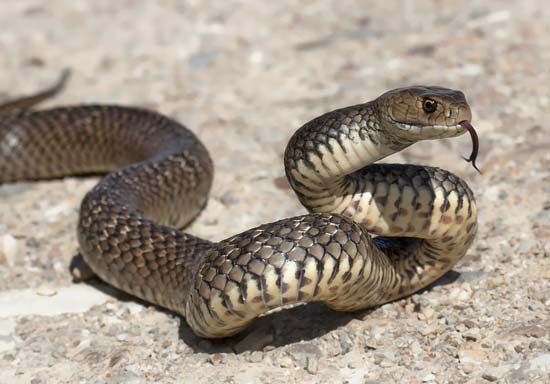
In Australia and New Guinea, the name applies to approximately 10 species of the genus Pseudonaja. These are alert, fast-moving, and highly venomous Elapidae snakes that are active during the daytime. Their diet consists primarily of small lizards, mice, and ground-dwelling birds.1
Brown Tree Snakes
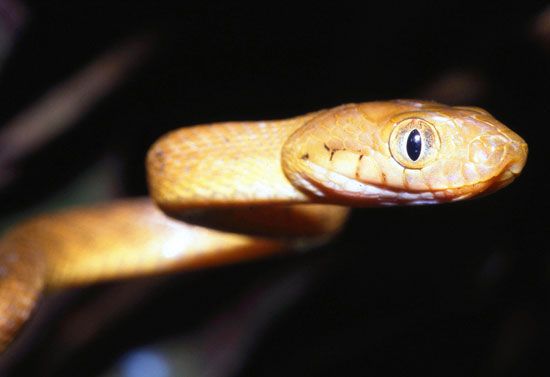
The brown tree snake (Boiga irregularis) is a distinct, primarily arboreal species. It is a nocturnal hunter that uses its large eyes with vertical pupils to facilitate hunting at night. As a voracious predator, it immobilizes prey by biting and holding on, then wrapping its body around the victim while using a chewing action to inject venom from grooved teeth at the back of its mouth2. Its diet is broad:2
- Younger snakes: Consume small birds, amphibians, small lizards, and eggs.2
- Larger snakes: Prey on larger lizards, birds, and small mammals such as bats and rodents. They are also known to scavenge carrion.2
What are the main predators of brown snakes, and how do they defend themselves?
Because the term “brown snake” refers to different groups of snakes, their predators and defensive strategies vary significantly.
Predators of Brown Snakes
While snakes are predators, they are also secondary consumers in the trophic pyramid and face threats from several types of animals:1
- Birds of Prey: Hawks, eagles, owls, herons, roadrunners, and crows are common predators that use keen eyesight to spot and capture snakes.1
- Mammals: Feral pigs and cats are documented predators of the brown tree snake. Mongooses are also well-known for hunting venomous snakes.21
- Other Reptiles: Monitor lizards are known to hunt snakes, and some species, such as king snakes, are specialized snake-eaters.1
- Amphibians: The brown tree snake is known to be vulnerable to cane toads.2
Defensive Strategies
Snakes employ various behaviors to deter potential threats:
- Body Posturing: Some snakes, including DeKay’s brown snake (Storeria dekayi), defend themselves by flattening or inflating their bodies to appear larger and more intimidating.3
- Warning Coloration: Many snakes possess bright colors on their undersides. By curling up or turning over, they expose these colors, which may serve as a warning to predators that the snake is distasteful or dangerous.4
- Camouflage: Many snakes use color and form to blend into their environment, such as resembling leaf litter or rocks, to avoid detection entirely.54
How do brown snakes reproduce and what is their typical lifespan?
Because “brown snake” refers to several distinct groups of snakes, their reproductive habits and lifespans vary significantly.
Reproduction
Reproductive strategies differ depending on the species:
- Brown Tree Snake (Boiga irregularis): These snakes are egg-layers. Breeding may occur throughout the year or be triggered by cooler seasonal temperatures. Females can store sperm for several years before fertilizing their eggs. They deposit two clutches of up to 12 eggs annually in dark, humid locations like caves or hollow logs. The snakes provide no parental care, and hatchlings must fend for themselves immediately upon emerging about 90 days later.1
- Mangrove Snakes (Genus Boiga): These are also egg-layers, typically producing modest clutches of 4–12 eggs.6
- General Snake Reproduction: Many snake species deposit eggs in protected, damp environments. Some species exhibit ovoviviparous development, where eggs are retained inside the mother until they hatch, allowing the young to be born live.27
Lifespan
The provided knowledge base does not contain specific data regarding the typical lifespan of brown snakes. Life history details for snakes are highly dependent on the specific species and the environmental pressures of their particular region, such as temperature, food availability, and predation.8
Where are brown snakes typically found, and what habitats do they prefer?
The term “brown snake” refers to several distinct groups of snakes, each with different geographic ranges and habitat preferences.
Australian and New Guinean Brown Snakes
In Australia and New Guinea, the name refers to approximately 10 species in the genus Pseudonaja. These highly venomous snakes are found across most of Australia, occupying a wide variety of environments throughout the continent.1
North American Brown Snakes
In North America, the name applies to five species in the genus Storeria, including DeKay’s brown snake (S. dekayi). These nonvenomous snakes are found from eastern Canada to Honduras. They are shy, secretive animals that prefer to spend their time hidden under rocks, heavy vegetation, and leaf litter. Notably, DeKay’s brown snake is the only North American snake that thrives in densely populated urban areas.1
Brown Tree Snakes
The brown tree snake (Boiga irregularis) is a primarily arboreal species native to New Guinea, the Solomon Islands, and northern and eastern Australia. While they are most commonly found in tropical forests and grasslands, they also inhabit urban ecosystems up to elevations of about 425 metres. As an invasive species, they have also established populations on islands such as Guam and Saipan.2
Sources
- brown snake — Encyclopædia Britannica
- brown tree snake — Encyclopædia Britannica
- What eats snakes? — Encyclopædia Britannica
- reptile - Display of colour — Encyclopædia Britannica
- reptile - Body form and posturing — Encyclopædia Britannica
- snake - Natural history — Encyclopædia Britannica
- snake - Egg formation and laying — Encyclopædia Britannica
- black-tailed rattlesnake — Encyclopædia Britannica
- mangrove snake — Encyclopædia Britannica
- DeKay's snake — Merriam-Webster
Published on · 4 min read