Arrowworm
The scientific name for the phylum commonly known as arrowworms is Chaetognatha.
What is the scientific name for the arrowworm phylum, and why are they called arrowworms?
The scientific name for the phylum commonly known as arrowworms is Chaetognatha.1
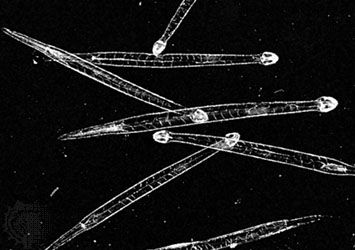
They are referred to as arrowworms because their bodies are shaped like arrows, appearing transparent to translucent or opaque. While the phylum name Chaetognatha literally translates to “bristle-jawed ones”—referring to the characteristic hooked spines used for grasping prey—the common name “arrowworm” is derived from their distinct, streamlined, arrow-like physical appearance.12
What types of prey do arrowworms typically consume?
Arrowworms are voracious marine carnivores that consume a wide variety of prey. Their diet typically includes the following organisms:
- Crustaceans: Including copepods, euphausiids, cladocerans, and amphipods.1
- Marine Larvae: Such as fish larvae and the larvae of various other animals.1
- Other Invertebrates: Including medusae and appendicularias.1
- Other Arrowworms: They are known to consume members of their own phylum.1
- Eggs: They also feed on the eggs of various animal species.1
To capture their prey, arrowworms use curved, grasping spines known as hooks, which are controlled by head muscles and covered by a retractable hood. Some species are even capable of subduing their prey by secreting paralyzing neurotoxins.1
How do arrowworms move through the water, and what adaptations help them swim?
Arrowworms move through the water using quick, dartlike motions. This locomotion is achieved primarily by contracting their longitudinal body muscles and flapping their tail.3
Several physical adaptations support their movement and survival in the water column:
- Streamlined Body: Their arrow-shaped, elongated bodies are designed for efficient movement through the water.3
- Fins: They possess paired lateral fins and a tail fin, which assist in stability and propulsion.3
- Transparency: Their bodies are transparent to translucent, which helps conceal them from both their prey and potential predators while they swim.3
- Musculature: Their body muscles are arranged longitudinally with some transverse bands, allowing for the rapid contractions necessary for their darting swimming style.3
Additionally, many species engage in diurnal migration, traveling hundreds of meters vertically through the water column each day, moving upward at dusk and downward at dawn.3
How do arrowworms reproduce and what is their life cycle like?
Arrowworms are simultaneous hermaphrodites, meaning each individual possesses both male and female reproductive organs. They are protandric, which means their male gonads mature before their female gonads.1
Reproduction and Fertilization
Because the ovaries (located in the trunk) and testes (located in the tail) are isolated from one another, arrowworms typically engage in cross-fertilization. Sperm is stored in seminal vesicles before being transferred to the seminal receptacle of another individual, often via discrete containers called spermatophores. Fertilization occurs as the eggs are laid or shortly before, within a duct common to the oviduct and the seminal receptacle.1
Life Cycle and Spawning
The life cycle varies by genus:
- Discharge: In Sagitta, eggs are released into the water one at a time over several cycles.1
- Attachment: Spadella species lay eggs with adhesive stalks that attach to surfaces.1
- Encapsulation: Some genera, such as Eukrohnia, enclose their eggs and larvae in a protective sac, while Pterosagitta uses a capsule.1
Most arrowworms die after spawning, though some species undergo multiple cycles of maturity and growth.1
Sources
- arrowworm — Encyclopædia Britannica
- chaetognath — Merriam-Webster
- Locomotion - Tetrapodal vertebrates — Encyclopædia Britannica
Published on · 2 min read