Aschelminth
The term "aschelminth" refers to an obsolete phylum that previously grouped together several diverse classes of wormlike invertebrates, including Nematoda…
What are the main characteristics that united the animals in the former aschelminth phylum?
The term “aschelminth” refers to an obsolete phylum that previously grouped together several diverse classes of wormlike invertebrates, including Nematoda, Rotifera, Acanthocephala, Gastrotricha, Kinorhyncha, and Nematomorpha.1
These animals were primarily united by the possession of a pseudocoel—a fluid-filled body cavity that lacks a lining of mesoderm on its inner side. Because this cavity is not lined with mesoderm, there is no muscular or connective tissue to support the gut within the coelomic fluid. This anatomical feature was considered a defining characteristic for the group, though it is now understood that these organisms do not share close evolutionary linkages.12
Modern classification has since reclassified these groups into separate phyla, as it has become clear that the pseudocoel evolved differently across these lineages.1
What are some examples of well-known animals that were once classified as aschelminths?
The former phylum Aschelminthes was a broad, now-obsolete grouping that contained several diverse classes of wormlike invertebrates. While these animals were once categorized together due to the presence of a pseudocoel, they are now recognized as distinct phyla.15
Well-known examples of animals formerly classified as aschelminths include:
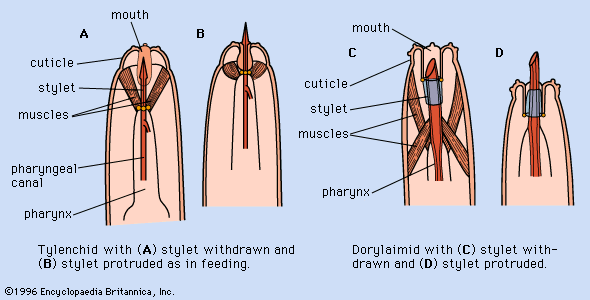
- Nematodes: Often called roundworms, this group includes both free-living species and significant parasites. Common examples include hookworms, pinworms, threadworms, whipworms, and eelworms.4
- Rotifers: Microscopic, aquatic animals often referred to as “wheel animals” due to the ciliated structures on their heads used for feeding and locomotion.1
- Nematomorphs: Also known as horsehair worms, these long, thin invertebrates are parasitic in arthropods during their larval stages.13
- Acanthocephalans: Commonly called spiny-headed worms, these are parasitic organisms characterized by a retractable proboscis covered in hooks.16
- Gastrotrichs: Minute, aquatic invertebrates that typically inhabit the spaces between sand grains or soil particles.57
- Kinorhynchs: Small, marine invertebrates that possess a segmented body and a retractable head.16
What role do former aschelminth groups play in various ecosystems?
Former aschelminth groups occupy diverse ecological niches, ranging from microscopic soil dwellers to complex parasites. Their roles vary significantly based on their life cycles and environments:
- Nematodes: As some of the most abundant animals on Earth, they function as both free-living organisms and parasites. Free-living forms are essential components of soil, marine, and freshwater ecosystems, while parasitic species significantly impact the health of plants, domesticated animals, and humans by causing various diseases.4
- Gastrotrichs: These microscopic invertebrates inhabit the spaces between sand grains and soil particles, as well as the surfaces of aquatic plants. They contribute to their ecosystems by consuming bacteria, organic debris, and protozoans like diatoms.6
- Rotifers: Primarily aquatic, rotifers act as primary consumers in freshwater environments. Using their ciliated corona to create water currents, they extract small organisms for food, though some species are parasitic.8
- Horsehair worms: These organisms exhibit a dual lifestyle. Their larval stages are parasitic within arthropods, while the adults transition to a free-living existence in marine or freshwater habitats.5
What impact did the reclassification of aschelminths have on our understanding of invertebrate evolution?
The reclassification of the former phylum Aschelminthes has been a significant development in systematics, shifting our understanding from a grouping based on superficial physical similarities to one rooted in phylogenetic taxonomy.12
Previously, these diverse invertebrates were grouped together primarily because they possessed a pseudocoel—a body cavity lacking a mesodermal lining.1 This classification was largely based on phenetic observations, which prioritized shared physical traits over evolutionary history. However, modern analysis has revealed that these organisms do not share close evolutionary linkages, leading to the dissolution of the phylum and the elevation of its former classes (such as Nematoda, Rotifera, and Gastrotricha) into their own distinct phyla.91012
This change highlights the transition toward cladism, which seeks to identify synapomorphies to determine true ancestral relationships. For instance, while the pseudocoel was once considered a defining evolutionary feature, it is now understood that other characteristics, such as the process of molting, suggest that many former aschelminths may be more closely related to arthropods than to each other.21
Sources
- aschelminth — Encyclopædia Britannica
- Animal - Pseudocoelomates , or aschelminths — Encyclopædia Britannica
- Animal - Critical appraisal — Encyclopædia Britannica
- nematode — Encyclopædia Britannica
- horsehair worm — Encyclopædia Britannica
- gastrotrich — Encyclopædia Britannica
- gastrotrich — Merriam-Webster
- rotifer — Encyclopædia Britannica
- pseudocoelomate — Merriam-Webster
- pseudocoelom — Merriam-Webster
- flatworm - Evolution — Encyclopædia Britannica
- annelid - Evolution and paleontology — Encyclopædia Britannica
- Philosophy of biology - Taxonomy — Encyclopædia Britannica
Published on · 3 min read