Arthrodire
Arthrodires are significant in the study of vertebrate evolution primarily as a prominent group of placoderms—the earliest known jawed fishes. Flourishing…
What is the significance of arthrodires in understanding the evolution of jawed vertebrates?
Arthrodires are significant in the study of vertebrate evolution primarily as a prominent group of placoderms—the earliest known jawed fishes. Flourishing during the Devonian Period, these “jointed-neck” fishes provide critical insights into the early development of jaws and predatory adaptations.123
Their evolutionary importance includes:
- Jaw Development: Arthrodires possessed specialized jaws featuring bony toothplates. While these structures were too specialized to be direct ancestors of modern bony fish, they represent a major milestone in the transition from filter-feeding jawless vertebrates to active predators.214
- Anatomical Innovation: Many arthrodires evolved a unique joint between their head and body shields, allowing for free head movement, which likely enhanced their efficiency as predators.2
- Ecological Diversity: They demonstrated a wide range of sizes and habitats, from small, armored bottom-dwellers like Arctolepis to massive marine predators like Dinichthys, which reached lengths of up to 9 meters.23
While some theories suggest a link between certain arthrodires and the chimaera line, these evolutionary relationships remain uncertain.1
What are some well-known fossil examples of arthrodires?
Several well-known fossil examples of arthrodires illustrate the diversity of these extinct, armored, jawed fishes from the Devonian Period:
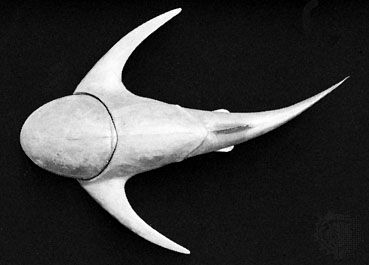
- Arctolepis: An early, heavily armored genus characterized by a flattened body and long, backward-curved shoulder spines, which likely helped the fish anchor itself or move along the seafloor.2
- Coccosteus: A Middle Devonian genus that represents a shift toward marine habitats. These predators were less armored than earlier forms and featured a distinct joint between their head and body shields, allowing for greater head mobility.26
- Dinichthys: A massive Late Devonian predator that could reach lengths of approximately 9 meters (30 feet). It possessed a large, hinged head shield that allowed its upper jaw to move independently of the lower jaw.27
- Dunkleosteus: Often associated with the size and predatory dominance of Dinichthys, this genus included some of the largest arthrodires, reaching lengths of 10 meters or more.21
- Phyllolepis: A genus notable for having lost most of its head armor, distinguishing it from the more heavily plated members of the order.2
What led to the extinction of arthrodires and other placoderms?
The extinction of arthrodires and other placoderms at the end of the Devonian Period was likely the result of a combination of environmental stresses rather than a single cause. These extinction events, which eliminated 70 to 80 percent of all animal species present during the period, were driven by several factors:1011
- Environmental Instability: Widespread hypoxic or anoxic conditions in marine environments, often indicated by layers of black shale, created significant stress for marine life. This was likely exacerbated by high global temperatures that slowed the mixing of ocean waters, reducing re-oxygenation rates.1011
- Climatic Shifts: Evidence suggests that rapid global warming or abrupt cooling—the latter associated with the development of glaciers and falling sea levels—played a major role in faunal turnover.1011
- Biological Competition: The rise of more adaptable fish groups, such as early bony fishes and cartilaginous fishes, likely contributed to the decline of placoderms, whose specialized anatomy may have made them less competitive.21
- Other Factors: While some researchers have investigated potential bolide impacts, such as the Siljan structure in Sweden, the link between these events and specific extinctions remains a subject of scientific debate. Additionally, increased nutrient runoff from the colonization of land by plants may have further contributed to marine anoxia.1011
What are arthrodires and how do they fit into the larger group of placoderms?
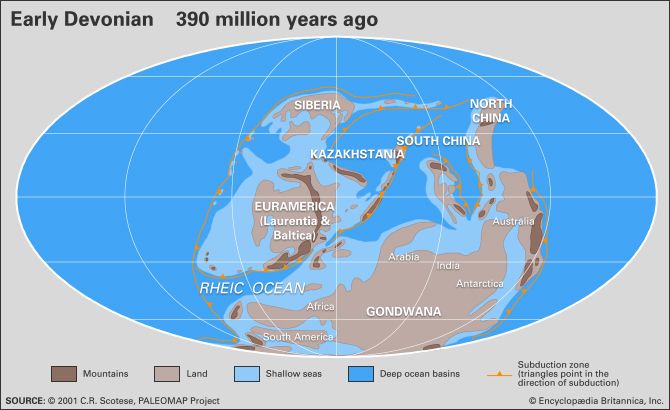
Arthrodires were an order of extinct, armored, jawed fishes that thrived during the Devonian Period (approximately 416 million to 359 million years ago). They are a prominent subgroup within the placoderms, a larger class of primitive jawed fishes defined by their characteristic dermal armor, which typically formed a head shield and a trunk shield.28
Arthrodires, often referred to as “jointed-neck” fishes, are distinguished by a specific anatomical feature: a joint on each side of the neck region that connected the head and body shields, allowing for greater head mobility. While early members like Arctolepis were heavily armored, bottom-dwelling creatures, later arthrodires evolved into diverse predatory forms. These later species, such as Coccosteus and the massive Dinichthys, exhibited reduced armor and specialized bony jaws, reflecting their transition into active, predatory marine lifestyles.21358
As a group, arthrodires represent the significant evolutionary success of placoderms, which dominated aquatic environments globally before becoming extinct at the end of the Devonian.28
Sources
- fish - Placodermi: plate-skin fishes — Encyclopædia Britannica
- arthrodire — Encyclopædia Britannica
- fish - Agnatha: early jawless fishes — Encyclopædia Britannica
- Arthrodira — Merriam-Webster
- Arctolepis — Encyclopædia Britannica
- Dinichthys — Encyclopædia Britannica
- Coccosteus — Merriam-Webster
- placoderm — Encyclopædia Britannica
- Coccosteidae — Merriam-Webster
- Devonian Period - Extinction events — Encyclopædia Britannica
- Devonian extinctions — Encyclopædia Britannica
- chondrichthyan - Evolution — Encyclopædia Britannica
- Placodermi — Merriam-Webster
Published on · 3 min read