Global Warming
Mitigating global warming requires a combination of systemic policy changes and individual actions aimed at reducing greenhouse gas emissions.
How can individuals and communities help mitigate the effects of global warming?
Mitigating global warming requires a combination of systemic policy changes and individual actions aimed at reducing greenhouse gas emissions.12
Individual Actions
Individuals can significantly reduce their carbon footprint by focusing on energy efficiency and lifestyle choices:
- Energy Use: Purchase electricity from renewable energy sources, improve home insulation, and transition to energy-efficient household appliances.13
- Transportation: Utilize public transportation and opt for electric or hybrid-electric vehicles.13
- Consumption: Reduce meat consumption, recycle, and choose products that require fewer emissions to produce and transport.13
- Offsets: Consider purchasing carbon offsets to compensate for unavoidable emissions.3
Community and Systemic Efforts
Communities and governments play a vital role by shifting toward sustainable development and supporting large-scale mitigation strategies:
- Energy Transition: Moving away from fossil fuels toward wind, solar, and hydropower1.
- Technology: Investing in carbon capture and storage.12
- Policy: Implementing carbon taxes and incentivizing climate-friendly infrastructure.1
- Equity: Addressing intersecting crises like poverty and inequality, which often compound the impacts of climate change.2
What international agreements have been made to address global warming?
International efforts to address global warming are primarily guided by the United Nations Framework Convention on Climate Change (UNFCCC), a binding treaty that entered into force in 1994. This framework established the principle of “common but differentiated responsibilities,” acknowledging that while all nations must act, industrialized countries bear a greater responsibility for historical emissions.56
Key international agreements under this framework include:
- Kyoto Protocol (1997): This was the first major addition to the UNFCCC, requiring industrialized nations to reduce their greenhouse gas emissions to specific targets relative to 1990 levels. It introduced flexible mechanisms such as emissions trading and the Clean Development Mechanism to help countries meet their goals.76
- Paris Agreement (2015): Replacing the Kyoto Protocol, this landmark accord was signed by 196 parties. It aims to limit the increase in global average temperatures to well below 2 °C (3.6 °F) above preindustrial levels, while striving to keep the increase to 1.5 °C (2.7 °F). Unlike the Kyoto Protocol, it includes commitments from both developed and developing nations.785
These agreements are reviewed and updated during the annual Conference of the parties (COP), which serves as the primary governing body for climate negotiations.5
What are some renewable energy sources that can help combat global warming?
Renewable energy sources are essential for combating global warming because they produce significantly lower greenhouse gas emissions compared to fossil fuels. By replacing carbon-intensive energy, these sources help mitigate the greenhouse effect and reduce the environmental impacts of air pollution.91011
Major renewable energy sources include:
- Solar power: Uses photovoltaic panels or thermal technologies to convert sunlight into electricity or heat.129
- Wind power: Utilizes turbines to capture the kinetic energy of moving air to generate electricity.1210
- Hydroelectric power: Harnesses the energy of flowing or falling water to drive generators.129
- Geothermal power: Taps into heat from the Earth’s interior for electricity and direct heating.121
- Biofuels: Derived from organic matter like plant material and agricultural waste to produce fuel, heat, or electricity.129
- Tidal power and Wave power: Capture energy from the movement of ocean tides and waves.129
While nuclear power is a low-carbon energy source, it is generally not classified as renewable because it relies on finite nuclear fuels.9
What are the observed and predicted effects of global warming on Earth’s climate?
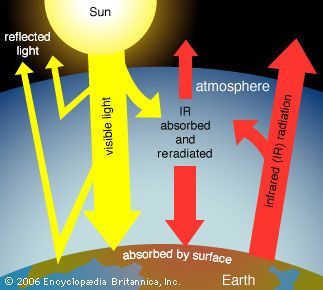
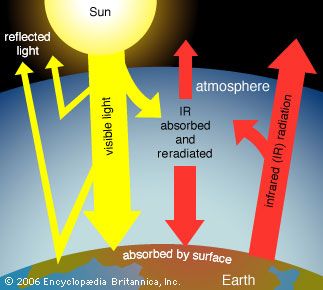
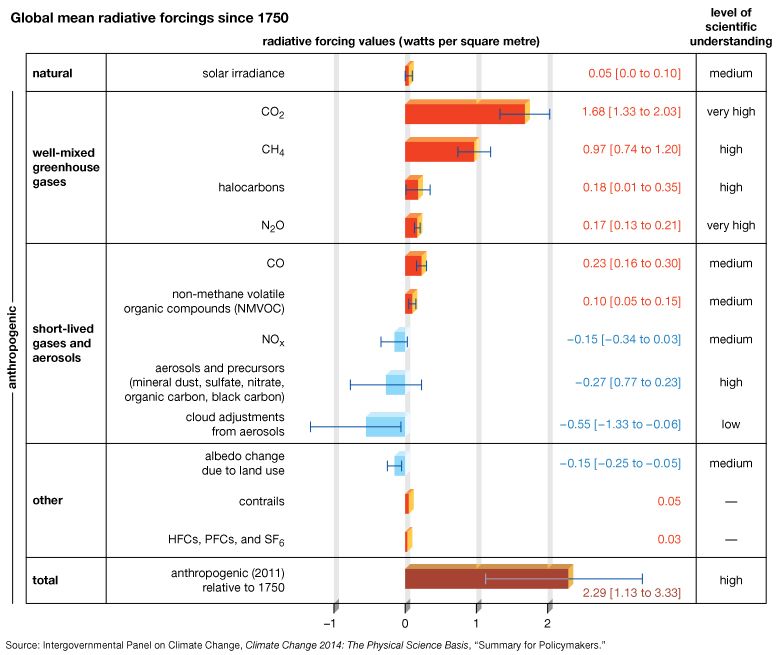
Global warming, driven primarily by human-induced greenhouse gas emissions, is causing rapid and significant changes to Earth’s climate system. Scientific consensus indicates that these shifts are occurring faster than those driven by natural forces alone.1314
Observed and Predicted Climate Effects
- Temperature Rise: Global mean surface temperatures have already risen by approximately 0.8 to 1.2 °C (1.4 to 2.2 °F) above preindustrial levels. Projections suggest a further increase of 0.3 to 4.8 °C (0.5 to 8.6 °F) by 2100, with warming significantly more pronounced at the poles than at the Equator.1415
- Hydrologic Cycle: Warming is intensifying the hydrologic cycle, leading to more extreme precipitation patterns. While some regions may experience increased rainfall and flooding, others—particularly in the mid-latitudes—face higher evaporation rates, reduced soil moisture, and more frequent droughts.151617
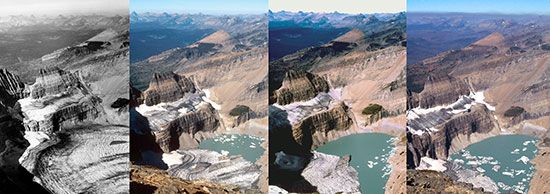
- Sea Level Rise: The melting of glaciers and ice caps, combined with the thermal expansion of warming oceans, is causing a steady rise in sea level, which threatens coastal populations and ecosystems.15
- Cryosphere Loss: Significant reductions in Arctic sea ice have been observed, with potential for complete seasonal melting, which would further alter global storm tracks and precipitation.1514
Ecological and Human Impacts
These climatic shifts pose severe risks to biodiversity, with many species facing increased extinction risks as their habitats change or disappear. Furthermore, warming temperatures facilitate the spread of infectious diseases by expanding the geographic ranges of insect and rodent carriers. The increased frequency of climate-related natural disasters, such as heat waves and intense hurricanes, also presents growing challenges for human infrastructure and agriculture.1817
We could dive deeper into how specific ecosystems, such as coral reefs, are responding to these changes.
Sources
- Global warming policy - Mitigation and adaptation — Encyclopædia Britannica
- Carbon footprint — Encyclopædia Britannica
- Global warming policy — Encyclopædia Britannica
- Climate change - Climate change mitigation and adaptation — Encyclopædia Britannica
- Paris Agreement — Encyclopædia Britannica
- Kyoto Protocol — Encyclopædia Britannica
- Conference of the parties — Encyclopædia Britannica
- Global warming policy - The UN Framework Convention and the Kyoto Protocol — Encyclopædia Britannica
- renewable energy: Top Questions — Encyclopædia Britannica
- renewable energy — Encyclopædia Britannica
- Climate change - 8. Wind power — Encyclopædia Britannica
- energy conversion - Exploiting renewable energy sources — Encyclopædia Britannica
- hydrosphere - Buildup of greenhouse gases — Encyclopædia Britannica
- Global warming - Precipitation patterns — Encyclopædia Britannica
- Is Climate Change Real? — Encyclopædia Britannica
- natural disaster - Frequency and disaster patterns — Encyclopædia Britannica
- Global warming - Environmental consequences of global warming — Encyclopædia Britannica
- Intergovernmental Panel on Climate Change — Encyclopædia Britannica
Published on · 5 min read