Dinichthys
Dinichthys is an extinct genus of arthrodires, which were primitive, armored, fishlike animals known as placoderms. These creatures dominated ancient marine…
What is Dinichthys?
Dinichthys is an extinct genus of arthrodires, which were primitive, armored, fishlike animals known as placoderms. These creatures dominated ancient marine environments during the Late Devonian Period, approximately 374 to 360 million years ago.12
Fossil evidence of Dinichthys has been discovered in North America, Europe, and northern Asia. Reaching lengths of about 9 metres (30 feet), these predators were characterized by a massive, armored head shield. This shield featured a unique hinge in the neck region, which allowed the upper jaw to move independently of the lower jaw. As a dominant marine predator, Dinichthys occupied a significant ecological role in the Devonian seas. While historically compared to other large prehistoric animals, it remains a distinct example of the specialized, heavily armored fish that defined its era.132
What are placoderms and how did they evolve?
Placoderms (class Placodermi) were a diverse group of primitive, jawed fishes that dominated marine and freshwater environments during the Devonian Period (approximately 416 to 359 million years ago). Their name, meaning “plate-skin,” refers to the heavy, bony armor that covered their heads and the anterior portions of their bodies, often connected by a joint in the neck region.34
Evolutionary Significance
While the exact origins of placoderms remain unknown, they represent a critical stage in the evolution of vertebrates. Key evolutionary advancements included:34
- Jaws: They possessed specialized jaws, often involving hyoid and quadrate bones, which allowed for diverse feeding strategies, from crushing hard-shelled invertebrates to swallowing smaller fish.34
- Paired Fins: The development of paired fins with well-formed structural elements improved their swimming capabilities.4
Although their specific lineage is debated, some paleontologists suggest that placoderms may have shared a common ancestor with sharks, chimaeras, and bony fishes. It is believed that placoderms may have given rise to the Chondrichthyes (cartilaginous fishes) and Osteichthyes (bony fishes), though these groups likely evolved independently. Most placoderms went extinct by the end of the Devonian, with only a few persisting into the Carboniferous Period.345
How does Dunkleosteus compare to Dinichthys?
It is a common misconception that Dunkleosteus and Dinichthys are the same; while both were massive, predatory placoderms from the Devonian Period, they are distinct genera of arthrodires.13
Both animals were apex predators that utilized a hinged neck mechanism to raise their upper jaws, allowing them to open their mouths wide to consume prey. However, they differ in their classification and physical characteristics:13
- Dinichthys: This genus was a dominant marine predator reaching lengths of approximately 9 metres (30 feet). It is noted for having its anterior bony armor reduced compared to other placoderms.12
- Dunkleosteus: These predators also reached impressive sizes of 10 metres (30 feet) or more. They are frequently cited as the quintessential example of the massive, heavily armored predators that defined the Devonian seas.3
While both occupied similar ecological niches as top-tier predators, they represent different evolutionary paths within the diverse group of armored placoderms.13
What was the environment like during the Devonian Period?
The Devonian Period (approximately 419.2 to 359 million years ago), often called the “Age of Fishes,” was a time of significant biological and geological transformation.
Paleoclimate and Geography
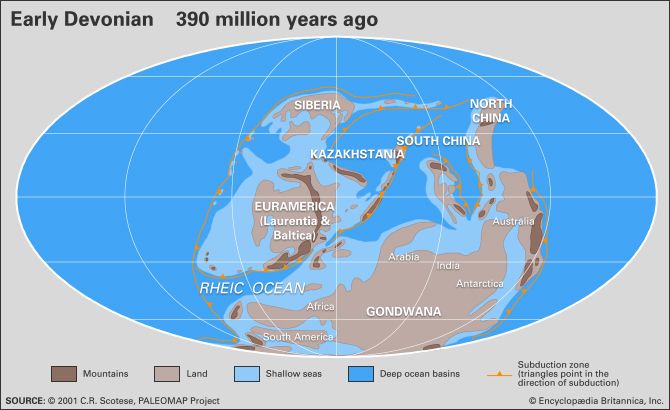
During this period, the Earth was generally warmer than it is today, with evidence of widespread desert conditions, carbonate reefs, and evaporite basins. While the existence of polar ice caps is debated, any that did exist were significantly smaller than modern ones. Geologically, the continents of Laurentia and Baltica collided to form the supercontinent Laurussia (or Euramerica), while the southern continents remained joined as Gondwana. The Caledonian orogeny created a massive mountain chain across parts of North America, Greenland, and Europe, leading to the formation of extensive terrestrial deposits known as the Old Red Sandstone.910
Life and Environment
The Devonian saw the first appearance of forests and the colonization of land by vertebrates. Marine environments were vast, covering about 85 percent of the globe, though they frequently experienced episodes of low oxygen (anoxia) that triggered significant extinction events, such as the Kellwasser Event. These environmental stresses, potentially linked to global temperature fluctuations or nutrient influxes from land plants, caused major losses in marine biodiversity.111012
Sources
- Dinichthys — Encyclopædia Britannica
- Dinichthys — Merriam-Webster
- placoderm — Encyclopædia Britannica
- fish - Placodermi: plate-skin fishes — Encyclopædia Britannica
- chondrichthyan - Evolution — Encyclopædia Britannica
- Permian extinction - Marine invertebrates — Encyclopædia Britannica
- Devonian extinctions — Encyclopædia Britannica
- holostean - Annotated classification — Encyclopædia Britannica
- A Journey Through Time Since the Precambrian - Devonian Period: 419.2 million to about 359 million years ago — Encyclopædia Britannica
- Devonian Period - Paleoclimate — Encyclopædia Britannica
- Devonian Period - Significant geologic events — Encyclopædia Britannica
- Devonian Period - Extinction events — Encyclopædia Britannica
- plant - Evolution of seed plants and plant communities — Encyclopædia Britannica
- Devonian Period - Devonian life — Encyclopædia Britannica
Published on · 3 min read