Artinskian Stage
The Artinskian Stage, which occurred during the early Permian Period, is associated with significant geological activity within the Uralian orogenic belt.…
What are some important economic resources associated with Artinskian-age rocks?
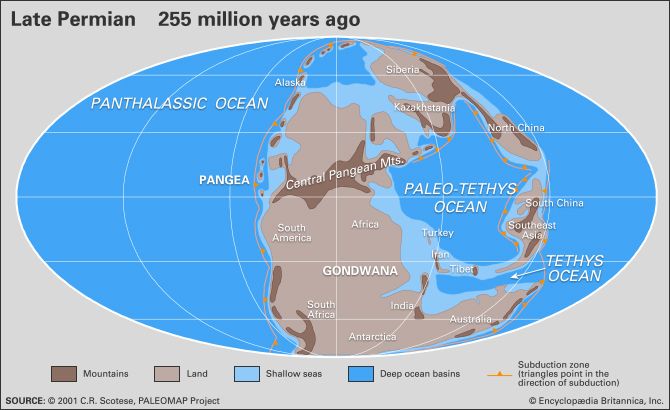
The Artinskian Stage, which occurred during the early Permian Period, is associated with significant geological activity within the Uralian orogenic belt. This tectonic environment facilitated the formation of several important economic resources:
- Chromite: The collision of island arcs and continental blocks during the formation of the Uralian belt resulted in the westward transport of oceanic floor slabs known as ophiolites, which are host to deposits of chromite.1
- Petroleum: The development of the Uralian orogenic belt led to the creation of oil-bearing foreland basins along the western side of the Ural Mountains.1
- Potash: In the region near the city of Perm, the accumulation of thick evaporites during the Permian resulted in the formation of economically significant potash deposits.1
While the Artinskian strata in the type area consist primarily of sedimentary rocks such as sandstones, siltstones, shales, and conglomerates, these broader tectonic processes define the resource potential of the era.21
How has our understanding of the Artinskian Stage changed over time with new research and technologies?
Our understanding of the Artinskian Stage has evolved significantly through the refinement of biostratigraphy, which is essential for correlating rock layers across different global regions.
Historically, correlating Permian strata has been challenging because many marine invertebrate faunas were highly endemic, meaning they were localized and difficult to compare between distant paleobiotic provinces. To overcome these limitations, researchers have increasingly shifted their focus toward pelagic (open-ocean) fossils, particularly conodonts.
Modern research has established precise conodont zonations to define the boundaries of the Artinskian Stage. The base of the stage is now specifically marked by the first appearance of the species Sweetognathus whitei and Mesogondolella bisselli. While these guide species are highly effective in the paleoequatorial belt, scientists continue to develop distinct zonation models for colder waters, such as those surrounding the Gondwana supercontinent, where different species and genera are present. This ongoing work helps resolve regional discrepancies and improves our ability to create a more accurate global timeline for the Permian Period.13
How does the Artinskian Stage relate to other stages in the Permian period?
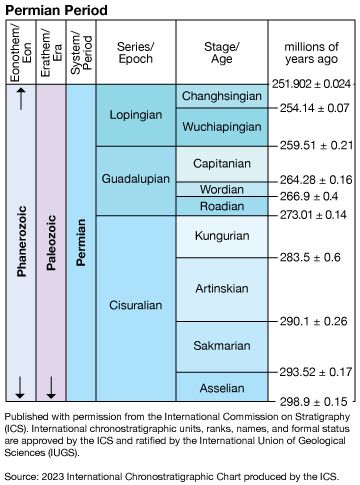
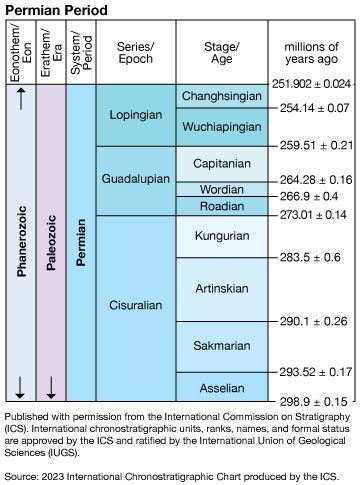
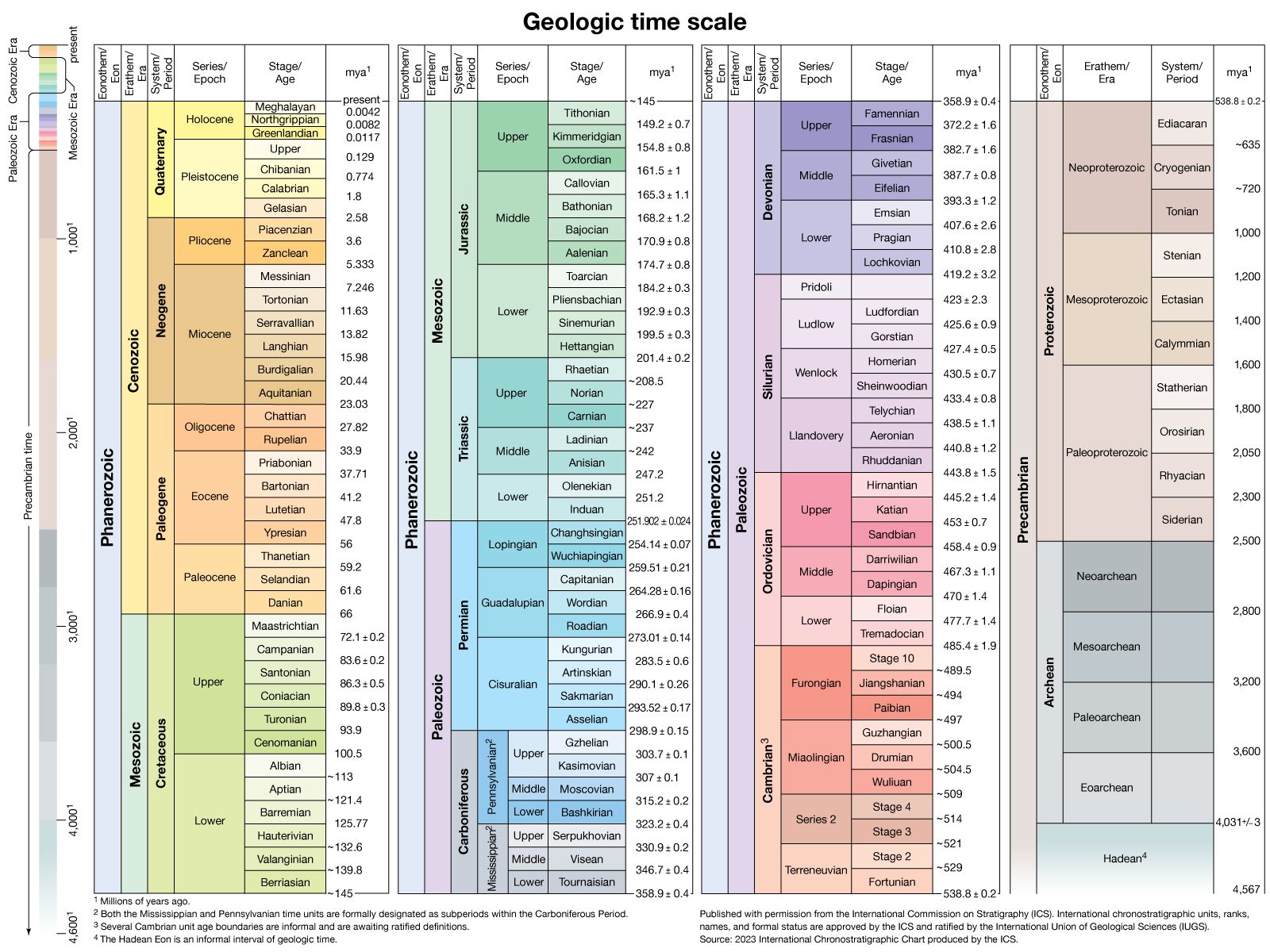
The Artinskian Stage is the third of four stages within the Cisuralian Series, which constitutes the Early Permian Period. Spanning from 290.1 million to 279.3 million years ago, it occupies a specific chronological position between the Sakmarian Stage and the Kungurian Stage.14
The chronological sequence of the Cisuralian Series is as follows:
- Asselian Stage: 298.9–295.5 million years ago4
- Sakmarian Stage: 295.5–290.1 million years ago4
- Artinskian Stage: 290.1–279.3 million years ago14
- Kungurian Stage: 279.3–272.3 million years ago4
The boundaries of these stages are defined by the first appearance of specific conodont species. The base of the Artinskian is marked by the emergence of Sweetognathus whitei and Mesogondolella bisselli, distinguishing it from the underlying Sakmarian and the subsequent Kungurian, which is defined by Neostreptognathodus pnevi and N. exculptus. While these markers are standard in the paleoequatorial belt, researchers utilize different zonation models for colder regions, such as those near Gondwana, to maintain stratigraphic consistency.14
How was the Artinskian Stage first defined, and where is its type section located?
The Artinskian Stage was originally defined based on strata located in the Ural region of Russia, which serves as its type area. During the Artinskian, these deposits formed within a marine tectonic foredeep—a narrow trough filled with sediment—situated along the western edge of the Ural geosyncline. As the Uralian orogenic belt shifted westward, these environments accumulated significant layers of sandstones, siltstones, shales, and conglomerates on a steep, inclined ramp.1
While the stage is now formally identified by the first appearance of specific conodont species, its historical characterization relied on distinct biostratigraphic zones. These zones are defined by the presence of primitive fusulinids belonging to the genus Parafusulina, as well as ammonites from the genera Metaperrinites and Perrinites.1
Sources
- Artinskian Stage — Encyclopædia Britannica
- Uralian orogenic belt — Encyclopædia Britannica
- Permian Period - Correlation of Permian strata — Encyclopædia Britannica
- Permian Period - Major subdivisions — Encyclopædia Britannica
- Permian Basin — Encyclopædia Britannica
Published on · 3 min read