Ash
Ash wood, derived from the genus Fraxinus, is highly valued for its combination of strength, resilience, and lightweight properties. Its industrial and daily…
What are the various uses of ash wood in industry and daily life?
Ash wood, derived from the genus Fraxinus, is highly valued for its combination of strength, resilience, and lightweight properties. Its industrial and daily applications are diverse, largely due to the physical characteristics of specific species.1
Sports and Tools
Because of its durability and shock resistance, white and green ash are primary materials for:
- Sports equipment: Baseball bats, hockey sticks, and tennis or other racket frames.1
- Agricultural implements: Handles for shovels, spades, hoes, and rakes.1
- Recreational gear: Paddles and oars.1
Construction and Furnishings
Other species, such as black, blue, and Oregon ash, are frequently utilized for:
- Interior design: Furniture and interior paneling.1
- Joinery and veneer: Japanese ash (Fraxinus mandschurica), also known as tamo, is specifically prized for these purposes due to its attractive grain, which resembles oak.2
- Storage: Barrels and other containers.1
Additionally, the Chinese ash is notable for yielding Chinese white wax. While wood generally can be processed into various chemical products—such as pulp, paper, and biofuels—ash is primarily sought after for its structural integrity in manufacturing and craftsmanship.13
What are some common species of ash trees?
The genus Fraxinus comprises 45–65 species of trees and shrubs. Several of these are particularly notable for their timber, ornamental value, or unique characteristics.
North American Species
- White ash (Fraxinus americana) and green ash (F. pennsylvanica): These are the most important timber-providing species in the United States, valued for their stiff, strong, and lightweight wood.1
- Black ash (F. nigra): Found in eastern North America, this species provides high-quality wood used for furniture and barrels.1
- Blue ash (F. quadrangulata): Native to the Midwest, it is also utilized for interior paneling and furniture.1
- Oregon ash (F. latifolia): A species of the Pacific Northwest used for similar industrial purposes as the black and blue ash.1
- Mexican ash (F. uhdei): A broad-crowned tree commonly planted in urban areas like Mexico City.1
European and Asian Species
- European ash (F. excelsior): A widely distributed timber tree in Europe, long cultivated for landscaping in various forms, including weeping and dwarflike varieties.1
- Flowering ash (F. ornus): Native to southern Europe, this species is recognized for its fragrant, creamy white flowers.1
- Chinese ash (F. chinensis): This species is notable for producing Chinese white wax.1
What are the distinctive characteristics of ash trees?
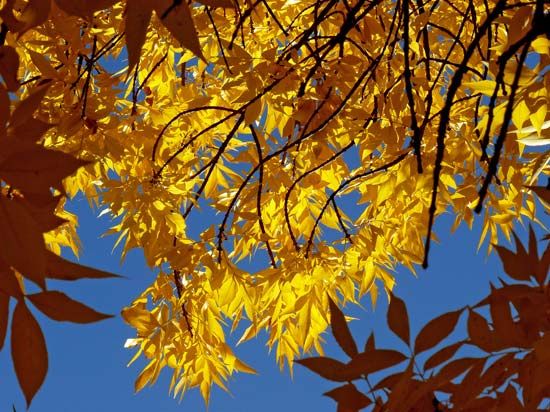
Ash trees, belonging to the genus Fraxinus within the Oleaceae family, are primarily distributed throughout the Northern Hemisphere. They are characterized by several distinct physical and botanical features:
Botanical Characteristics
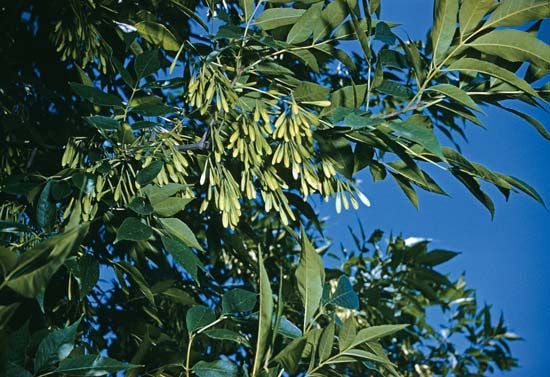
- Leaves: Ash trees typically feature opposite, deciduous, and pinnately compound leaves. These leaves usually consist of an odd number of leaflets, commonly ranging from five to eleven depending on the species.14
- Flowers: The flowers are generally small and often grow in showy clusters. While many species have small, apetalous (petal-less) flowers, some varieties produce blooms with petals.14
- Fruit: The trees produce one-seeded, winged fruits known as samaras.14
- Bark: The bark of these trees is typically thin and furrowed.4
Growth and Form
Most ash trees are small to medium in size, though larger timber-providing species can reach heights of 18 to 34 meters (60 to 120 feet). They are highly regarded for their wood, which is known for being stiff, strong, resilient, and lightweight.1
Where are ash trees commonly found in the world?
Ash trees (genus Fraxinus) are primarily distributed throughout the Northern Hemisphere. While they are most commonly associated with temperate regions, their range is extensive:
- North America: Numerous species are found across the United States and Canada. For example, white and green ash are widespread throughout the eastern and central United States, while the Oregon ash is native to the Pacific Northwest.
- Europe: The European ash is widely distributed across the continent, and the flowering ash is native to southern Europe.
- Asia: Various species are native to regions including China, Japan, and eastern Russia.
- Tropical Regions: A few species extend their range into the tropical forests of Mexico and Java.
Sources
- Ash — Encyclopædia Britannica
- Japanese ash — Merriam-Webster
- wood - Products of chemical processing — Encyclopædia Britannica
- Fraxinus — Merriam-Webster
- emerald ash borer: Top Questions — Encyclopædia Britannica
Published on · 3 min read