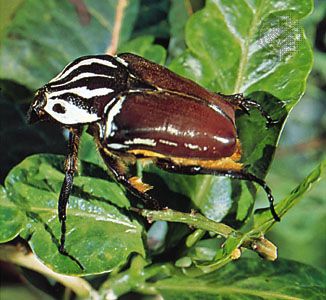
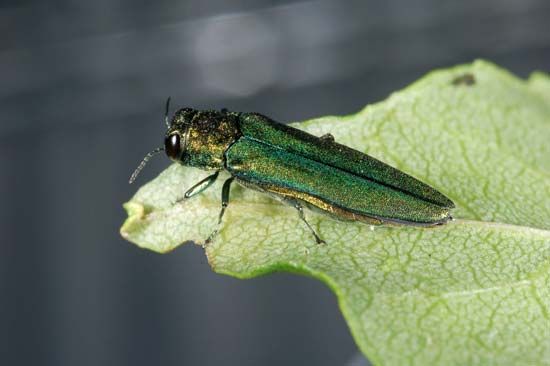
Metallic Wood-boring Beetle
Sorry, the Britannica knowledge base does not contain information regarding the evolutionary history or the fossil record of metallic wood-boring beetles.
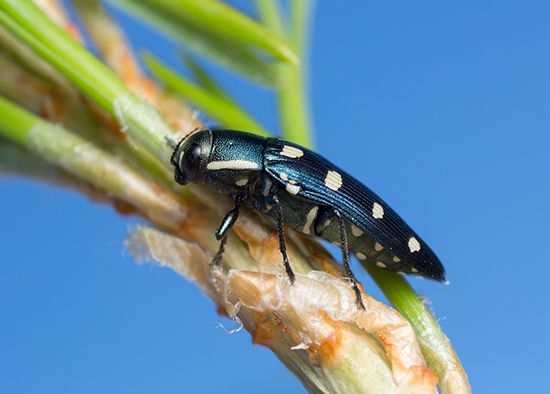
How long have metallic wood-boring beetles existed, and what does the fossil record tell us about their evolution?
Sorry, the Britannica knowledge base does not contain information regarding the evolutionary history or the fossil record of metallic wood-boring beetles.
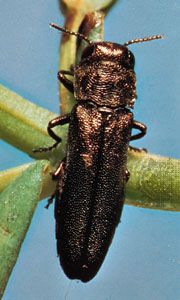
How do metallic wood-boring beetles reproduce and what is their life cycle?
Metallic wood-boring beetles (family Buprestidae) follow a life cycle typical of many wood-boring insects, progressing through stages of egg, larva, pupa, and adult.
Larval Development
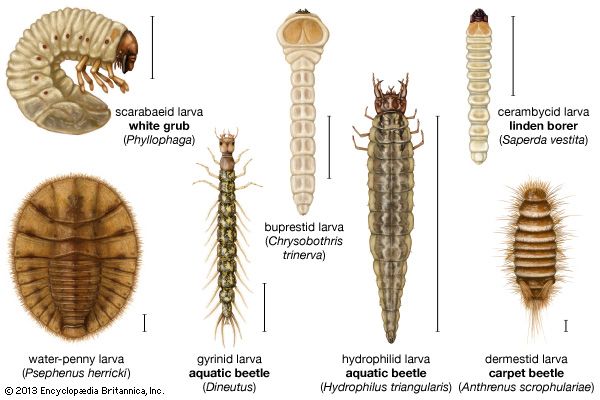
The larvae of these beetles are often referred to as “flatheaded borers” because their head region is flattened and expanded sideways, while the remainder of their body is narrow, cylindrical, and legless, giving them a tadpole-like appearance. These larvae are soft-bodied and slender. They typically bore under the bark of trees or burrow beneath the surface of leaves, often carving out distinct, ribbon-shaped tunnels as they feed. In some cases, such as with the genus Agrilus, the larvae induce the formation of a gall within which they reside.45
Pupation and Emergence
When ready to pupate, wood-boring larvae generally chew or dig a specialized cavity known as a pupal cell. Some species may construct a cocoon or a protective barrier of frass (chewed wood fibers) to shield themselves from predators. During the pupal stage, the insect undergoes metamorphosis, often appearing white or pale before darkening as it matures. Once the adult form has hardened, it must break through the barrier of the pupal cell and chew through the remaining wood to emerge from the tree. Upon emergence, the adult rapidly assumes its final form, though its characteristic metallic coloration may take several days to fully develop.1
What natural predators do metallic wood-boring beetles have?
Metallic wood-boring beetles (family Buprestidae) face pressure from a variety of natural predators and parasites throughout their life cycle.
Predators and Parasites
- Parasitic Wasps: Certain insects, such as the parasitic wood wasps in the family Orussidae, specifically target metallic wood-boring beetles. The larvae of these wasps are parasitic on buprestid larvae, effectively controlling their populations. Additionally, many beetle larvae are susceptible to various hymenopterous parasites, including wasps that lay their eggs directly on or within the beetle larvae.71
- Predatory Beetles: Larvae of the family Cleridae are notable predators that feed on the larvae of wood-boring beetles.8
- Generalist Predators: Adult beetles are subject to predation by a range of insectivorous animals, including birds (such as swifts), bats, reptiles, and frogs. Other insects may also act as predators.1
Defensive Strategies
Metallic wood-boring beetles utilize specific adaptations to evade detection. Their brilliant metallic coloration, while striking, can serve as a form of camouflage; when a flying beetle lands and folds its wings, it may appear as a dull, dark-colored lump on a branch, potentially causing a predator to lose interest or fail to recognize it as prey.9
How do metallic wood-boring beetles impact trees and forests?
Metallic wood-boring beetles, particularly invasive species like the emerald ash borer, exert a profound and often devastating impact on trees and forest ecosystems.
Mechanisms of Damage
The primary damage is caused by the larvae, which bore into the tree to feed on the phloem and outer sapwood layers. As they feed, they create extensive, S-shaped tunnel networks known as galleries. These tunnels effectively girdle the tree, disrupting its vascular system and preventing the transport of water and nutrients, which leads to the death of the tree. While some species, such as Chrysobothris, target fruit trees and shrubs, others like the emerald ash borer can kill both stressed and healthy trees, often resulting in mortality within one to four years depending on the tree’s size and the severity of the infestation.12131
Ecological and Economic Consequences
- Ecosystem Alteration: The mass mortality of host trees, such as the ash tree, dramatically alters forest composition and urban canopies. The resulting loss of trees opens the forest canopy, which often facilitates the spread of invasive plant species that further degrade the habitat.1413
- Food Web Disruption: Because many insects, including various moths and butterflies, are specialists dependent on specific tree species, the decline of these trees negatively impacts the broader food web.1413
- Increased Fire Risk: The accumulation of dead trees increases fuel loads, making forests significantly more vulnerable to intense wildfires.1413
- Economic Impact: The destruction of timber resources and the costs associated with removing or treating infested trees in urban and suburban areas have resulted in billions of dollars in economic losses.13
Sources
- metallic wood-boring beetle — Encyclopædia Britannica
- buprestid — Merriam-Webster
- Buprestidae — Merriam-Webster
- Coleoptera - Pupae — Encyclopædia Britannica
- long-horned beetle — Encyclopædia Britannica
- Coleoptera - Larvae — Encyclopædia Britannica
- Coleoptera - Beetles as prey — Encyclopædia Britannica
- Coleoptera - Feeding habits and habitats — Encyclopædia Britannica
- Coleoptera - As predators — Encyclopædia Britannica
- Coleoptera - As plant feeders — Encyclopædia Britannica
- wood wasp — Encyclopædia Britannica
- Emerald Ash Borer: At a Glance — Encyclopædia Britannica
- emerald ash borer: Top Questions — Encyclopædia Britannica
- emerald ash borer — Encyclopædia Britannica
Published on · 3 min read