Asparagaceae
Asparagaceae, commonly known as the asparagus family, is a diverse group of flowering plants within the order Asparagales. It comprises approximately 153…

What is the Asparagaceae family?
Asparagaceae, commonly known as the asparagus family, is a diverse group of flowering plants within the order Asparagales. It comprises approximately 153 genera and over 2,500 species distributed nearly worldwide, with particular diversity in tropical regions experiencing seasonal aridity.12
The family is primarily defined by genetic and evolutionary relationships rather than distinct physical traits. Most members are herbaceous perennials, often growing from bulbs or corms. As monocots, they typically feature straplike leaves with parallel veins and flowers with parts in multiples of three.12
The family is organized into seven subfamilies, including Agavoideae (which contains agave and yucca), Asparagoideae (including the garden asparagus), and Nolinoideae (which includes popular houseplants like dracaena and snake plants). These plants are culturally and economically significant, providing food, fibers, and ornamental foliage.23
Which common plants belong to the Asparagaceae family?
The Asparagaceae family includes a wide variety of plants, ranging from common vegetables and popular houseplants to desert succulents and ornamental flowers. Notable examples include:
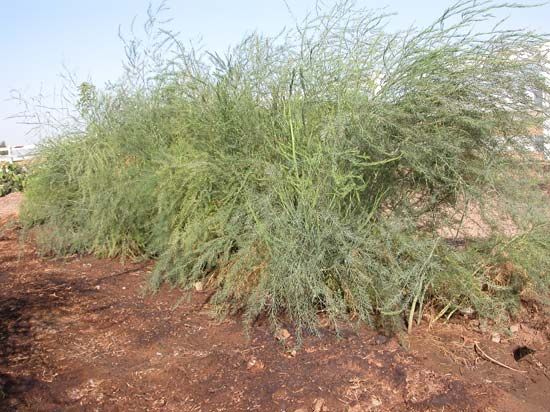
- Vegetables: The family is named after the garden asparagus (Asparagus officinalis), a widely consumed vegetable.3
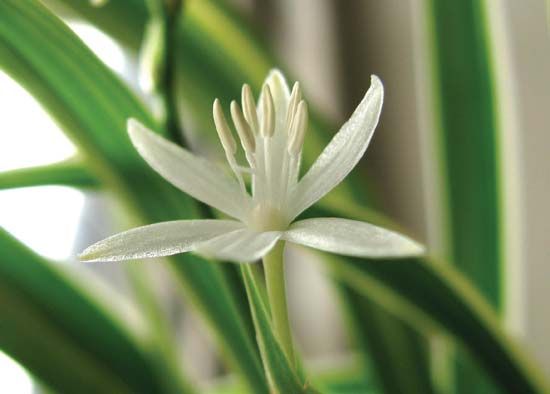
- Houseplants: Many common indoor plants belong to this family, such as spider plants, snake plants, lucky bamboo, and corn plants.3
- Ornamentals: Popular garden and foliage plants include hostas, tuberose, hyacinths, grape hyacinths, and various ferns (such as florist’s fern and asparagus fern).3
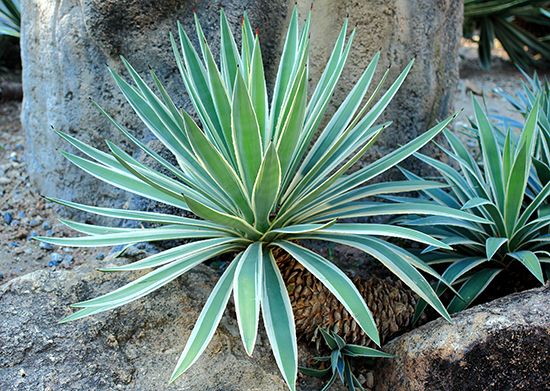
- Desert and Succulent Plants: The family includes agave species—used for sisal fiber and the production of tequila—as well as yuccas, such as the Joshua tree.32
- Wildflowers: Cluster-lilies of the genus Brodiaea are common wildflowers in parts of North America.3
Where are plants from the Asparagaceae family found around the world?
Plants in the Asparagaceae family are nearly cosmopolitan, meaning they are found in almost every part of the world. While they have a global distribution, they are particularly diverse in tropical regions that experience seasonal aridity.6
The geographic range and concentration of these plants vary by subfamily and genus:
- Americas: The subfamily Agavoideae is well-represented in the Americas, where species of Yucca and Agave are common in desert environments. Additionally, the subfamily Brodiaeoideae is found throughout a range extending from Guatemala north to British Columbia, Canada.36
- Australia: The subfamily Lomandroideae is predominantly Australian in its distribution.6
- Africa and Eurasia: Many genera are especially populous in Africa and parts of the Indian subcontinent. The genus Asparagus is native to regions stretching from Siberia to southern Africa. Furthermore, the subfamily Scilloideae is found in Mediterranean climates, extending from southern Africa to Central Asia and Japan.62
- Endemic Species: Some groups have very specific ranges, such as the subfamily Aphyllanthoideae, which consists of a single species endemic to the western Mediterranean region.6
What are some key features of Asparagaceae plants?
The Asparagaceae family is a diverse group of flowering plants within the order Asparagales, comprising over 2,500 species. While they share a genetic relationship, they exhibit significant physical variety, making them difficult to define by a single set of morphological traits.63
Key Features
- Growth Habit: Most members are herbaceous perennials, often growing from bulbs or corms. Some species, such as those in the subfamily Agavoideae, are large and treelike, though their trunks consist of fibrous tissue rather than true wood.67
- Leaves: As monocots, they typically feature straplike leaves with parallel veins, often arranged in tight rosettes or whorls.6
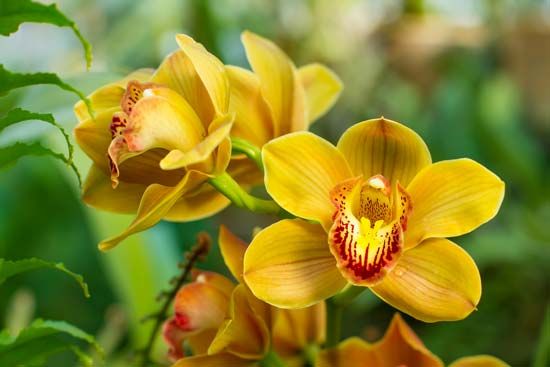
- Flowers: The flowers are generally showy, with parts (including stamens) occurring in multiples of three. The sepals and petals are often identical in appearance, leading them to be referred to as tepals.62
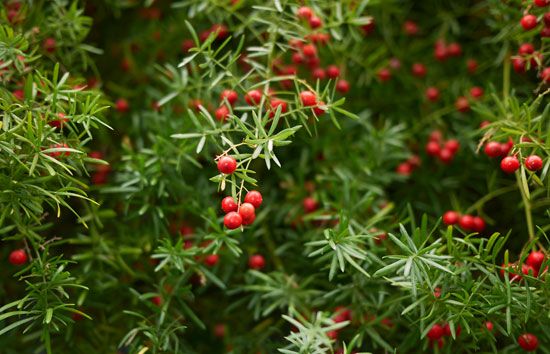
- Fruits and Seeds: Fruits are typically dry capsules or fleshy berries. Many species produce black seeds due to the presence of a pigment called phytomelanin.68
- Specialized Structures: Some species, such as asparagus, utilize cladodes—flattened, photosynthetic stems—to perform the functions of leaves.9
Sources
- list of plants in the family Asparagaceae — Encyclopædia Britannica
- Asparagales - Organization and taxonomy — Encyclopædia Britannica
- Asparagaceae — Encyclopædia Britannica
- Asparagus — Encyclopædia Britannica
- Asparagales — Encyclopædia Britannica
- Asparagales - Order growth characteristics — Encyclopædia Britannica
- angiosperm - Shoot system modifications — Encyclopædia Britannica
- Asparagales - Flowers — Encyclopædia Britannica
- Asparagales - Fruits and seeds — Encyclopædia Britannica
Published on · 3 min read