Aspen
An aspen is any of three tree species within the genus Populus, which belongs to the willow family (Salicaceae). Native to the Northern Hemisphere, these…
What is aspen?
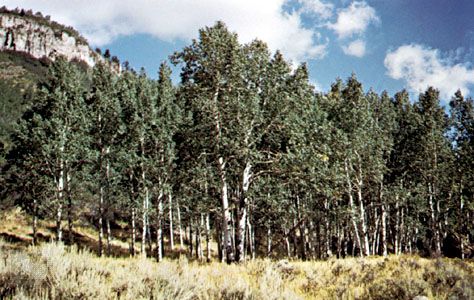
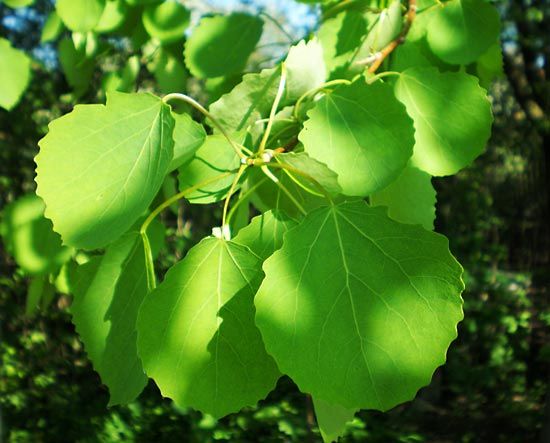
An aspen is any of three tree species within the genus Populus, which belongs to the willow family (Salicaceae). Native to the Northern Hemisphere, these trees are well-known for their leaves, which flutter in the slightest breeze due to their flat petioles (leaf stalks).12
Aspens typically feature smooth, gray-green bark and produce catkins in the spring before their leaves emerge. They are known for being hardy, often growing at higher altitudes and further north than other Populus species. The three primary species include:1
- European aspen (P. tremula): Reaches about 27 meters (90 feet) in height.12
- Quaking aspen (P. tremuloides): Similar in height to the European variety, it spreads via rhizomes. It is famous for forming massive clonal colonies, such as the Pando forest in Utah.12
- Big-tooth aspen (P. grandidentata): A smaller tree reaching up to 18 meters (59 feet) with larger, coarse-toothed leaves.12
What is the Pando forest and why is it considered a single organism?
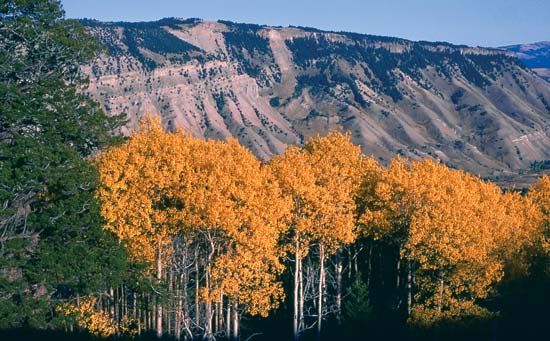
The Pando forest, located in the Fishlake National Forest of central Utah, is a massive colony of quaking aspen trees (Populus tremuloides). Although it appears to be a forest of nearly 47,000 individual trees, it is considered a single, massive organism because all of its stems are clones that share an identical genetic makeup and are physically connected by a vast, ancient, and prolific root system.3
This unique structure allows the organism to function as a unified individual:
- Interconnectivity: The root system supports the entire colony, and evidence suggests it can even redistribute water from one area to another to support trees in need.3
- Asexual Reproduction: Unlike organisms that rely solely on sexual reproduction, Pando spreads by sending up new shoots from its existing roots. These shoots never separate from the parent, meaning the “offspring” remain part of the original organism.3
- Longevity and Mass: Estimated to be at least 80,000 years old, Pando is one of the oldest known organisms on Earth. With a total biomass of approximately 6,600 tons, it is also considered the most massive clonal organism in the world.3
Why do aspen leaves tremble in the wind?
Aspen leaves tremble in the wind primarily due to the unique structure of their leaf stalks, known as petioles. Unlike the cylindrical stalks found on many other trees, aspen petioles are flattened in shape.51
This flattened design makes the connection between the leaf blade and the branch highly flexible, allowing the leaves to flutter or “quake” even in the slightest breeze. This characteristic is so defining that it serves as the namesake for the quaking aspen (Populus tremuloides).51
How do aspen trees reproduce using root suckers?
Aspen trees reproduce through a process known as suckering, which is a form of vegetative reproduction. This process relies on the plant’s ability to regenerate tissues from existing structures.
In this asexual method, adventitious buds located on the tree’s extensive root system are stimulated to grow. These buds develop into new stems and root systems, effectively creating a new tree that is genetically identical to the parent. Because these new shoots remain physically connected to the original root system rather than separating, the colony functions as a single, integrated organism. This method allows aspen populations to expand rapidly and persist over long periods without the need for seeds.
Sources
- aspen — Encyclopædia Britannica
- poplar — Encyclopædia Britannica
- The Clone Giants - Learn more — Encyclopædia Britannica
- The Clone Giants - “The Clone Giants” transcript — Encyclopædia Britannica
- quaking aspen — Merriam-Webster
- suckering — Encyclopædia Britannica
- horticulture - Grafting — Encyclopædia Britannica
Published on · 3 min read