Elk
Elk (Cervus elaphus canadensis) are distinguished from other deer species by several key physical and behavioral adaptations:
What are the key physical characteristics that distinguish elk from other deer species?
Elk (Cervus elaphus canadensis) are distinguished from other deer species by several key physical and behavioral adaptations:
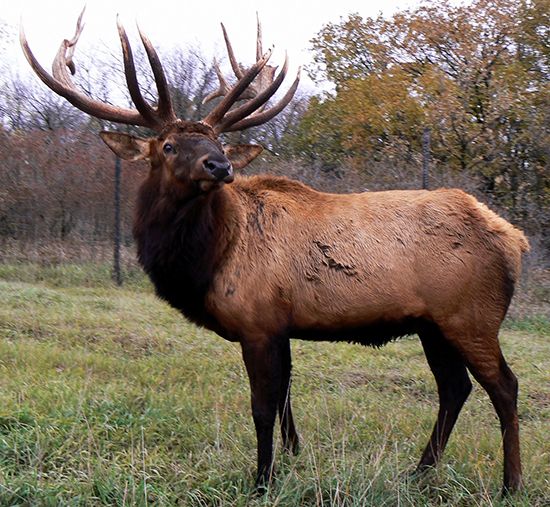
- Size and Build: Elk are among the largest members of the deer family, second only to the moose. Unlike many other deer, female elk are more similar to bulls in external appearance and body mass.1
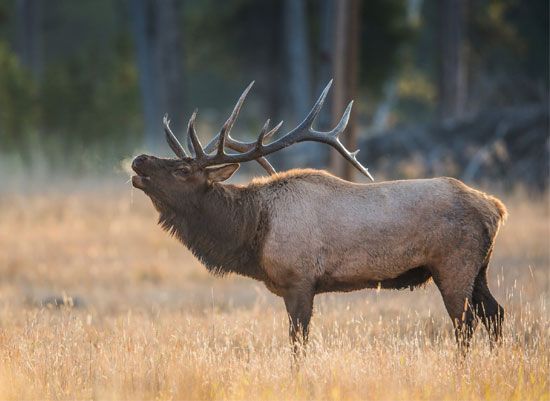
- Coat and Manes: During winter, all elk develop a dark neck mane that contrasts sharply with their tan or light brown body color.1
- Antlers: Elk are highly adapted to cold climates and possess large, complex antlers—typically five- or six-pronged—that they retain longer than other red deer subspecies (approximately 185 days).12
- Vocalizations: Male elk are known for a high-pitched bugling call used during the rut, a specialized vocal adaptation designed to carry sound across long, open landscapes.1
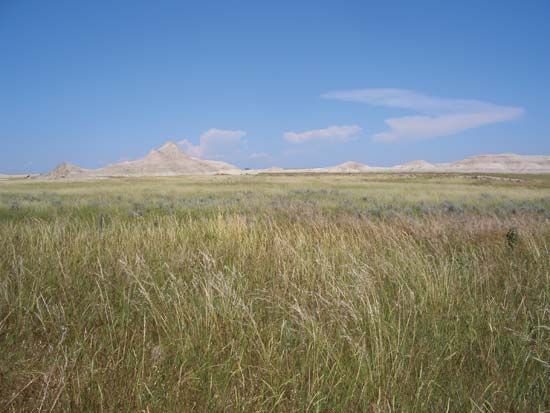
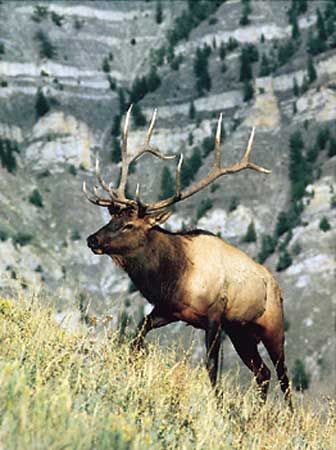
- Ecological Specialization: Unlike many deer that rely on forest cover, elk are highly adapted as fast endurance runners suited for open plains and grazing, though they also thrive in diverse habitats ranging from coniferous forests to prairies.1
Where are elk typically found in the wild, and what are their preferred habitats?
Elk (Cervus elaphus canadensis) are found in two primary regions: North America and the high mountain ranges of Central Asia. In Asia, their range is restricted to cold grasslands on high plateaus, including areas in Outer Mongolia, southern Siberia, and the Altai and Tien Shan mountains.1
In North America, elk occupy a diverse array of environments, ranging from the Yukon to northern Mexico and from Vancouver Island to Pennsylvania. They are highly adapted to open plains and grazing, thriving in habitats such as:
- Coniferous rain forests along the Pacific coast
- Prairies and aspen parklands
- Sagebrush flats and eastern deciduous forests
- The Rocky Mountains
- Valley regions1
While they are versatile, elk generally avoid deserts, boreal forests, and tundra.1
How do elk differ from their close relatives, such as moose or red deer?
Elk (Cervus elaphus canadensis) are a distinct subspecies of red deer, though they possess unique biological adaptations that set them apart from other members of the deer family.
Differences from Red Deer
Compared to European red deer, elk are more highly specialized for life in open plains and cold, long winters. Key differences include:
- Gestation: Elk have a longer gestation period of 255 days, compared to 235 days for European red deer.
- Antlers: Bull elk retain their antlers for approximately 185 days, whereas European red deer typically retain theirs for 150 days or fewer.
- Appearance: Elk are generally larger, and their females are more similar to bulls in body mass and external appearance than is common in other red deer subspecies.
Differences from Moose
While the term “elk” is used to refer to the moose in Europe, they are biologically distinct. Elk are significantly smaller than moose, which are the largest members of the deer family. Additionally, elk are evolved as fast endurance runners suited for open landscapes, whereas moose occupy different ecological niches.
What is an elk?
The elk (Cervus elaphus canadensis) is the largest and most advanced subspecies of red deer, belonging to the deer family, Cervidae. While the term “elk” is used to refer to the moose in Europe, in North America, it is the established name for this species, which is also known as the wapiti—a Shawnee word meaning “white deer” that refers to the light-colored coat of the bull.1
Elk are highly adapted to open plains, grazing, and cold, long winters. They evolved as fast endurance runners and rely on group formation for protection from predators. Physically, they are characterized by a dark neck mane in winter and a distinct, high-pitched bugling call used during the rut to communicate across open landscapes.1
Found in North America and the high mountains of Central Asia, elk are a vital part of the Artiodactyla order. Though nearly exterminated by 19th-century market hunting, they have been successfully reintroduced across North America and are currently thriving.1
Sources
- elk — Encyclopædia Britannica
- deer - Morphology and behaviour — Encyclopædia Britannica
- deer - Old World deer — Encyclopædia Britannica
- Tundra - Alpine mammals — Encyclopædia Britannica
- deer: Top Questions — Encyclopædia Britannica
Published on · 3 min read