Atheriniform
Atheriniform fishes (order Atheriniformes) are classified within the class Actinopterygii, or ray-finned fishes. Within this large class, they belong to the…
How are atheriniform fish classified within the larger group of ray-finned fishes?
Atheriniform fishes (order Atheriniformes) are classified within the class Actinopterygii, or ray-finned fishes. Within this large class, they belong to the infraclass Teleostei, which comprises the advanced bony fishes.123
Specifically, atheriniforms are categorized as part of the Acanthopterygii (spiny-finned fishes) superorder. While they share several anatomical features with more advanced acanthopterygians, these similarities are often considered to be in mosaic distribution, suggesting they were independently acquired. For instance, while many atheriniforms possess spines in front of their dorsal and anal fins, these structures appear to have evolved independently from those found in true acanthopterygians.14
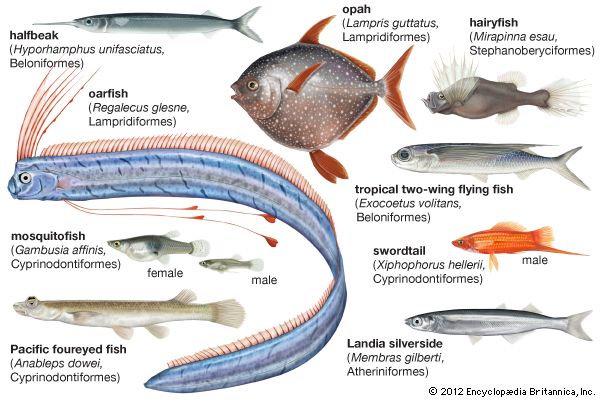
The order contains 15 families of marine and freshwater fishes, including flying fishes, needlefishes, silversides, and cyprinodonts (such as guppies and mollies).1
In what types of habitats are atheriniform fish typically found?
Atheriniform fishes are an extremely varied group that occupy a wide range of aquatic environments, though they are most commonly associated with life near the air-water interface. Their habitats include:15
- Marine Environments: Many species are found in the open ocean, including pelagic forms like flying fishes, needlefishes, and halfbeaks, which inhabit surface waters. Others, such as silversides, are frequently found along coasts in warm and temperate regions worldwide.54
- Freshwater Environments: Many atheriniforms, particularly those in the suborder Cyprinodontoidei, thrive in diverse freshwater settings. These include tropical and subtropical regions where they inhabit everything from stable rivers to highly rigorous environments.156
- Extreme and Rigorous Habitats: Certain cyprinodonts are remarkably hardy, capable of surviving in hot springs with temperatures near the coagulation point of protoplasm, or in stagnant, deoxygenated waters. Some species have adapted to seasonal habitats by becoming annuals, living in temporary bodies of water that dry up during the dry season, with their eggs remaining dormant in the mud for years until the next wet season.5
What is the evolutionary history of atheriniform fish?
The evolutionary history of atheriniform fish is characterized by their status as a primitive group within the superorder Acanthopterygii, or spiny-finned fishes. While they share certain anatomical features with more advanced acanthopterygians, these similarities are generally considered to be in mosaic distribution, indicating that they were acquired independently rather than through direct lineage from those groups.48
The order represents a radiation that emerged from near the base of the acanthopterygian stock. Although their exact relationships within this superorder remain uncertain, current evidence suggests that the group originated in the fresh or brackish waters of the tropical Indo-Pacific region. Unfortunately, the early fossil history of the order is poorly documented, leaving much of their precise evolutionary timeline unknown.8
Anatomically, atheriniforms demonstrate unique evolutionary solutions to functional challenges. For example, their jaw protrusion mechanism differs significantly from that of typical acanthopterygians, relying on a simpler system of ligaments rather than a complex jointed structure. Similarly, while many species possess spines in front of their dorsal and anal fins, these structures appear to have evolved independently from those found in true acanthopterygians.4
How do atheriniform fish reproduce and what are their life cycles like?
Atheriniform fish exhibit a wide array of reproductive strategies and life cycles, characterized by several distinct specializations that set them apart from many other fish groups. Unlike many bony fishes that produce large quantities of small, non-adhesive eggs, all atheriniforms are defined by the production of a smaller number of large, adhesive eggs.9
Reproductive Strategies
- Mating Behavior: These fish typically mate in pairs and often display pronounced sexual dimorphism, where males and females differ significantly in coloration, fin shape, or body size.9
- Egg Deposition: Many species attach their eggs to floating objects or aquatic plants using adhesive filaments. Some, like the grunion, have evolved to spawn on sandy shores, burying their eggs in the sand to hatch during subsequent spring tides.9
- Viviparity: A significant reproductive advancement in several atheriniform groups is viviparity, or the production of live young. In some live-bearers (Poeciliidae), males use a specialized intromittent organ called a gonopodium to fertilize females internally, allowing for the birth of fully developed young.9
- Specialized Adaptations: Some species, such as phallostethoids, possess a unique organ called a priapium for internal fertilization, though they remain egg-layers. In extreme environments, some cyprinodonts have even developed functional hermaphroditism, allowing for self-fertilization.9
Life Cycles
Atheriniforms generally lack a larval metamorphosis; the young are typically born or hatched as miniature versions of the adults. In seasonal tropical habitats, some species have adapted as “annuals,” where they reach sexual maturity rapidly in temporary pools. Before these pools dry up, they bury their eggs in the mud, where they can remain dormant for years until the next wet season triggers hatching.9
Sources
- atheriniform — Encyclopædia Britannica
- fish - Annotated classification — Encyclopædia Britannica
- fish - Actinopterygii: ray-finned fishes — Encyclopædia Britannica
- atheriniform - Form and function — Encyclopædia Britannica
- silversides — Encyclopædia Britannica
- atheriniform - Natural history — Encyclopædia Britannica
- silverside — Merriam-Webster
- atheriniform - Paleontology — Encyclopædia Britannica
- How do fish reproduce? — Encyclopædia Britannica
Published on · 3 min read