Boxfish
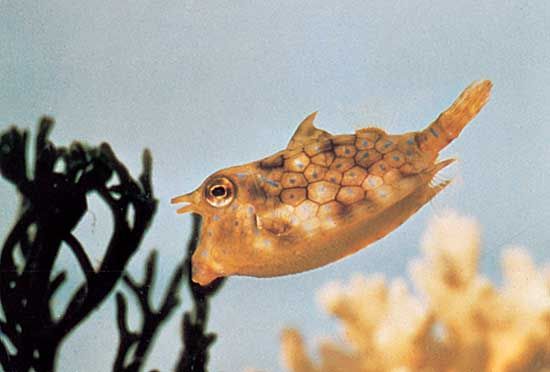
Boxfishes, members of the family Ostraciontidae, possess a rigid, boxlike carapace made of fused plates that encases most of their body. Unlike many other…
How do boxfish move through the water, given their unique body shape?
Boxfishes, members of the family Ostraciontidae, possess a rigid, boxlike carapace made of fused plates that encases most of their body. Unlike many other fish that rely on the undulation of a flexible body or trunk musculature to generate propulsive thrust, the boxfish’s rigid structure prevents such movement.123
Because their bodies cannot bend to create the sinuous waves typical of anguilliform locomotion, boxfishes rely on their fins and tail for movement. While the provided information notes that their eyes, mouth, fins, and tail remain outside the protective shell, the specific mechanics of how these appendages compensate for the lack of body flexibility are not detailed in the available search results.21
How do boxfish reproduce and what is unique about their mating behavior?
The provided search results do not contain specific information regarding the reproductive habits or unique mating behaviors of boxfish (family Ostraciontidae). While the articles discuss general reproductive strategies in bony fishes—such as oviparity, external fertilization, and hermaphroditism—they do not detail the specific life history or courtship displays of this particular group.567
What are some common species of boxfish and how do they differ from each other?
Boxfishes, belonging to the family Ostraciontidae, are a group of small, tropical marine fishes defined by their rigid, protective carapace composed of fused bony plates. While the provided information does not list specific individual species, it highlights key ways in which these fishes differ from one another:18
- Body Shape: The cross-sectional shape of the carapace varies by species, appearing as a rough triangle, square, or pentagon.1
- Head Projections: Some species are referred to as “cowfish” due to the presence of hornlike projections on their heads, a feature not found in all members of the family.1
- Coloration: Boxfishes are known for being attractively colored, often displaying a wide range of striking hues.1
These fishes are also closely related to the keeled boxfishes of the family Aracanidae, which differ by having a distinct keel along their underside and specific openings behind their dorsal and anal fins.1
Where are boxfish typically found in the world’s oceans?
Boxfishes (family Ostraciontidae) are typically found in warm and tropical seas throughout the world. These shallow-water marine fishes generally inhabit areas along the ocean bottom.18
In contrast, the related keeled boxfishes (family Aracanidae) have a more specific distribution, ranging from Japan to Australia.1
Sources
- boxfish — Encyclopædia Britannica
- Locomotion - Anguilliform locomotion — Encyclopædia Britannica
- Locomotion - Invertebrates — Encyclopædia Britannica
- fish - The muscle system — Encyclopædia Britannica
- Reproductive behaviour - Fishes — Encyclopædia Britannica
- How do fish reproduce? — Encyclopædia Britannica
- ostariophysan - Reproductive cycle — Encyclopædia Britannica
- boxfish — Merriam-Webster
- Ostraciidae — Merriam-Webster
- fish - Structural diversity — Encyclopædia Britannica
Published on · 2 min read