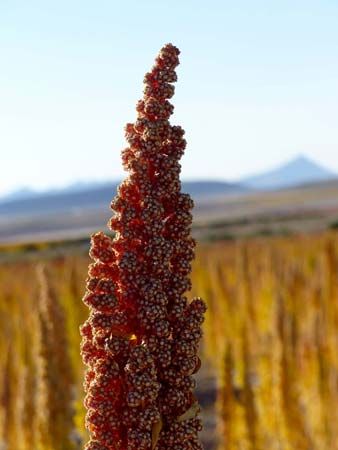
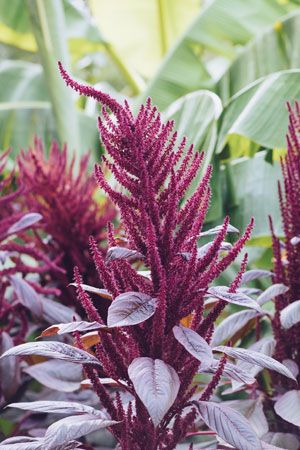
Saltbush
Saltbush refers to any of approximately 300 species of herbs and shrubs belonging to the genus Atriplex within the Amaranthaceae family. These plants are…
What is saltbush?
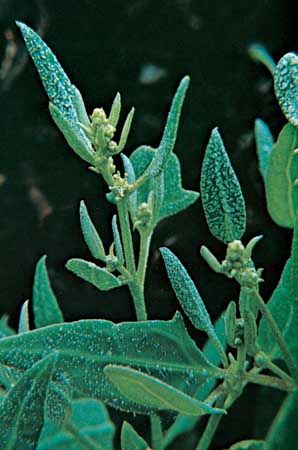
Saltbush refers to any of approximately 300 species of herbs and shrubs belonging to the genus Atriplex within the Amaranthaceae family. These plants are widely distributed throughout temperate and subtropical regions and are notable for their ability to thrive in saline, dry, or alkaline soils.12
Physically, saltbushes can be annuals or perennials with leaves that may appear white, scurfy, or mealy. Their small flowers are typically arranged in spikelike clusters.1
Beyond their ecological role as salt-tolerant shrubs, some species have practical uses. For instance, the young leaves of the garden orach are edible and can be prepared similarly to spinach. In arid regions, various saltbush species serve as important browse plants for animals. Common examples in western North America include the four-wing saltbush (A. canescens) and the spiny saltbush (A. confertifolia).12
How do plants adapt to living in highly saline soil?
Plants that grow in highly saline environments, known as halophytes, have evolved specialized mechanisms to survive conditions that would dehydrate or kill most other vegetation. In saline soils, high salt concentrations create a hyperosmotic environment, which typically draws water out of plant roots through osmosis, leading to dehydration and wilting.45
To counter this, these plants employ several adaptive strategies:
- Osmolyte Synthesis: Plants expend energy to produce organic molecules called osmolytes within their root cells. These molecules help balance internal osmotic pressure, allowing the plant to maintain hydration while effectively excluding salts from the root tissues.4
- Salt Accumulation: Some species, such as glassworts, tolerate high salinity by actively accumulating salts within their own leaves and stems, sequestering the ions to prevent interference with cellular functions.6
- Salt Excretion: Certain plants possess specialized structures known as salt glands, which are capable of excreting concentrated salt solutions to maintain internal balance.7
These adaptations allow halophytes to thrive in environments like salt marshes, where they manage the constant challenge of saline water and limited oxygen.6
What are some other examples of edible wild plants?
Beyond the saltbush mentioned previously, there are several other plants that can be foraged or found in the wild for culinary use. It is essential to note that expert identification is always required, as some edible plants have toxic look-alikes.
- Watercress (Nasturtium officinale): A hardy, creeping perennial native to Europe that has become naturalized in streams, pools, and ditches worldwide. Its piquant young leaves are popular in salads and as sandwich fillings.10
- Garden Cress (Lepidium sativum): Often found growing as a weed, this fast-growing plant is frequently used for its seedlings, which serve as a flavorful garnish.10
- Winter Cress (Barbarea vulgaris): Also known as yellow rocket, this common weed is easily identified in fields by its bright yellow spring flowers.10
- Minari (Oenanthe javanica): This plant is widely consumed, but caution is vital. Because it belongs to the carrot family, it can be easily confused with species like O. crocata, which contain potent neurotoxins. Foraging for this plant is generally discouraged in favor of obtaining it from cultivated sources.11
Why is the Amaranthaceae family important to ecosystems?
The Amaranthaceae family plays a significant role in ecosystems primarily due to its remarkable physiological adaptations and its status as a major group of C4 plants. By utilizing the C4 carbon fixation pathway, these plants are highly efficient at photosynthesizing in environments with high temperatures and limited water, which grants them superior drought tolerance compared to many other species.1213
Their ecological importance is further defined by:
- Saline Soil Tolerance: Many members of the family are well-adapted to poor, saline soils, allowing them to colonize and stabilize environments where other vegetation might struggle to survive.1412
- Biodiversity and Distribution: With approximately 2,500 species distributed worldwide, they contribute to the floral diversity of various habitats, ranging from waste areas to specialized saline ecosystems.1412
- Agricultural and Nutritional Value: Beyond their wild ecological roles, the family includes essential food crops like quinoa, beets, and spinach, which are valued for their high protein and nutrient density.1213
While some species are beneficial, others are considered competitive weeds or invasive species that can challenge agricultural systems due to their resilience and ability to develop herbicide resistance.13
Sources
- saltbush — Encyclopædia Britannica
- saltbush — Merriam-Webster
- Atriplex — Merriam-Webster
- Biosphere - Salinity — Encyclopædia Britannica
- Salt marsh — Encyclopædia Britannica
- Osmotic pressure — Encyclopædia Britannica
- salt gland — Merriam-Webster
- salinity — Encyclopædia Britannica
- sodium - Biological properties — Encyclopædia Britannica
- cress — Encyclopædia Britannica
- minari: Top Questions — Encyclopædia Britannica
- list of plants in the family Amaranthaceae — Encyclopædia Britannica
- Amaranthaceae — Encyclopædia Britannica
- Amaranth — Encyclopædia Britannica
Published on · 3 min read