Blue Sheep
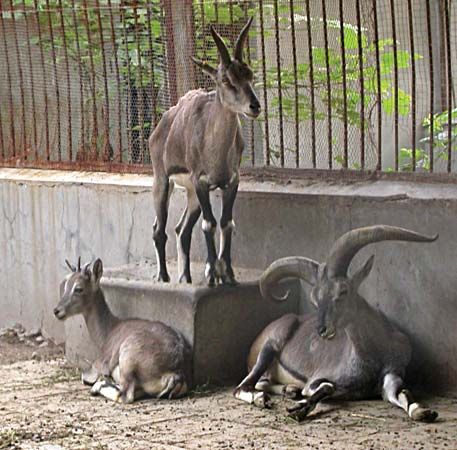
Blue sheep (Pseudois nayaur) are not true sheep but are caprines more closely related to goats. They have evolved specific adaptations to survive in the…
What are the unique adaptations of blue sheep that help them survive in their habitat?
Blue sheep (Pseudois nayaur) are not true sheep but are caprines more closely related to goats. They have evolved specific adaptations to survive in the harsh, high-altitude environments of China and the Himalayas.1
Key adaptations include:
- Predator Evasion: Blue sheep inhabit treeless slopes, alpine meadows, and shrub zones near cliffs. These rocky areas serve as vital escape routes, and the animals rarely venture more than 200 meters from these protective retreats.1
- Convergent Evolution: Because they occupy habitats typically used by sheep, they have developed anatomical and behavioral traits similar to Ovis, such as the lack of a beard and the absence of knee calluses or strong body odor.1
- Goat-like Features: Retaining traits from their goat ancestry, they possess large dew claws and conspicuous markings on their forelegs, which assist in navigating their rugged terrain.1
- Environmental Resilience: The species is highly adaptable, ranging from gentle hillsides to the steep, arid, and barren slopes of the Yangtze River gorge, where the dwarf blue sheep (P. schaeferi) resides.1
How do blue sheep interact with other species in their habitat, including predators?
Blue sheep (Pseudois nayaur) interact with their environment primarily by utilizing specific terrain to manage their safety. Their most significant interaction regarding predators is their reliance on proximity to rocky cliffs, which serve as essential escape routes. These animals rarely venture more than 200 meters from such rocky retreats, ensuring they can quickly reach safety when threatened.1
Beyond predator avoidance, blue sheep live in social groups within alpine meadows, shrub zones, and on gentle hillsides where they graze on grasses and sedges. While they share these habitats with other species, their primary negative interaction is with humans. Hunting, particularly by and for foreigners, has historically impacted their populations; commercial hunting in the Chinese province of Qinghai once led to significant exports for luxury markets, and trophy hunting of mature males continues to alter the age structure of some populations.1
What are the main threats to blue sheep populations in the wild?
The primary threats to blue sheep populations are driven by human activity rather than natural environmental factors. The most significant pressures include:
- Commercial Hunting: Historically, large-scale commercial hunting has severely impacted populations. For example, between the 1960s and 1980s, massive quantities of blue sheep meat were exported from the Chinese province of Qinghai to supply luxury markets in Europe, particularly Germany.1
- Subsistence Hunting: Even local subsistence hunting has become increasingly destructive due to the widespread use of modern firearms, which significantly increases the efficiency and impact of the harvest.1
- Trophy Hunting: The practice of allowing foreign tourists to hunt mature males has negatively altered the age structure of certain populations, potentially disrupting natural social and reproductive dynamics.1
Despite these pressures, blue sheep remain widespread and are considered abundant in some regions.1
How do blue sheep compare to other wild sheep species in terms of behavior and habitat?
Blue sheep (Pseudois) are often misidentified; despite their name, they are not true sheep (Ovis) but are more closely related to goats (Capra)1. Their unique characteristics arise from convergent evolution, where they developed traits similar to sheep due to occupying similar environments.1
Behavioral and Habitat Comparisons
- Habitat Preference: While goats typically inhabit steep, rugged cliffs, blue sheep prefer gentler terrain such as alpine meadows, shrub zones, and treeless slopes. Their habitat choice is distinctly sheeplike, as they rarely venture more than 200 meters from rocky cliffs, which they use as essential escape routes from predators.1
- Anatomy and Social Traits: Blue sheep exhibit a blend of traits. Like sheep, they lack beards, knee calluses, and strong body odors. However, they share goatlike features such as a flat, broad tail with a bare underside, prominent foreleg markings, and large dewclaws.1
- Evolutionary Context: Molecular and chromosomal analyses confirm that blue sheep diverged early from the ancestral caprine stock. Their adaptation to sheep-occupied habitats led to the development of Ovis-like behaviors, which historically obscured their closer genetic affinity to goats.1
We could dive deeper into the specific evolutionary biology of the Caprinae subfamily if you are interested.
Sources
- blue sheep — Encyclopædia Britannica
Published on · 3 min read