Blesbok
The blesbok (Damaliscus pygargus phillipsi) is a species of antelope native to the treeless Highveld of South Africa. Historically, these animals were…
Where is the natural habitat of the blesbok, and what is its distribution?
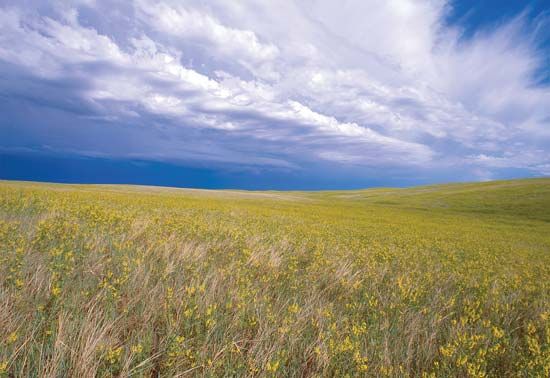
The blesbok (Damaliscus pygargus phillipsi) is a species of antelope native to the treeless Highveld of South Africa1. Historically, these animals were migratory, grazing on the region’s sweetveld grasses during the rainy season and moving to sourveld grasslands in the dry season.1
Following a period in the mid-19th century when they were hunted nearly to extinction, blesbok populations have recovered significantly through reintroduction efforts. Today, they are among the most abundant antelopes in South Africa, though they no longer exist as free-ranging migratory populations. Because the Highveld has been settled and divided into fenced ranches, the species is now distributed across separate, often inbred units on private farms and protected areas throughout and beyond its former range.1
How have blesboks been historically important to humans, particularly in South Africa?
Historically, the blesbok has played a significant role in the landscape and economy of South Africa. During the mid-19th century, these antelopes were a dominant feature of the Highveld, existing in “countless thousands” and serving as a vital component of the region’s grassland ecosystem.1
Their relationship with humans shifted dramatically during this period, as they were hunted nearly to extinction. This decline was a consequence of the intense pressure placed on native herbivores as the Highveld was settled and partitioned into fenced ranches.1
In more recent times, the blesbok has become a symbol of successful conservation and wildlife management. Through extensive reintroduction efforts, the species has recovered to become one of the most abundant antelopes in the country. Today, they are primarily managed on private farms and protected areas, where they contribute to the biodiversity and economic value of these lands. The name itself reflects this cultural integration, derived from the Afrikaans words bles (blaze) and bok (antelope), highlighting the animal’s distinctive facial markings.12
What are the physical characteristics of the blesbok?
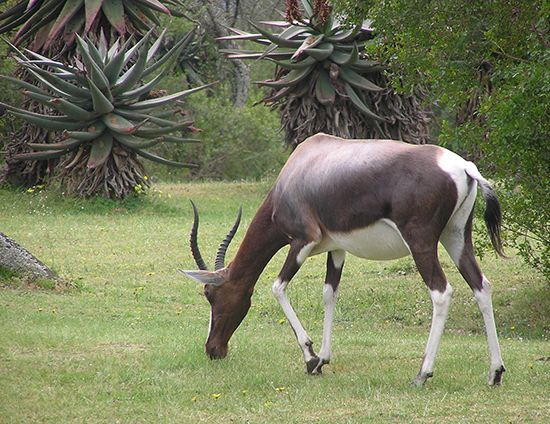
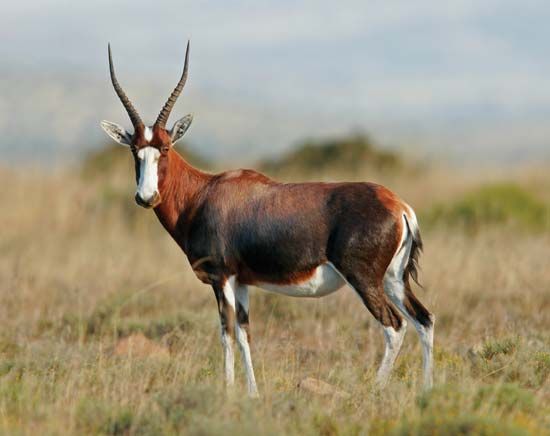
The blesbok (Damaliscus pygargus phillipsi) is the smallest member of the hartebeest tribe, characterized by the following physical traits:
- Size and Weight: Adults stand approximately 85–100 cm (33–39 inches) tall at the shoulder and weigh between 55 and 80 kg (120–175 pounds).1
- Coat: The animal possesses a glossy, dark reddish-brown coat. This color provides a striking contrast to the white markings found on its belly, lower legs, and the distinctive facial blaze.1
- Horns: Both sexes possess S-shaped horns. The male’s horns are typically 35–50 cm (14–20 inches) long, while the female’s horns are generally thinner and shorter.1
- Calves: Newborn calves are light tan in color and already display the characteristic dark facial blazes.1
As a member of the antelope family, the blesbok is known for being one of the more colorful species in its group, though it is slightly less vibrant than its close relative, the bontebok.1
What is the scientific classification of the blesbok?
The scientific classification of the blesbok is Damaliscus pygargus phillipsi.1
It is a member of the hartebeest tribe and is closely related to the bontebok (Damaliscus pygargus dorcas), which is considered an isolated subspecies.1
Sources
- blesbok — Encyclopædia Britannica
- blesbok — Merriam-Webster
- springbok — Encyclopædia Britannica
Published on · 2 min read