Australian Christmas Tree
The term "Australian Christmas tree" most commonly refers to Nuytsia floribunda, a parasitic species in the mistletoe family (Loranthaceae) native to Western…
What is Australian Christmas tree?
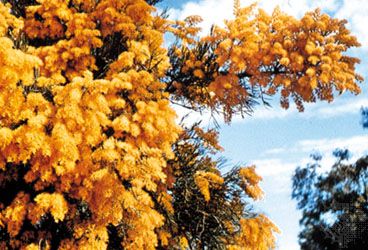
The term “Australian Christmas tree” most commonly refers to Nuytsia floribunda, a parasitic species in the mistletoe family (Loranthaceae) native to Western Australia. It is known for reaching heights of 10 meters (33 feet) and producing vibrant yellow-orange flowers during the Christmas season.1
This tree is biologically unique because it uses haustoria to attach to the roots of neighboring plants, such as grasses, to extract water and nutrients. This aggressive root behavior is so powerful that it can even damage underground cables.1
It is important to note that the name is sometimes also applied to the “Christmas bush” (Ceratopetalum gummiferum), a member of the Cunoniaceae family often used in holiday decorations.2
How does a parasitic plant obtain nutrients from its host?
Parasitic plants obtain nutrients and water from a host through a specialized organ called a haustorium. This structure, which can develop from either the stem or root of the parasite, penetrates the tissues of the host plant to establish a direct vascular union.34
Once this connection is formed, the parasite redirects the host’s resources to support its own growth. The level of dependence varies by species:3
- Hemiparasites: These plants retain some ability to photosynthesize but rely on the host primarily for water and mineral nutrients.4
- Holoparasites: These are nonphotosynthetic and depend entirely on the host for all their nutritional needs.4
To ensure survival, many parasitic plants have evolved sophisticated mechanisms to identify and attach to suitable hosts, such as detecting specific chemical signals (like strigolactones) released by host roots or using volatile chemicals to orient their growth toward a host.4
We could dive deeper into the specific agricultural impact of parasitic weeds like witchweed or broomrapes, or perhaps discuss the evolutionary transition from autotrophy to heterotrophy.
What are some other unique plants native to Western Australia?
Western Australia is a global biodiversity hotspot, home to over 10,000 species of vascular plants, with approximately one-third being endemic to the region. The state’s diverse landscape supports a wide array of unique flora:5
- Kangaroo Paws: The red-and-green kangaroo paw (Anigozanthos manglesii) is the state flower of Western Australia. These sedgelike herbs are known for their distinctive, woolly, clustered flowers.67
- Boab Tree: Found in the Kimberley region, the boab is a moisture-storing tree with close affinities to the baobabs of Africa and India.5
- Eucalypt Forests: The Yilgarn block contains true forests dominated by eucalypts, including the jarrah (E. marginata), marri (E. calophylla), and the towering karri, which can reach heights of up to 85 meters (275 feet).5
- Shrublands: The arid regions feature extensive acacia shrublands and mallee scrubland, while the Nullarbor Plain is characterized by saltbush and bluebush.5
- Spinifex: This grass is ubiquitous across the northern and central desert regions of the state.5
Why do some plants evolve to become parasitic?
Plants evolve to become parasitic through an evolutionary transition from autotrophy (self-feeding) to heterotrophy, a process that has occurred independently about 12 times among angiosperms. This shift allows these plants to bypass the energy-intensive requirements of independent survival by tapping into the resources of a host.4
The evolution of parasitism is driven by the survival advantages of accessing a direct, reliable source of water and nutrients. This transition has led to significant morphological changes:
- Specialized Organs: The development of the haustorium is the defining structural adaptation, allowing the parasite to penetrate host tissues and form a vascular union.43
- Reduced Structures: In holoparasites—which are entirely dependent on their hosts—leaves and root systems are often reduced or absent because they are no longer necessary for photosynthesis or soil absorption.4
- Host Recognition: Parasites have evolved sophisticated mechanisms to detect hosts, such as sensing chemical signals like strigolactones or using volatile chemicals to orient their growth.4
We could dive deeper into the specific evolutionary pressures that favor hemiparasitism versus holoparasitism, or explore the complex life cycles of obligate parasites.
Sources
- Australian Christmas tree — Encyclopædia Britannica
- Christmas bush — Merriam-Webster
- haustorium — Encyclopædia Britannica
- parasitic plant — Encyclopædia Britannica
- Australia - Plant life — Encyclopædia Britannica
- Western Australia - Plant and animal life — Encyclopædia Britannica
- kangaroo paw — Merriam-Webster
- Western Australia: Country Facts — Encyclopædia Britannica
- kangaroo's-foot — Merriam-Webster
- Floristic region — Encyclopædia Britannica
- parasitism — Encyclopædia Britannica
Published on · 3 min read