Australopithecus Sediba
Australopithecus sediba is distinguished by a unique "mosaic" of primitive, apelike traits and derived, humanlike characteristics that suggest it was an…
What are the key physical characteristics of Australopithecus sediba that make it unique among early hominins?
Australopithecus sediba is distinguished by a unique “mosaic” of primitive, apelike traits and derived, humanlike characteristics that suggest it was an intermediate form between earlier australopiths and the genus Homo.12
Key physical characteristics include:
- Hand and Wrist: Unlike earlier australopiths with long, robust fingers, A. sediba possessed shorter fingers and an elongated thumb. This structure likely provided the dexterity required for tool manipulation while retaining the ability to climb trees efficiently.12
- Pelvis: The pelvis is short, curved, and broad, similar to Homo. Notably, these modern features developed before significant brain expansion, suggesting that pelvic evolution was driven by the requirements of bipedal locomotion rather than the need to birth larger-brained offspring.2
- Skull and Brain: While the brain volume remained small, the braincase showed a shift toward a more humanlike frontal lobe, with structures similar to modern humans.2
- Lower Body: The foot and ankle indicate a dual adaptation for both bipedalism and arboreal life, featuring a primitive, apelike heel alongside a foot arch and robust Achilles tendon.2
How many individual specimens of Australopithecus sediba have been found so far?
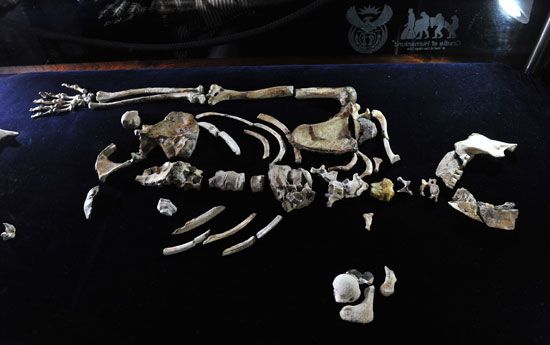
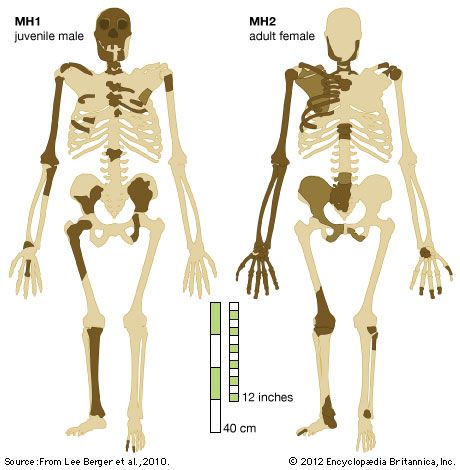
To date, two primary partial skeletons of Australopithecus sediba have been identified and documented in the scientific literature.12
These two specimens were discovered in the Malapa Cave system in South Africa:2
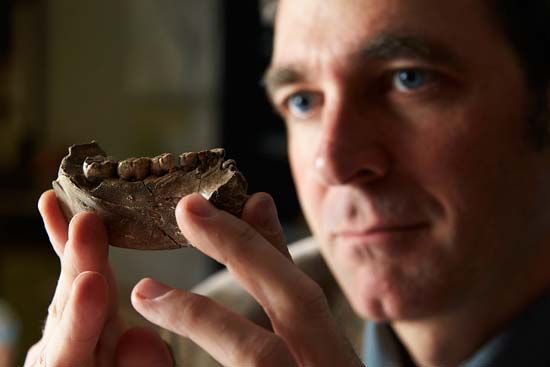
- MH1 (Malapa Hominin 1): A juvenile male, often referred to by the nickname “Karabo,” which consists of a fossilized jawbone, collarbone, and other associated remains.12
- MH2 (Malapa Hominin 2): An adult female, which includes a nearly complete arm and hand, as well as portions of the pelvis, foot, and leg.12
These findings are significant because they represent some of the most complete remains of an extinct hominin ever discovered, providing researchers with a unique opportunity to study the species’ mosaic of primitive and humanlike physical traits.12
How has the discovery of Australopithecus sediba impacted our understanding of human evolution?
The discovery of Australopithecus sediba has significantly influenced the study of paleoanthropology by providing a unique “mosaic” of traits that bridge the gap between earlier australopiths and the genus Homo.1
Its impact on our understanding of human evolution includes:
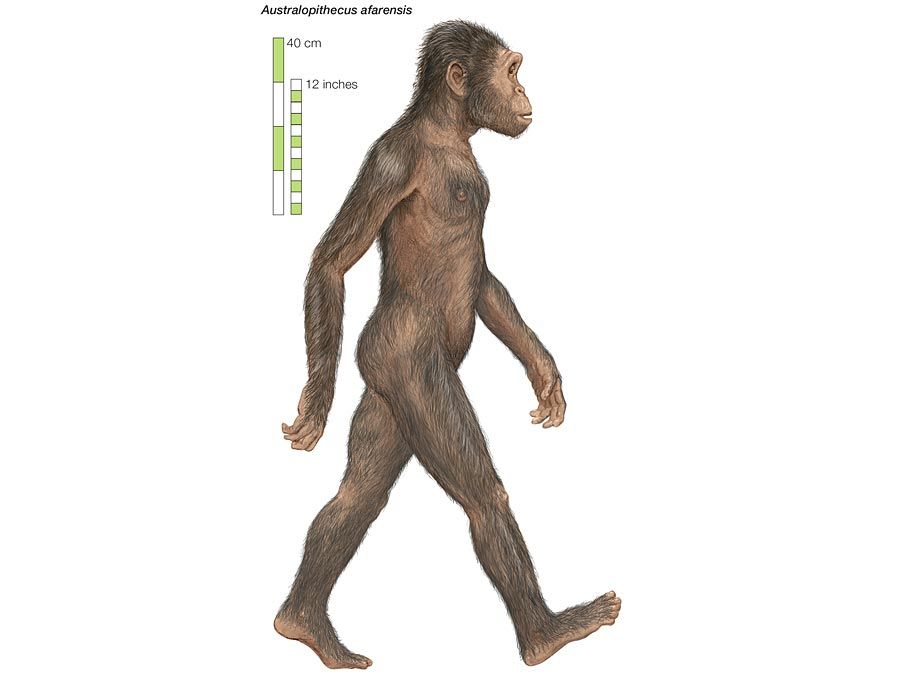
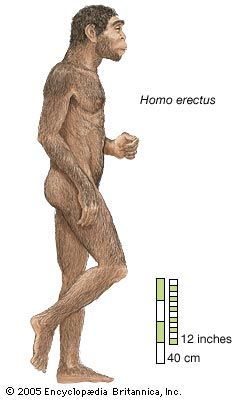
- Ancestral Debates: The species shares facial and dental similarities with A. africanus, suggesting it may be a direct descendant. Furthermore, because it possesses humanlike features in the pelvis, limbs, and skull—many of which are also found in H. erectus—some researchers propose it could be a direct ancestor to the human lineage.1
- Tool Use Potential: The discovery of a nearly complete hand and wrist, featuring shorter fingers and an elongated thumb, suggests that A. sediba may have possessed the dexterity required to create and utilize simple stone tools.1
- Scientific Contention: The find has sparked debate; while some view it as a pivotal link to Homo, others argue it may have been a contemporary of the true ancestors of Homo rather than a direct precursor.1
What methods were used to date the Australopithecus sediba fossils?
Because the Australopithecus sediba fossils themselves were too old to be dated directly, researchers determined their age by analyzing the surrounding geological context. The fossils were estimated to be approximately 1.977 million years old using the following methods:1
- Uranium-Lead Dating: Scientists dated the uranium-rich flowstone matrix that encased the fossil remains. This uranium-lead dating method is highly valued in geochronology because it utilizes two separate radioactive uranium isotopes, providing a built-in mechanism to verify the accuracy of the age calculation.12
- Paleomagnetic Dating: This process determines the age of a rock by comparing the magnetic orientation of the iron minerals within the rock to the known history of Earth’s magnetic field reversals.1
Sources
- Australopithecus - Australopithecus sediba — Encyclopædia Britannica
- Australopithecus sediba — Encyclopædia Britannica
- dating - Double uranium-lead chronometers — Encyclopædia Britannica
Published on · 3 min read