Lucy
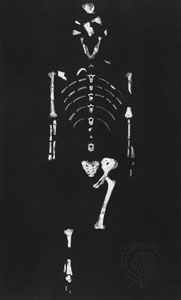
Lucy is the nickname for a remarkably complete, 40-percent-intact hominin skeleton discovered in 1974 by American paleoanthropologist Donald Johanson at the…
What is Lucy?
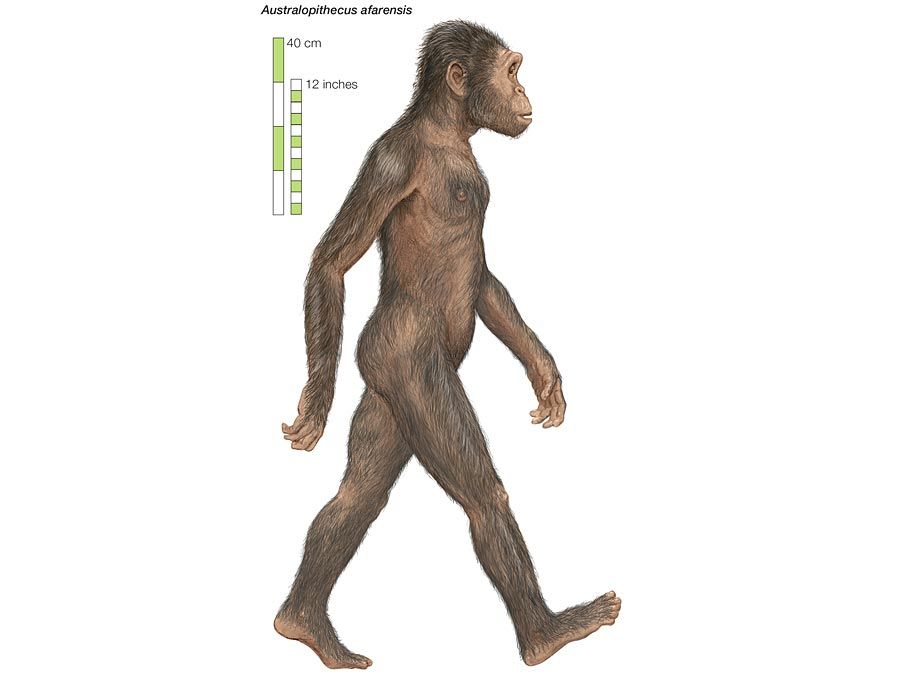
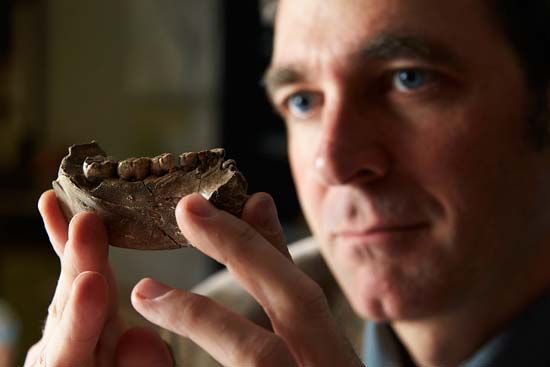
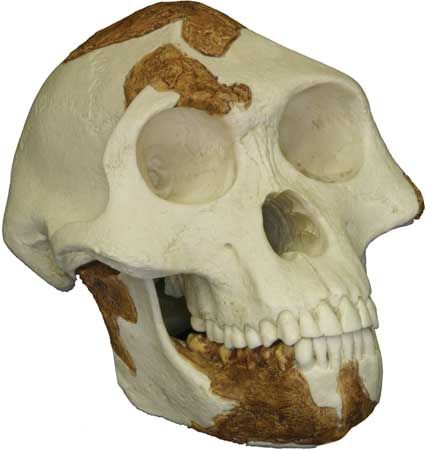
Lucy is the nickname for a remarkably complete, 40-percent-intact hominin skeleton discovered in 1974 by American paleoanthropologist Donald Johanson at the Hadar site in Ethiopia. Dated to 3.2 million years ago, the specimen is classified as Australopithecus afarensis.123
The nickname was inspired by the Beatles song “Lucy in the Sky With Diamonds,” which was played during the celebration following the discovery. Lucy stood approximately 3 feet 7 inches tall and weighed about 60 pounds. Her skeleton provides significant evidence that bipedal locomotion—upright walking—preceded the development of larger, more humanlike brains in hominin evolution. While she possessed apelike features such as long arms, a small brain, and a prognathic face, her pelvis and leg anatomy indicate a humanlike, striding gait.13
Lucy is currently housed at the National Museum of Ethiopia in Addis Ababa.1
What are the Laetoli footprints and why are they important?
The Laetoli footprints are a 27.5-meter (90-foot) trackway discovered at a paleoanthropological site in northern Tanzania. Preserved in volcanic sediments dated to approximately 3.56 million years ago, these tracks were created by three individuals walking at a leisurely pace across moist volcanic ash.45
These footprints are of monumental importance to the study of human evolution for several reasons:
- Evidence of Bipedalism: The tracks provide direct, physical evidence that early hominins—presumably Australopithecus afarensis—were already adept, habitual bipeds millions of years ago.45
- Humanlike Gait: In all observable features of foot shape and walking pattern, the prints are astonishingly similar to those of modern, barefoot humans living in the tropics.5
- Evolutionary Context: While the feet of these hominins appear strikingly human, the tracks remind researchers that other parts of their bodies, such as their upper limbs, retained features suited for arboreal climbing. The discovery confirms that a humanlike, striding gait was established well before the development of larger brains in the human lineage.5
How does sexual dimorphism appear in early hominin species?
Sexual dimorphism—the difference in appearance, such as size and structure, between males and females of the same species—was a marked feature in early hominin species.62
In *Australopithecus afarensis*, for example, this dimorphism was significant: males were substantially larger, weighing 45–68 kg (99–150 pounds) and standing about 151 cm (5 feet) tall, while females weighed approximately 30 kg (66 pounds) and stood about 105 cm (3 feet 5 inches) tall. Similar patterns of pronounced size differences are observed in other early hominins, such as *Ardipithecus ramidus* and *Paranthropus*.2
Evolutionary biologists suggest that such body-size dimorphism is often an adaptation related to the intensity of male-male physical competition for access to females. In contrast, species within the genus *Homo* generally exhibit less sexual dimorphism than earlier australopiths, largely because females in the Homo lineage became relatively larger. For instance, the level of dimorphism in *Australopithecus sediba* has been noted as being more equivalent to that of modern humans.789
What is the significance of the First Family fossil discovery?
The “First Family” is a significant paleoanthropological discovery consisting of the remains of at least nine adults and four juveniles of the species Australopithecus afarensis, all found buried together at the Hadar site in Ethiopia.10
Discovered in 1975 by paleoanthropologist Donald Johanson, the collection is vital to scientific research for several reasons:
- Life Stage Diversity: Because the site contains individuals spanning a variety of life stages, it provides researchers with a unique opportunity to study growth, development, and age-related variation within a single early hominin population.2
- Population Insight: The recovery of multiple associated skeletal remains from a single geological context helps address the challenge of understanding variation within a species, which is often difficult when relying on isolated fossil finds.3
- Evolutionary Context: As part of the Au. afarensis fossil record, these remains contribute to our broader understanding of a species that possessed a mosaic of apelike and humanlike traits and is considered a key ancestor in the human lineage.10
Sources
- Lucy — Encyclopædia Britannica
- Australopithecus - Australopithecus afarensis and Au. garhi — Encyclopædia Britannica
- Donald Johanson — Encyclopædia Britannica
- Laetoli — Encyclopædia Britannica
- human evolution - The fossil evidence — Encyclopædia Britannica
- Sexual dimorphism — Encyclopædia Britannica
- Australopithecus sediba — Encyclopædia Britannica
- human evolution - Theories of bipedalism — Encyclopædia Britannica
- Animal behaviour - Adaptive design — Encyclopædia Britannica
- Australopithecus - Quality of the fossil record — Encyclopædia Britannica
Published on · 3 min read