Baboon
Baboons are large, robust monkeys belonging to the genus Papio. Their physical characteristics include:
What are the distinguishing physical characteristics of baboons?
Baboons are large, robust monkeys belonging to the genus Papio. Their physical characteristics include:
- Size and Build: They are among the largest monkeys, ranging from 50 to 115 cm (20–45 inches) in length, excluding their tails. Significant sexual dimorphism exists; males are often twice the size of females.1
- Facial Features: All species possess long, prominent snouts. While this structure resembles the muzzles of other mammals, it is considered a dental muzzle in baboons, evolved to accommodate their large jaws and teeth rather than for an enhanced sense of smell.12
- Dentition: Male baboons are distinguished by long, daggerlike canine teeth, which are significantly larger than those of females and serve both protective and threatening functions.13
- Tail: They have tails measuring 45–70 cm, which are characteristically carried in an arch.1
- Coat and Coloration: Appearance varies by species. For example, the chacma baboon is brown or blackish, while the hamadryas baboon displays striking sexual dimorphism: females are brown, whereas males are silvery gray with an enormous cape of hair on the neck and shoulders.1
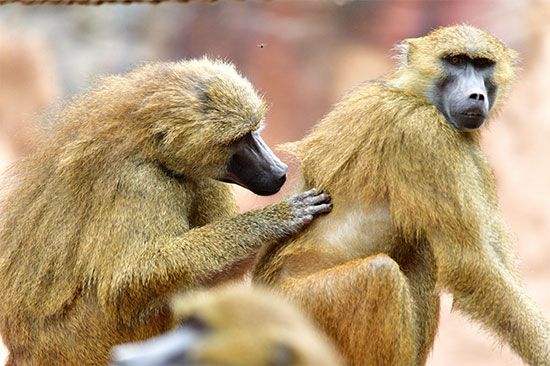
Where are baboons primarily found in the wild, and what types of habitats do they prefer?
Baboons are primarily found in the dry regions of Africa and Arabia, ranging from parts of the Sahara southward across the continent.1
Unlike many other primates that inhabit tropical forests, most baboons are terrestrial, preferring savanna and semiarid environments where they spend much of their time on the ground. Their specific habitat preferences include:14
- Savanna and Grasslands: Most species, collectively known as savannah baboons, inhabit open country, grasslands, and the Sahel.1
- Semidesert and Highlands: The hamadryas baboon is typically found in semidesert hills along the coasts of the Red Sea. Other populations, such as the olive baboon, occupy less-arid highlands, including areas like Tibesti and Aïr.1
- Montane Regions: Some baboons have adapted to rugged, high-altitude mountainous terrain and moorlands, where they navigate seasonal food scarcity.4
While they are primarily ground-dwelling, they regularly climb trees to sleep, keep watch, or feed, though hamadryas baboons notably prefer sleeping on cliffs rather than in trees.1
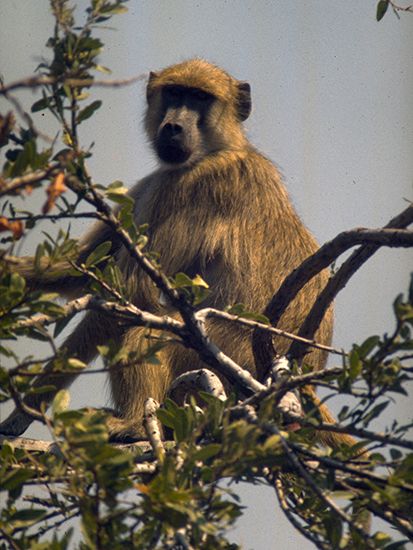
What are the different species of baboons, and how do they differ from one another?
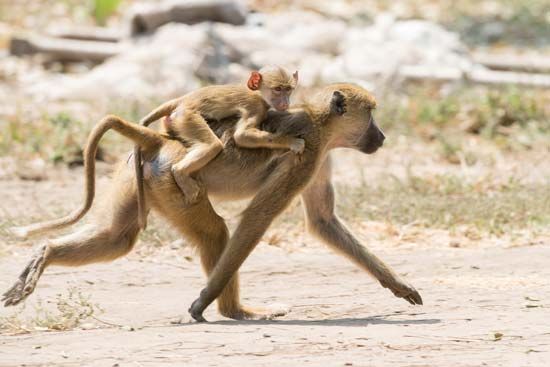
There are five recognized species of baboons (genus Papio), which are large, robust, and primarily terrestrial monkeys found across Africa and Arabia. They are generally categorized into four “savannah baboons” and one distinct species, the hamadryas baboon.1
Savannah Baboons
These four species share similar social structures, living in large, cohesive troops with complex dominance hierarchies.1
- Chacma Baboon (P. ursinus): The largest species, found in southern Africa. They are typically brown or blackish in color.1
- Yellow Baboon (P. cynocephalus): A smaller species found from the Zambezi River northward to the Kenya coast and Somalia.1
- Olive Baboon (P. anubis): Named for its olive-colored coat, this species has a wide range from Ethiopia and Kenya westward to Mali. Males possess a large mane of hair over the head and shoulders.1
- Guinea Baboon (P. papio): A small, red-colored species restricted to far western Africa; males feature a cape of hair.1
Hamadryas Baboon (P. hamadryas)
The hamadryas baboon is the smallest species and is physically and behaviorally distinct. Males are silvery gray with an enormous cape of hair, while females are brown. Unlike the cohesive troops of savannah baboons, hamadryas baboons live in smaller, male-led “harems” that congregate on cliffs at night.15
What is a baboon?
A baboon (genus Papio) is any of five species of large, robust, and primarily terrestrial monkeys native to the dry regions of Africa and Arabia.1
Physically, baboons are characterized by long snouts with nostrils at the end and a tail typically carried in an arch. Males are significantly larger than females and possess long, daggerlike canine teeth. They range from 50 to 115 cm (20–45 inches) in length, excluding their tails.1
Unlike most monkeys, baboons primarily inhabit savanna and semiarid regions, where they forage on the ground for a diverse diet of plants, seeds, roots, tubers, and small animals. While they are ground-dwellers, they frequently climb trees to sleep, feed, or keep watch.1
The five species—the chacma, yellow, olive, Guinea, and hamadryas baboons—exhibit complex social structures, typically living in large, hierarchical troops. The hamadryas baboon is the most distinct, known for its unique appearance and cliff-dwelling habits.1
Sources
- baboon — Encyclopædia Britannica
- canine tooth — Encyclopædia Britannica
- primate - Snouts , muzzles, and noses — Encyclopædia Britannica
- primate - Forest and savanna — Encyclopædia Britannica
- hamadryas — Encyclopædia Britannica
Published on · 4 min read