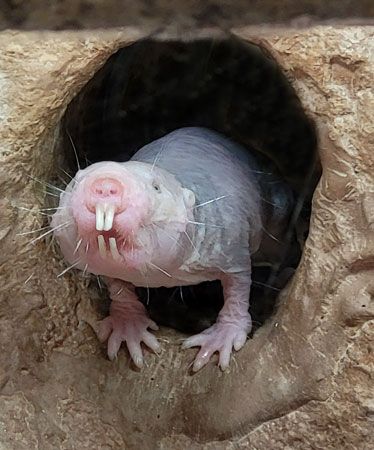
Blind Mole Rat
The blind mole rat (subfamily Spalacinae) contributes to its environment primarily through its extensive burrowing activities. By excavating complex networks…
How do blind mole rats contribute to soil health in their habitats?
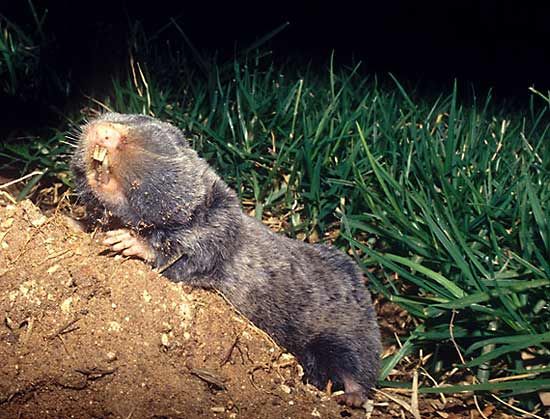
The blind mole rat (subfamily Spalacinae) contributes to its environment primarily through its extensive burrowing activities. By excavating complex networks of tunnels 10 to 25 cm below the surface, these rodents physically turn and aerate the soil.
As they dig, they use their incisors to loosen earth and their heads to bulldoze excess debris onto the surface, creating mounds. This process of moving soil from deeper layers to the surface and creating vertical passageways helps mix soil components and improves aeration within their habitat. Furthermore, the animals construct specific chambers for nesting, food storage, and excreta, which can influence nutrient distribution within the soil profile. While their primary ecological role is defined by these mechanical disturbances to the ground, they are highly specialized for life in various landscapes, including meadows, pastures, and cultivated fields, where their burrowing activity is a constant feature of the local ecosystem.1
How do blind mole rats reproduce and care for their young?
Blind mole rats are solitary and territorial animals that come together specifically for reproduction. During the wet autumn and winter months, females construct large mounds that contain specialized chambers designed for mating and rearing their young.1
The reproductive process is characterized by the following details:
- Gestation: The period of pregnancy lasts approximately one month.1
- Litter Size: Females typically give birth to a litter ranging from one to five offspring.1
- Rearing: The young are raised within the protected, deep-soil chambers built by the female, which are connected to the broader network of tunnels used for food storage and daily activity.1
What are the unique physical characteristics of blind mole rats?
The blind mole rat (subfamily Spalacinae) possesses several specialized physical adaptations suited for its subterranean lifestyle:
- Body Form: They have a cylindrical, furred body with short limbs, measuring 13 to 35 cm in length and weighing between 100 and 570 grams.
- Head and Sensory Features: The head is keeled and wedgelike, featuring a flattened, padded nose. Sensory bristles extend rearward from the nose toward the eyes.
- Eyes and Ears: They appear eyeless and earless because these structures are vestigial and covered by fur. The tiny eyes are hidden beneath the skin, and the external ears are reduced to slight folds.
- Teeth and Limbs: They have prominent, protruding incisor teeth used for digging. Their feet and claws are surprisingly small for such specialized burrowers.
- Tail: They possess a minute, externally invisible tail.
- Fur: The dense, soft fur is typically pale to reddish brown or buff gray on the upperparts, with grayish or buff brown underparts. The front of the head is often paler and may feature white or yellow stripes.
How do blind mole rats differ from other rodents in terms of their social behavior?
Blind mole rats are distinct from many other rodents due to their strictly solitary and territorial nature. While many rodent species live in social groups or colonies, blind mole rats spend their lives in isolation, excavating and maintaining individual networks of tunnels.1
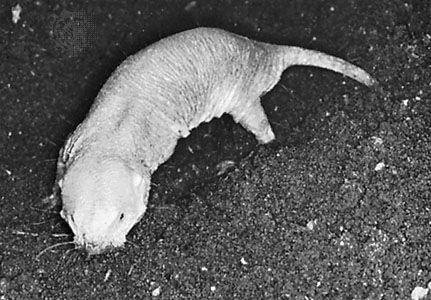
Their social interaction is highly limited, occurring primarily during the mating season. During the wet autumn and winter months, females construct specialized mounds to facilitate reproduction and the rearing of their young. Outside of these brief reproductive periods, they remain solitary, aggressively defending their burrow systems, which they navigate and maintain using their incisors and specialized head-butting behaviors to move soil. This behavior contrasts sharply with the complex social structures found in other subterranean rodents, such as the highly eusocial naked mole rat.1
Sources
- blind mole rat — Encyclopædia Britannica
- naked mole rat — Encyclopædia Britannica
Published on · 3 min read