Back-arc Basin
Geologists study and map back-arc basins—submarine basins formed behind island arcs—using a combination of geophysical, acoustic, and sampling techniques.
What methods do geologists use to study and map back-arc basins?
Geologists study and map back-arc basins—submarine basins formed behind island arcs—using a combination of geophysical, acoustic, and sampling techniques.
Because electromagnetic radiation cannot penetrate deep water, researchers rely on the following methods:
- Acoustic and Seismic Techniques: Multifrequency systems like Seabeam and Gloria allow for accurate two-dimensional mapping of seafloor morphology. These are often used alongside seismic reflection methods, which use sound waves to measure the structure of the Earth’s crust deep below the seafloor.12
- Remote Sensing: Satellite measurements of sea surface topography help map global ocean-bottom features, including seamounts, by correlating surface shape with seafloor gravity.1
- Sampling: Geologists collect physical materials using grabbing devices (snappers), dredges, and coring devices to analyze sediment composition and mineralogy.1
- Borehole Logging: Tools lowered into drill holes measure electrical resistance, acoustic properties, and magnetic or gravitational effects to provide immediate data for analysis.1
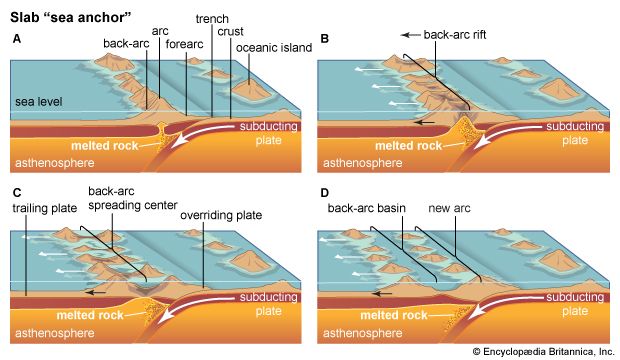
What is a back-arc basin and how does it form in geological settings?
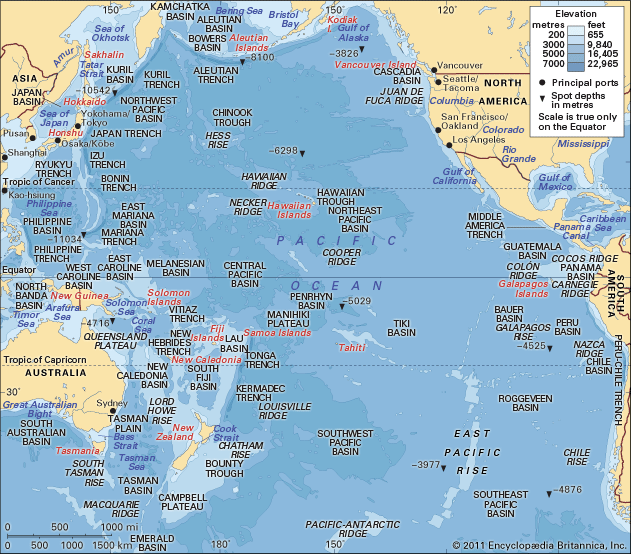
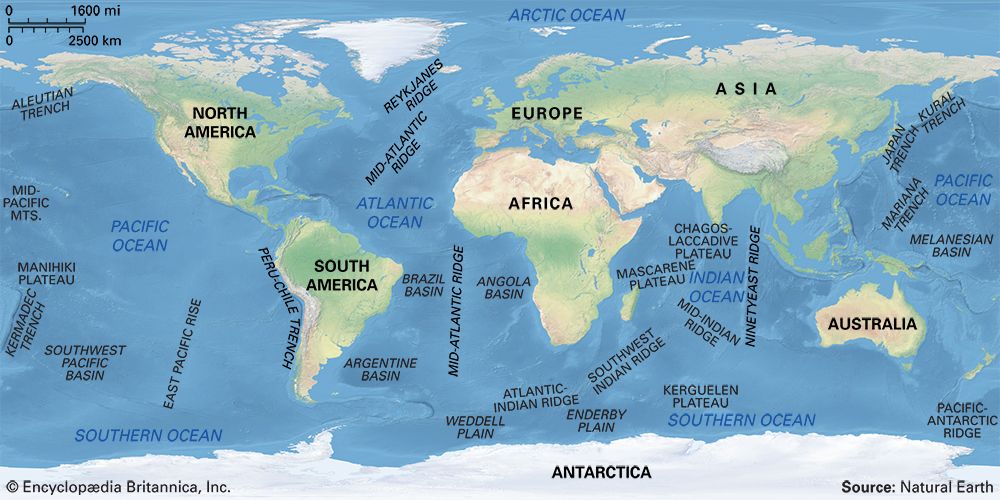
A back-arc basin is a submarine basin that forms behind an island arc at convergent plate boundaries, most notably along the western margin of the Pacific Ocean.15
Formation Process
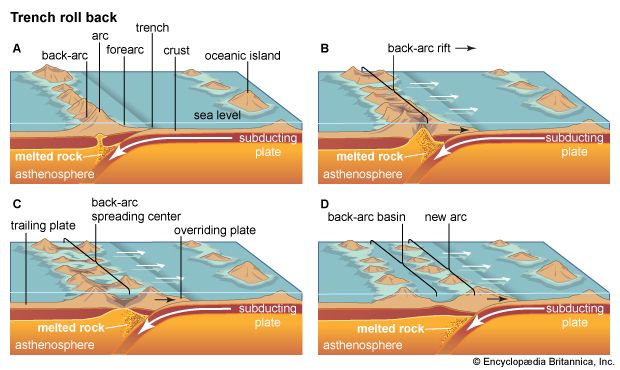
These basins are created through a process called back-arc spreading, which occurs when one oceanic crust plate subducts beneath another. As the older, denser slab sinks into the asthenosphere, it may undergo trench roll-back, causing the overlying plate to stretch and thin.15
This extension triggers several geological events:
- Magmatism: Decompression of the underlying mantle causes melting, producing magma that rises to the surface.15
- Rifting: Rising magma increases pressure, creating rifts in the crust behind the island arc.1
- Spreading: Spreading centres develop within these rifts, widening the seafloor and expanding the basin.15
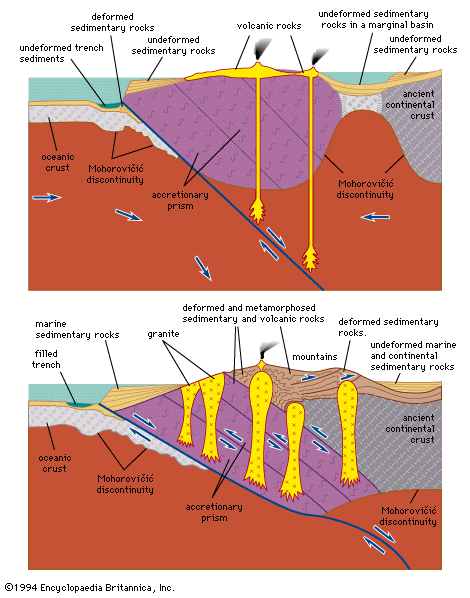
If convergence rates increase or thick crust enters the subduction zone, the slab may flatten, causing the basin to close through deformation and metamorphism.5
How do back-arc basins contribute to our understanding of plate tectonics?
Back-arc basins are essential to our understanding of plate tectonics because they provide critical evidence of the complex dynamics occurring at convergent plate boundaries. By studying these regions, geologists gain insights into several fundamental processes:
- Subduction Dynamics: Back-arc basins demonstrate that subduction is not merely a simple collision; the process of trench roll-back—where a sinking slab retreats oceanward—causes the overriding plate to stretch and thin, leading to back-arc spreading.
- Magmatic Processes: These basins serve as natural laboratories for observing how mantle decompression and subduction-related fluids generate magma. Geochemical analysis of basalts found here helps scientists distinguish between crust formed at oceanic ridges and that influenced by subducted slabs.1
- Ophiolite Identification: The recognition of ophiolites—slices of oceanic crust preserved on land—has been revolutionized by our understanding of back-arc basins. Geochemical data now confirms that many ophiolites originated in these extensional back-arc settings rather than at main ocean ridges, which is vital for reconstructing ancient tectonic environments.6
How do back-arc basins differ from other types of ocean basins?
Back-arc basins differ from other ocean basins, such as those formed at oceanic ridges, primarily in their tectonic setting and formation mechanism. While major ocean basins typically form where tectonic plates diverge, back-arc basins develop at convergent boundaries where one plate subducts beneath another.15
Key distinctions include:
- Tectonic Context: Unlike ocean ridges, which occur at divergent boundaries, back-arc basins form behind an island arc due to the extension of the overriding plate, often triggered by trench roll-back.17
- Spreading Centers: The spreading centres within back-arc basins are significantly shorter than those found along the global mid-ocean ridge system.1
- Geochemical Signature: While both settings produce basalt through mantle melting, the geochemistry of back-arc basin basalts often reveals the subtle influence of fluids derived from the nearby subducted slab, a feature absent in standard mid-ocean ridge basalts.7
- Lifecycle: Back-arc basins are susceptible to closure through deformation and metamorphism if convergence rates increase or thick crust enters the subduction zone, a process not characteristic of stable mid-ocean ridges.7
Sources
- back-arc basin — Encyclopædia Britannica
- undersea exploration - Exploration of the seafloor and the Earth’s crust — Encyclopædia Britannica
- Earth exploration - Seismic reflection methods — Encyclopædia Britannica
- geology - Igneous petrology — Encyclopædia Britannica
- plate tectonics - Back-arc basins — Encyclopædia Britannica
- plate tectonics - Mountains by terrane accretion — Encyclopædia Britannica
- back-arc — Merriam-Webster
Published on · 3 min read