Oceanic Ridge
Oceanic ridges are central to the theory of plate tectonics because they serve as the primary sites where new oceanic crust is created.
How do oceanic ridges contribute to seafloor spreading and plate tectonics?
Oceanic ridges are central to the theory of plate tectonics because they serve as the primary sites where new oceanic crust is created.12
At these submarine mountain systems, molten magma from the Earth’s mantle wells up to the surface. As this material cools, it forms new crust and is pushed laterally away from the ridge axis, a process known as seafloor spreading. This continuous production of crust acts as a conveyor belt, driving the movement of tectonic plates across the planet’s surface.31
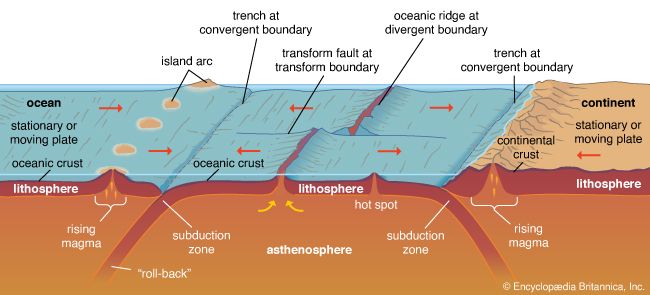
The ridges also contribute to plate motion through a mechanism called “ridge push”. Because the crust at the ridge is hot and elevated, it is buoyant; as it moves away and cools, it becomes denser and contracts. The resulting gravitational force pushes the plates away from the ridge, facilitating the divergence of tectonic plates. This process is intrinsically linked to the global cycle of crustal creation at ridges and destruction at subduction zones.4123
What are some of the most notable oceanic ridge systems in the world?
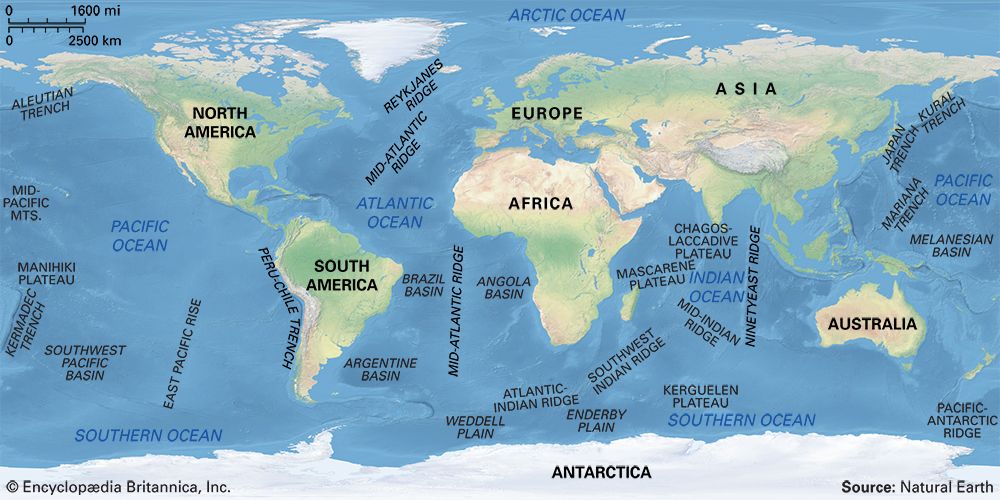
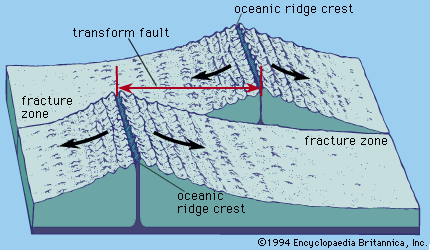
The global oceanic ridge system is a vast, interconnected network of submarine mountain chains extending approximately 80,000 km (50,000 miles) across the world’s oceans. These ridges are the primary sites of seafloor spreading, where new crust is continuously formed.564
Some of the most notable systems include:
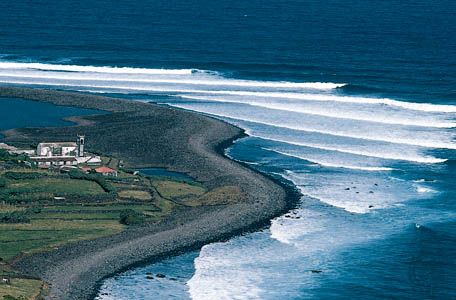
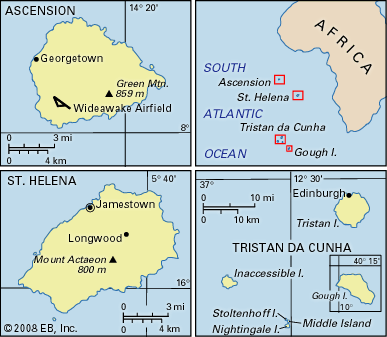
- Mid-Atlantic Ridge: An immense, slow-spreading mountain chain that bisects the Atlantic Ocean from the Arctic to near the southern tip of Africa. It reaches up to 1,000 miles in width and occasionally rises above sea level to form islands such as the Azores and Tristan da Cunha.789
- East Pacific Rise: A fast-spreading, linear volcanic chain in the southeastern Pacific. Unlike the Mid-Atlantic Ridge, it is not centrally located in its basin and features a relatively smooth surface with an axial high rather than a deep rift valley.645
- Indian Ocean Ridge System: This complex system forms an inverted “Y” shape on the seafloor. It includes the slow-spreading Southwest Indian Ridge, the Mid-Indian Ridge, and the Southeast Indian Ridge, which exhibits distinct asymmetric spreading.1011
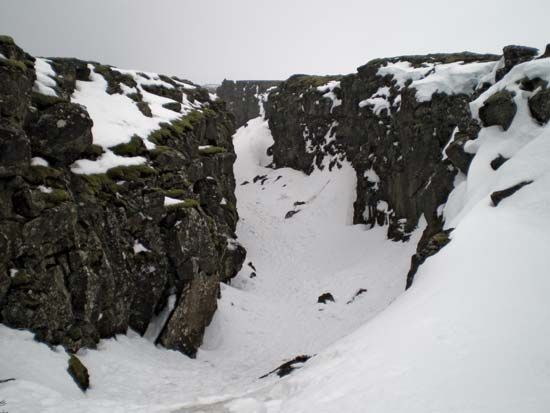
- Reykjanes Ridge: An extension of the Mid-Atlantic Ridge south of Iceland. Despite its slow spreading rate, it lacks a typical rift valley, likely due to the influence of a nearby hot spot.12
How do earthquakes and volcanic activity relate to oceanic ridges?
Oceanic ridges are fundamental to plate tectonics as they function as divergent plate boundaries where new oceanic crust is continuously created. This process, known as seafloor spreading, is intimately linked to both volcanic and seismic activity.11314
Volcanic Activity
As tectonic plates move apart, magma from the Earth’s mantle rises to fill the gap, resulting in extensive volcanism. to fill the gap, resulting in extensive volcanism. While most of this activity occurs underwater and is difficult to observe, it is characterized by the eruption of basaltic lavas. In rare instances, such as in Iceland, these ridges rise above sea level, allowing for subaerial volcanic eruptions.131543
Seismic Activity
Earthquakes are common along the crests of oceanic ridges and within the transform faults that offset ridge segments. These seismic events are typically shallow, occurring as the crust repeatedly rifts, heals, and rifts again due to the tension generated by divergent forces. Unlike the deep-focus earthquakes found at subduction zones, the high heat flow at ridge crests limits the depth at which brittle, earthquake-prone rocks can exist.16113
How have oceanic ridges influenced the evolution of marine life over geological time?
Oceanic ridges have significantly influenced the evolution of marine life through two primary mechanisms: the creation of unique deep-sea ecosystems and the long-term tectonic restructuring of the planet.
Chemosynthetic Ecosystems
The discovery of hydrothermal vents along spreading ridges revealed ecosystems that are entirely independent of the Sun. Unlike most life on Earth, these communities rely on chemosynthesis, where bacteria derive chemical energy by oxidizing hydrogen sulfide from vent fluids. This process supports a diverse array of specialized organisms, including bivalves, crabs, and vestimentiferan worms, many of which maintain symbiotic relationships with these bacteria. Some scientists speculate that these environments may have played a critical role in the origin of life on Earth or have exerted a cumulative influence on evolutionary history.1819208
Tectonic and Environmental Change
On a broader scale, oceanic ridges drive plate tectonics, which continuously rearranges ocean basins and continents. This movement alters ocean circulation and climate, which are major drivers of biological development. For instance, periods of high global spreading rates can cause sea levels to rise, leading to the transgression of ocean waters onto continents and creating new marine habitats. Furthermore, the fragmentation and dispersal of continents—facilitated by ridge activity—have been linked to increased biological diversity over geologic time18.183
Sources
- plate tectonics - Seafloor spreading — Encyclopædia Britannica
- How do tectonic plates move? — Encyclopædia Britannica
- seafloor spreading — Encyclopædia Britannica
- oceanic ridge - Principal characteristics — Encyclopædia Britannica
- East Pacific Rise — Encyclopædia Britannica
- oceanic ridge - Indian Ocean — Encyclopædia Britannica
- oceanic ridge - Atlantic Ocean — Encyclopædia Britannica
- Mid-Atlantic Ridge — Encyclopædia Britannica
- oceanic ridge — Encyclopædia Britannica
- oceanic ridge - Distribution of major ridges and spreading centres — Encyclopædia Britannica
- Indian Ocean - Oceanic ridges and fracture zones — Encyclopædia Britannica
- Atlantic Ocean: Top Questions — Encyclopædia Britannica
- volcanism — Encyclopædia Britannica
- earthquake - Tectonic associations — Encyclopædia Britannica
- igneous rock - Divergent plate boundaries — Encyclopædia Britannica
- oceanic ridge - Hydrothermal vents — Encyclopædia Britannica
- volcano - Volcanoes related to plate boundaries — Encyclopædia Britannica
- plate tectonics - Life — Encyclopædia Britannica
- Marine ecosystem - Organisms of the deep-sea vents — Encyclopædia Britannica
- deep-sea vent — Encyclopædia Britannica
Published on · 4 min read