Oceanic Trough
An oceanic trough is an elongate depression in the seafloor characterized by being shallower, shorter, narrower, and topographically gentler than oceanic…
What is oceanic trough?
An oceanic trough is an elongate depression in the seafloor characterized by being shallower, shorter, narrower, and topographically gentler than oceanic trenches. While trenches are typically associated with subduction zones, oceanic troughs originate from a wide variety of geologic mechanisms.1
Key characteristics of oceanic troughs include:
- Dimensions: Lengths typically range from 270 to 2,300 km, with an average of about 700 km. Widths average approximately 50 km.1
- Depth: While some reach depths of over 7,000 meters, most have maximum depths between 4 and 5 km below sea level.1
- Variability: Some features, such as the Laurentian Trough, are classified as glacial troughs formed by glacial activity, while others, like the Mariana Trough, function as back-arc basins created by seafloor spreading.123
Unlike the V-shaped, sediment-scarce axes of deep-sea trenches, troughs exhibit diverse topographic profiles and origins.124
How do oceanic trenches differ from oceanic troughs in their formation?
Oceanic trenches and oceanic troughs differ significantly in their formation and geological characteristics.
Oceanic Trenches
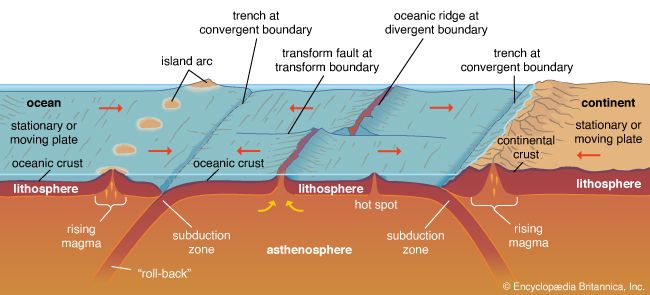
Oceanic trenches are primarily formed by subduction zones, where a dense lithospheric plate underthrusts another plate and descends into the asthenosphere. This process is characterized by:32
- Seismicity: Trenches are associated with distinct zones of earthquake activity that define the path of the descending plate.3
- Gravity Anomalies: They exhibit negative gravity anomalies, indicating that the crust is being forced downward against buoyant isostatic forces3.
- Sediment Scarcity: Because the seafloor is actively plunging into the Earth’s interior, large quantities of sediment cannot accumulate; they are either dragged down or scraped off to form an accretionary prism.31
Oceanic Troughs
In contrast, oceanic troughs are not defined by a single tectonic process. While some, such as back-arc basins, may be related to seafloor spreading, others originate from a wide variety of geologic mechanisms, including glacial activity or rift valley formation. They are generally shallower, shorter, and topographically gentler than trenches and lack the consistent V-shaped, subduction-driven profile.15
What is a subduction zone and how does it create deep-sea trenches?
A subduction zone is a region along the margins of ocean basins where a denser lithospheric plate underthrusts a less-dense plate, dragging it downward into the Earth’s upper mantle. This process is the primary mechanism for the formation of deep-sea trenches.53
How Trenches Are Created
Deep-sea trenches serve as the topographic expression of the subduction process. Their formation involves several key factors:2
- Frictional Drag: As the descending oceanic plate bends and plunges into the asthenosphere, frictional drag between the plates creates a deep, V-shaped depression.63
- Gravity Anomalies: Measurements show that gravity is lower than normal at these sites, indicating that the lithosphere is being forced downward against buoyant isostatic forces.2
- Sediment Dynamics: Trenches remain deep because large quantities of sediment cannot accumulate; they are either dragged into the Earth’s interior or scraped off to form an accretionary prism on the overriding plate.26
- Seismicity: The descent of the cold, rigid slab is marked by a plane of earthquakes known as the Wadati-Benioff zone, which confirms the plate’s movement into the mantle.23
What are some examples of major oceanic troughs found on Earth?
Oceanic troughs are elongate seafloor depressions that are generally shallower, shorter, and topographically gentler than oceanic trenches. While they originate from a variety of geologic mechanisms rather than a single process, several notable examples exist:
- Papuan Trough: Reaches a maximal depth of approximately 2,300 meters (7,500 feet).
- Banda Trough: A significantly deeper feature with a maximal depth of about 7,440 meters.
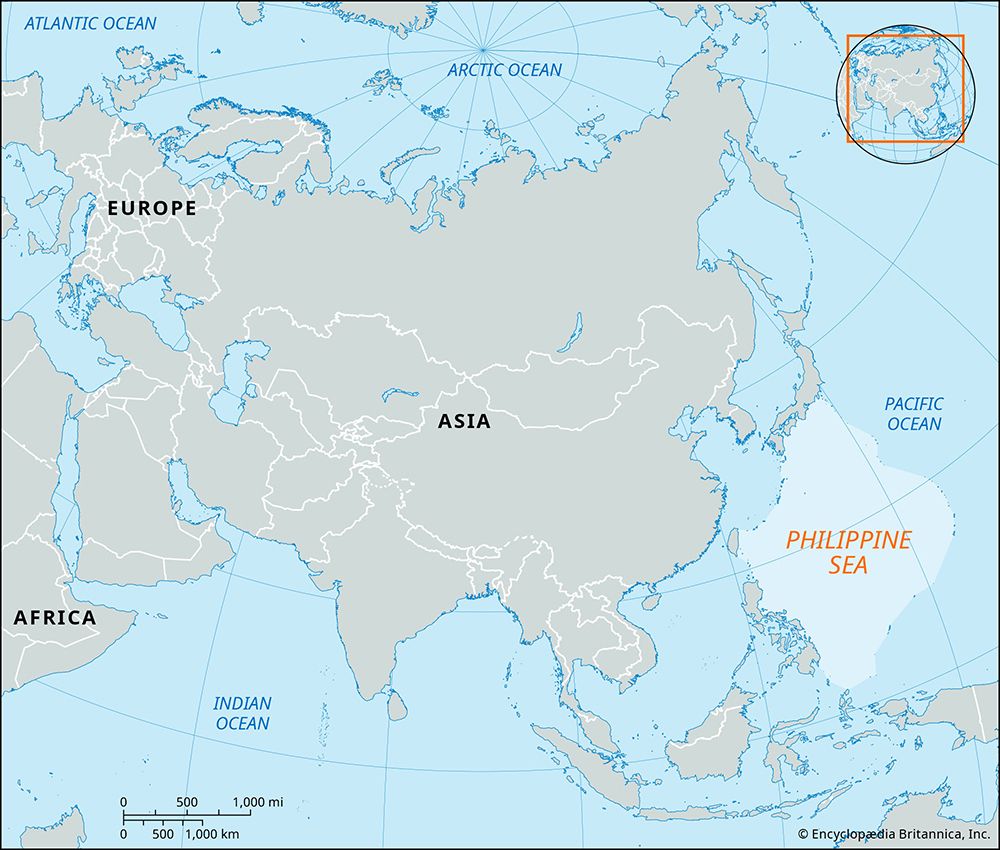
- Mariana Trough: Located in the Philippine Sea, this is a well-studied back-arc basin that formed behind the Mariana island arc due to seafloor spreading associated with subduction dynamics.
Other features, such as those found within fracture zones or rift valleys, also manifest as troughs. For instance, the Diamantina Fracture Zone (sometimes referred to as the Diamantina trench) is a rift valley formed during the separation of Australia and Antarctica. Unlike the consistent V-shaped profile of subduction-driven trenches, these troughs exhibit diverse structural origins and characteristics.18
Sources
- oceanic trough — Encyclopædia Britannica
- deep-sea trench - Structure — Encyclopædia Britannica
- deep-sea trench - Origin of deep-sea trenches — Encyclopædia Britannica
- Laurentian Trough — Encyclopædia Britannica
- subduction zone — Encyclopædia Britannica
- plate tectonics - Subduction zones — Encyclopædia Britannica
- deep-sea trench - Types — Encyclopædia Britannica
- back-arc basin — Encyclopædia Britannica
- plate tectonics - Discovery of ocean basin features — Encyclopædia Britannica
Published on · 3 min read