Island Arc
An island arc is a long, curved chain of volcanic islands typically found along the margins of oceanic basins. These features are characterized by intense…
What is an island arc and how does it form?
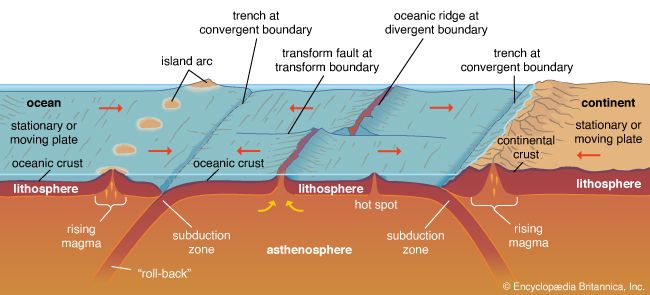
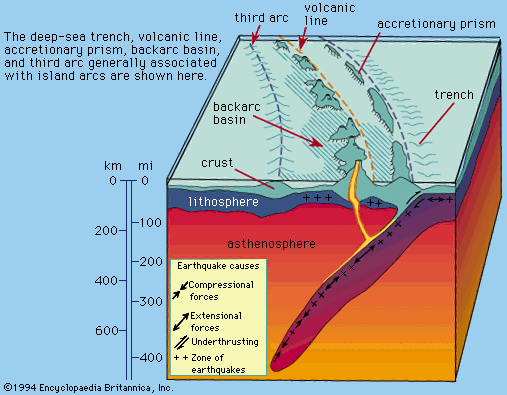
An island arc is a long, curved chain of volcanic islands typically found along the margins of oceanic basins. These features are characterized by intense seismic and volcanic activity and are almost always accompanied by a deep-sea trench on their convex side.1
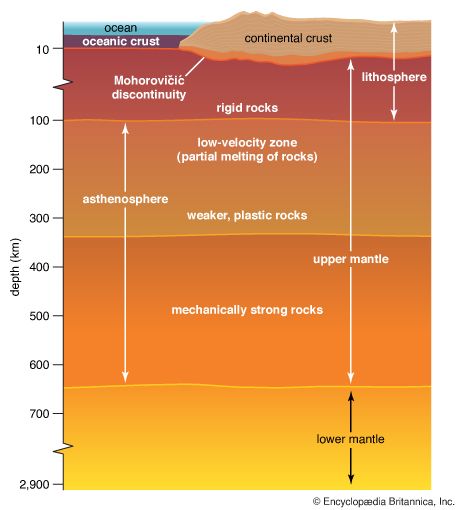
These arcs form through the process of plate tectonics when two oceanic plates converge. As the plates collide, the denser oceanic plate is forced downward into the mantle in a process called subduction. When the descending slab reaches a depth of approximately 100 km (60 miles), heat and pressure drive off volatile components, which trigger partial melting in the overlying mantle wedge.12
This process generates magma that rises to the surface, creating a line of volcanoes on the overriding platecanoes](https://www.britannica.com/science/volcanism) on the overriding plate. Over time, these eruptions build up a chain of islands parallel to the subduction zone. While similar volcanic processes occur at continental margins, the term “island arc” specifically refers to these chains formed by ocean-ocean convergence.21
How do island arcs contribute to the formation of new continental crust?
Island arcs play a fundamental role in the growth and evolution of continental crust. This process occurs primarily through the following mechanisms:
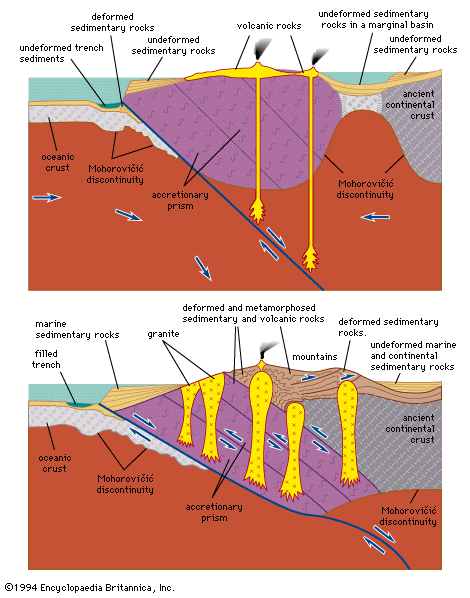
- Accretion: Throughout Earth’s history, continents have grown through the collision and subsequent accretion of volcanic island arcs onto existing continental margins. As tectonic plates move, these arcs are effectively “welded” onto the edges of continents, increasing their overall mass and size.13
- Magmatic Addition: Island arcs are built by the extrusion of basalts and andesites. These volcanic materials, generated by the partial melting of the mantle wedge above a subduction zone, represent the addition of new, less-dense material to the lithosphere. Over geological time, this volcanic activity contributes to the formation of crustal material that is intermediate in composition and thickness between oceanic and continental crust.412
- Sedimentary Accumulation: The regions surrounding island arcs, such as fore-arc basins, often serve as repositories for significant amounts of sediment. When these areas are eventually compressed and deformed during tectonic collisions, these accumulated sediments are incorporated into the growing continental mass.32
How do island arcs relate to plate tectonics and subduction zones?
Island arcs are direct products of plate tectonics occurring at convergent plate boundaries where two oceanic plates meet. When these plates collide, the denser oceanic plate undergoes subduction, buckling downward into the mantle beneath the overriding plate.12
As the descending slab reaches depths of approximately 100 km (60 miles), heat and pressure release volatile components that trigger partial melting in the overlying mantle wedge. This generates magma, which rises to the surface to form a chain of volcanoes on the overriding plate, parallel to a deep-sea trench located on the convex side of the arc.12
While similar volcanic processes occur at continental margins, the term island arc specifically describes these features when they form on oceanic crust. These regions are characterized by intense seismic activity, including deep-focus earthquakes that occur as the slab descends into the mantle.12
Where are some notable examples of island arcs found in the world?
Notable examples of island arcs are found across the globe, with the majority concentrated along the western margin of the Pacific Basin. These geological features are characterized by chains of volcanic islands, intense seismic activity, and associated deep-sea trenches.1
Notable Island Arcs
- Aleutian-Alaska Arc: A prominent volcanic chain extending from mainland Alaska through the Aleutian Islands and into the Kamchatka Peninsula.15
- Kuril-Kamchatka Arc: Located in the northwest Pacific, this arc is associated with the subduction of the Pacific Plate.15
- Japan Arc: A major volcanic chain where the Pacific Plate is subducted beneath the overriding plate, featuring iconic volcanoes like Mount Fuji.5
- Mariana Island Arc: Situated in the western Pacific, this arc is famous for the adjacent Mariana Trench, which contains some of the greatest ocean depths.1
- Tonga-Kermadec Arc: A significant structural feature in the South Pacific, comprising the Tonga and Kermadec islands along with their respective deep-sea trenches.167
- Lesser Antilles: Located at the eastern edge of the Caribbean Sea, this arc marks the zone where the North Atlantic seafloor underthrusts the Caribbean Plate.8
- Indonesian Arcs: A complex system including the Sunda arc, which features highly active volcanoes such as Krakatoa and Mount Tambora.5
Sources
- island arc — Encyclopædia Britannica
- plate tectonics - Island arcs — Encyclopædia Britannica
- continental crust — Encyclopædia Britannica
- North America - 600 to 250 million years ago — Encyclopædia Britannica
- mountain - Volcanoes and island arcs surrounding the northwest Pacific basin — Encyclopædia Britannica
- Kermadec Trench — Encyclopædia Britannica
- Asia - Cenozoic events in the island arcs and the marginal basins — Encyclopædia Britannica
- Tonga Trench — Encyclopædia Britannica
- mountain - The Caribbean chains — Encyclopædia Britannica
Published on · 3 min read