Baleen Whale
Large whales, including baleen species, typically follow seasonal migration patterns driven by the need for food and suitable breeding grounds. During the…
What are the migration patterns and breeding habits of baleen whales?
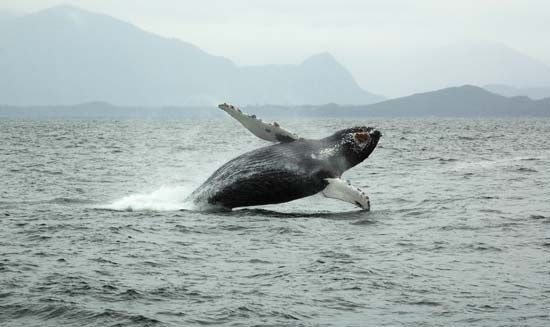
Large whales, including baleen species, typically follow seasonal migration patterns driven by the need for food and suitable breeding grounds. During the summer, they inhabit high-latitude polar waters, which are rich in biological productivity and food supplies. In the fall, they migrate toward the Equator to reach warmer waters for breeding.1
While many migratory whales generally do not cross the Equator—leading to genetically distinct northern and southern populations—some individuals have been documented traveling between ocean basins. Not all populations migrate; some reside in a single locality year-round.1
Regarding reproduction, cetacean breeding is typically seasonal and occurs during the winter. Females generally calve once every two years, carrying a single fetus for approximately one year. Birth occurs tail-first, and mothers provide their young with highly nutritious milk containing up to 50 percent fat. Calves are weaned between six months and one year of age but continue to grow rapidly for several years.2
Which species are classified as baleen whales, and how do they differ from toothed whales?
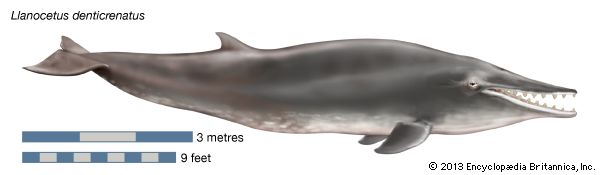
Baleen whales, belonging to the suborder Mysticeti, are distinguished by their lack of teeth in adulthood and their possession of baleen plates—unique, keratinized structures used to filter small prey like plankton and krill from the water. In contrast, toothed whales (suborder Odontoceti) possess simple, conical teeth used for grasping prey, which they swallow whole.45
Key Differences
The primary differences between these two groups include:
- Feeding Mechanisms: Baleen whales filter-feed by taking in large quantities of water and squeezing it out through their baleen bristles, which trap food. Toothed whales use their teeth to grasp individual prey, such as fish or squid.45
- Skull and Anatomy: Mysticetes have symmetrical skulls and paired blowholes, whereas odontocetes typically have asymmetrical skulls and a single blowhole.6
- Diversity: There are 12 recognized species of baleen whales categorized into four families, while toothed whales are more diverse, comprising 69 species across six families, including dolphins, porpoises, and sperm whales.56
Baleen Whale Classification
The 12 living species of baleen whales are grouped into the following families:
- Balaenopteridae: Includes rorquals and the humpback whale. The blue whale is the largest animal known to have lived.6
- Eschrichtiidae: Comprises the gray whale.6
- Balaenidae: Includes right whales, known for their arched skulls and long, flexible baleen.6
- Neobalaenidae: Consists of the pygmy right whale.6
How do baleen whales feed, and what is the function of their baleen plates?
Baleen whales (suborder Mysticeti) are specialized filter feeders that consume vast quantities of small marine organisms, such as plankton, krill, and small fish. Because they lack teeth, they rely on baleen plates—long, comb-like structures made of keratin—to strain their food from the water.785
The Function of Baleen Plates
Baleen plates hang in two transverse rows from the roof of the mouth. Each plate is smooth on the outer edge, while the inner edge is frayed into bristles. When a whale takes in a large mouthful of water containing prey, it closes its mouth and uses its tongue to force the water out through the sides. The bristly inner edges of the baleen act as a sieve, trapping the tiny organisms inside so they can be swallowed.587
Feeding Methods
Baleen whales generally employ two primary feeding strategies:
- Gulp Feeding: Common in rorquals, this method involves opening the mouth to engulf a massive volume of water and prey. These whales possess ventral grooves that allow their oral cavity to expand significantly during the process.4
- Skim Feeding: Used by whales such as the right whale and gray whale, this involves swimming through concentrations of prey with the mouth held open, continuously filtering water until the whale closes its mouth to swallow the accumulated food.4
Some species, like the humpback whale, also utilize cooperative strategies like bubble netting to concentrate prey before feeding.7
How do baleen whales communicate with each other?
Baleen whales (suborder Mysticeti) communicate primarily through low-frequency vocalizations produced by their larynx. Unlike toothed whales, which use nasal passages to generate high-frequency clicks, baleen whales blow air through a U-shaped ridge of tissue at the top of the larynx. This mechanism allows them to recycle air, enabling them to sing underwater without needing to inhale or exhale.1112
Communication Functions
These vocalizations serve several critical purposes:
- Social Identification: Whales use specific songs and dialects to identify members of their own pods. These songs are dynamic and can evolve as groups incorporate patterns from one another.1312
- Courtship and Mating: Male whales, particularly humpbacks, perform elaborate, sustained songs to attract females and assert dominance over other males.1311
- Navigation and Orientation: Due to their low frequency, these sounds can travel across entire ocean basins. Researchers believe these calls help whales map their environment and locate one another in the vast, featureless ocean.1112
Because these signals often occupy the same frequency bands as noise from shipping vessels, human-made ocean noise can significantly interfere with their ability to communicate over long distances.12
Sources
- cetacean - Distribution and migration — Encyclopædia Britannica
- Migration - Marine mammals — Encyclopædia Britannica
- cetacean - Reproduction — Encyclopædia Britannica
- baleen whale — Encyclopædia Britannica
- Do whales have teeth? — Encyclopædia Britannica
- cetacean - Annotated taxonomy — Encyclopædia Britannica
- What do whales eat? — Encyclopædia Britannica
- Filter feeding — Encyclopædia Britannica
- Llanocetus denticrenatus — Encyclopædia Britannica
- cetacean - Feeding — Encyclopædia Britannica
- Why do whales sing? — Encyclopædia Britannica
- cetacean - Sound production and communication — Encyclopædia Britannica
- whale vocalization — Encyclopædia Britannica
Published on · 4 min read