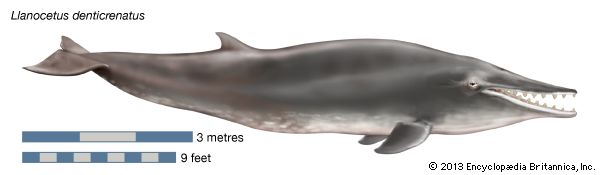
Llanocetus Denticrenatus
The fossils of Llanocetus denticrenatus, one of the earliest known baleen whales, were discovered on Seymour Island in Antarctica. The remains, which include…
Where were the fossils of Llanocetus denticrenatus discovered?
The fossils of Llanocetus denticrenatus, one of the earliest known baleen whales, were discovered on Seymour Island in Antarctica. The remains, which include part of a jaw and an endocast of the brain cavity, were excavated during expeditions in 1974 and 1975.1
What methods do paleontologists use to reconstruct the appearance and behavior of Llanocetus denticrenatus?
Paleontologists reconstruct the appearance and behavior of Llanocetus denticrenatus primarily through the analysis of its fossil remains, specifically a partial jaw and an endocast of the brain cavity.1
To determine its physical characteristics and habits, researchers utilize the following methods:
- Endocast Analysis: By studying the cast of the brain cavity, scientists identified specialized structures, such as spaces for blood vessels and skull openings, that indicate the presence of rete—highly vascularized tissues. This suggests the animal possessed the physiological adaptations necessary for deep-diving and protecting the brain from pressure changes.1
- Dental Morphology: The unique structure of its teeth, which feature gear-shaped cusps and deep grooves, allows paleontologists to infer its feeding behavior. By comparing these teeth to those of the living crabeater seal, researchers hypothesize that L. denticrenatus engaged in filter feeding by straining plankton through its teeth.1
- Comparative Anatomy: By examining the 2-metre-long skull, researchers compare its features to those of basilosaurids and modern baleen whales to understand its evolutionary position.1
How do scientists determine the age of Llanocetus denticrenatus fossils?
Scientists determine the age of Llanocetus denticrenatus fossils primarily through biostratigraphy, a method that identifies and arranges fossils within sedimentary rock strata to establish their relative geologic age. By analyzing the specific rock layers where the fossils were excavated on Seymour Island, paleontologists can correlate these findings with established geologic time scales.134
This process is often integrated with other geochronological techniques to refine the dating. For instance, researchers may apply radiometric dating—which measures the decay of radioactive isotopes like potassium-40—to volcanic minerals found within the same stratigraphic sequences. By combining these isotopic ages with biostratigraphic data and magnetostratigraphy (the study of magnetic polarity reversals recorded in rocks), scientists have dated the L. denticrenatus fossils to approximately 34 million years ago, placing the species within the Late Eocene Age.453
What can Llanocetus denticrenatus tell us about the feeding habits of early whales?
Llanocetus denticrenatus provides critical insights into the evolutionary transition of baleen whales from toothed ancestors to modern filter feeders. Although it possessed teeth throughout its life, its feeding habits suggest a functional bridge between these two states.1
Evidence of Early Filter Feeding
Unlike modern mysticetes that use baleen plates, L. denticrenatus utilized its specialized teeth to capture prey. The teeth featured gear-shaped cusps and deep grooves, which likely functioned as a mesh to strain plankton from water as it was expelled from the mouth. This mechanism is comparable to the feeding strategy of the modern crabeater seal, indicating that a filter-feeding lifestyle may have evolved before the development of specialized baleen filters.1
Dietary Scope and Diving Behavior
The spacing between its teeth suggests that L. denticrenatus consumed larger prey than modern baleen whales, such as invertebrates and small fish. Furthermore, analysis of its brain cavity reveals vascular structures that protected the animal from high pressure, indicating it was capable of deep-diving to access food sources in deep waters.1
Sources
- Llanocetus denticrenatus — Encyclopædia Britannica
- cetacean - Paleontology — Encyclopædia Britannica
- Eocene Series — Encyclopædia Britannica
- Tertiary Period - Correlation of Tertiary strata — Encyclopædia Britannica
- geology - Isotopic geochemistry — Encyclopædia Britannica
- biostratigraphy — Merriam-Webster
- Seymour Island — Encyclopædia Britannica
- What do whales eat? — Encyclopædia Britannica
- cetacean - Feeding adaptations — Encyclopædia Britannica
Published on · 2 min read