Neogene Period
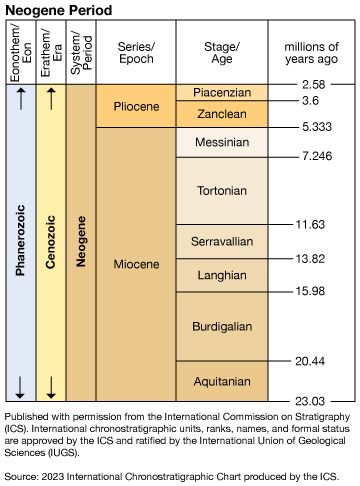
The Neogene Period (23 million to 2.6 million years ago) was a time of significant tectonic and climatic transformation that shaped the modern world. Key…
What were the key geological events that occurred during the Neogene Period?
The Neogene Period (23 million to 2.6 million years ago) was a time of significant tectonic and climatic transformation that shaped the modern world. Key geological events during this interval include:12
- Major Orogeny: Extensive mountain-building occurred globally. The Himalayan range and the Tibetan Plateau experienced intensified uplift, while the Andes were uplifted due to the subduction of the South Pacific plate beneath South America. In Europe, the Alpine orogeny continued throughout much of the period.34
- Tectonic Shifts: The Isthmus of Panama formed, reestablishing a land connection between North and South America by the mid-Pliocene (about 3.5 million years ago). Additionally, the East African Rift System saw significant rifting, and the San Andreas Fault system developed in North America.564
- Climatic Cooling and Glaciation: The period was characterized by a long-term cooling trend. Northern Hemisphere glaciation began approximately 3.2 million years ago, driven by tectonic events like the closing of the Panama seaway and mountain uplift, which altered global atmospheric and oceanic circulation.3
What significant evolutionary changes occurred in mammals during the Neogene Period?
During the Neogene Period (23 million to 2.6 million years ago), mammalian evolution was profoundly shaped by global cooling, the expansion of grasslands, and significant tectonic shifts.910
Adaptation to Changing Environments
As the climate cooled and dried, forests gave way to open grasslands, driving major evolutionary changes in herbivorous mammals. Many groups evolved specialized, high-crowned teeth to graze on gritty grasses, alongside longer limbs that facilitated running and escaping predators in these open habitats. By the late Miocene, grassland communities similar to modern savannas were established across most continents.94
Faunal Interchange and Diversification
- Global Migration: The Neogene saw significant faunal interchange between continents. For example, proboscideans (ancestors of modern elephants) migrated from Africa into Eurasia and eventually reached North America.104
- The Great American Biotic Interchange: The formation of the Isthmus of Panama about 3 million years ago reconnected North and South America. This allowed placental mammals to migrate south, leading to the extinction of several orders of South American marsupial mammals due to competition with more adaptable northern carnivores.11
Primate and Hominin Evolution
The Neogene was a pivotal era for primates. Advanced apes, including the dryopithecines, evolved and spread across Africa and Europe](https://www.britannica.com/animal/Dryopithecus), evolved and spread across Africa and Europe. During the Pliocene, shifting African biomes stimulated the diversification of hominins, leading to the development of an energy-efficient bipedal stride and the eventual emergence of the genus Homo.412
What major extinction events, if any, occurred during the Neogene Period?
There were no global mass extinction events—comparable to the “Big Five” mass extinctions—that occurred during the Neogene Period (23 million to 2.6 million years ago).119
While the Neogene did not experience a singular, catastrophic mass extinction, it was a time of significant faunal turnover and localized extinctions driven by environmental changes:1115
- Marine Diversity: Planktonic foraminiferans experienced a long-term reduction in diversity during the mid-Cenozoic, likely linked to global cooling trends.11
- Megalodon Demise: The giant shark Otodus megalodon experienced a population decline and eventual extinction near the Pliocene-Pleistocene boundary (approximately 2.6 million years ago). Research suggests this was primarily due to shifting food-chain dynamics, including a decrease in the availability of its primary prey, baleen whales, and increased competition from smaller predators like the great white shark and early killer whales.16
- Faunal Turnover: The period saw ongoing evolutionary turnover as cooling climates and the expansion of grasslands replaced archaic herbivore groups with more modern, grazing-adapted species.15
How do scientists use geochronology to date and study the Neogene Period?
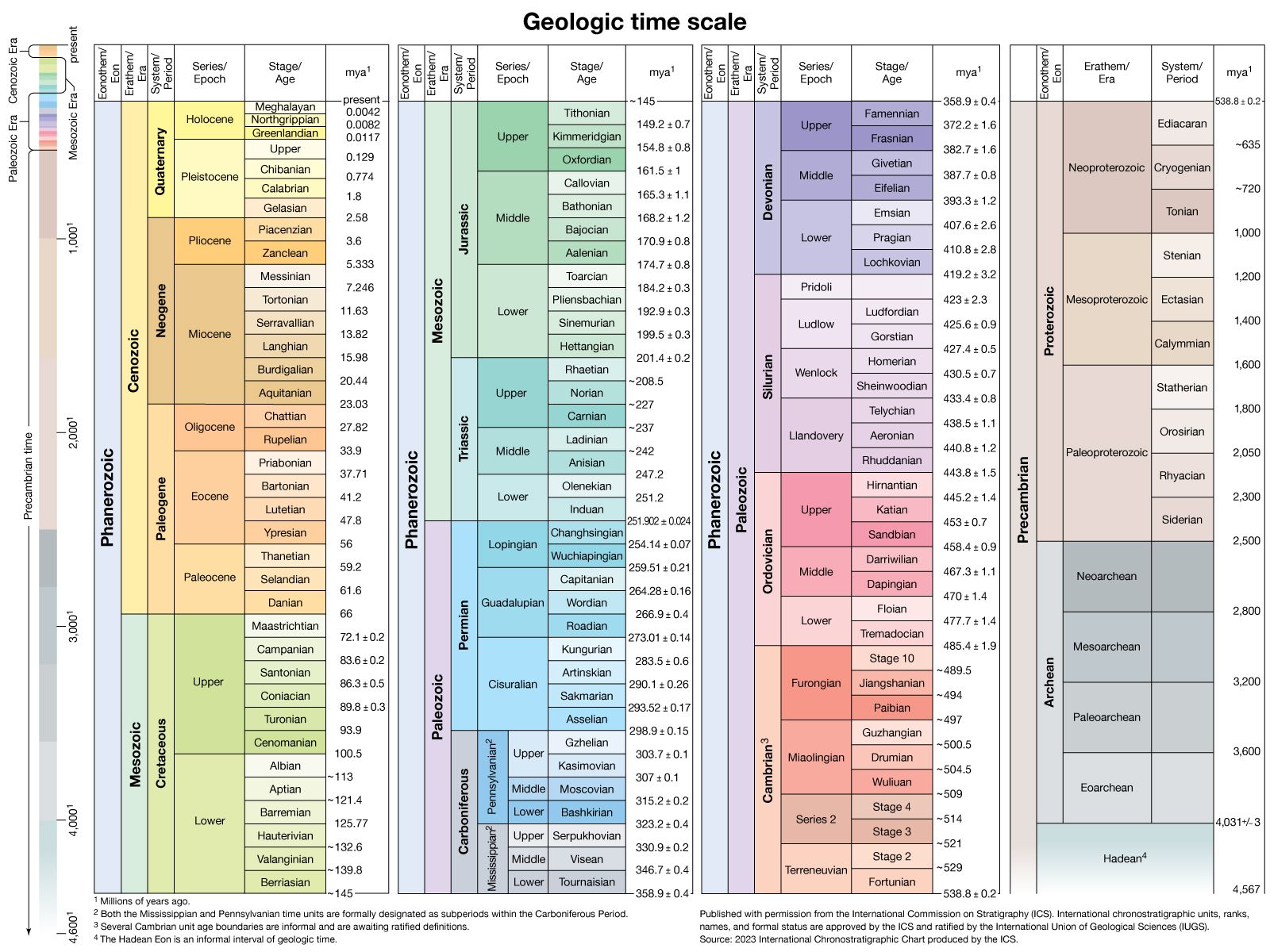
Scientists use an integrated approach to geochronology to date and study the Neogene Period, combining several methodologies to create a high-resolution, consistent time scale.19
Key Dating Methodologies
- Radiometric Dating: This technique is essential for numerically quantifying geologic time by measuring the decay of radioactive isotopes into stable daughter elements. Techniques such as potassium-argon dating and argon-40/argon-39 dating are particularly effective for dating volcanic mineral samples, allowing for precise age determination of rock layers.20211922
- Biostratigraphy: Scientists use index fossils—organisms that were abundant, widely distributed, and existed for a short time—to correlate rock strata. In the Neogene, micropaleontologists rely on zones based on the distribution of calcareous plankton (such as foraminiferans and nannoplankton) and siliceous varieties like radiolarians and diatoms to correlate sediments globally.2319
- Magnetostratigraphy: By measuring the magnetic orientation preserved in rocks, scientists can identify a sequence of polarity reversals. These magnetic lineations, detected in seafloor basalt and deep-sea cores, provide a chronological framework that can be calibrated against isotopic ages.19
- Astronomical Tuning: Recent advancements involve using cyclical components in the stratigraphic record, such as fluctuations in fossil taxa or lithological couplets (e.g., marl and chalk), to fine-tune the geologic time scale to a resolution of approximately 5,000 years in the late Neogene.19
By integrating these methods, researchers can tie together marine, terrestrial, and ice-core records to reconstruct the history of the Neogene.1922
Sources
- Climate change - Cenozoic climates — Encyclopædia Britannica
- Neogene Period — Encyclopædia Britannica
- Pliocene Epoch — Encyclopædia Britannica
- Miocene Epoch — Encyclopædia Britannica
- Tertiary Period - Volcanism and orogenesis — Encyclopædia Britannica
- Pleistocene Epoch - Tectonic and isostatic movements — Encyclopædia Britannica
- A Journey Through Time Since the Precambrian - Paleogene Period: 66 million to 23 million years ago, and Neogene Period: 23 million to 2.6 million years ago — Encyclopædia Britannica
- Global warming - Climatic variation since the last glaciation — Encyclopædia Britannica
- Tertiary Period - The rise of mammals — Encyclopædia Britannica
- human evolution - Hominin habitats — Encyclopædia Britannica
- Cenozoic Era - Cenozoic life — Encyclopædia Britannica
- Tertiary Period - Mammalian migration from Eurasia to North America — Encyclopædia Britannica
- plate tectonics - Evolution — Encyclopædia Britannica
- Isthmus of Panama — Encyclopædia Britannica
- Pleistocene Epoch - Megafaunal extinctions — Encyclopædia Britannica
- Holocene Epoch - Faunal change — Encyclopædia Britannica
- K–T extinction — Encyclopædia Britannica
- megalodon - Extinction — Encyclopædia Britannica
- Tertiary Period - Correlation of Tertiary strata — Encyclopædia Britannica
- geochronology — Encyclopædia Britannica
- dating: Top Questions — Encyclopædia Britannica
- index fossil — Encyclopædia Britannica
- Pleistocene Epoch - Chronology and correlation — Encyclopædia Britannica
- Quaternary - Correlation of Quaternary deposits — Encyclopædia Britannica
Published on · 4 min read