Bark-gnawing Beetle
A bark-gnawing beetle refers to any of approximately 500 species within the family Trogossitidae. These beetles are typically dark-colored and range from 5…
What is bark-gnawing beetle?
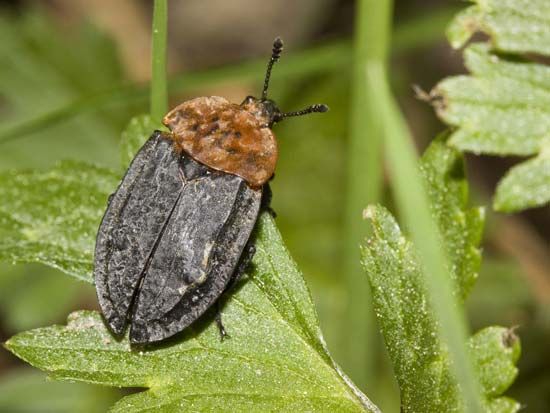
A bark-gnawing beetle refers to any of approximately 500 species within the family Trogossitidae. These beetles are typically dark-colored and range from 5 to 20 mm (0.2 to 0.8 inch) in length. They are primarily found in tropical regions, where they inhabit areas under tree bark, woody fungi, and dry plant materials.1
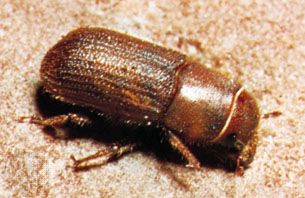
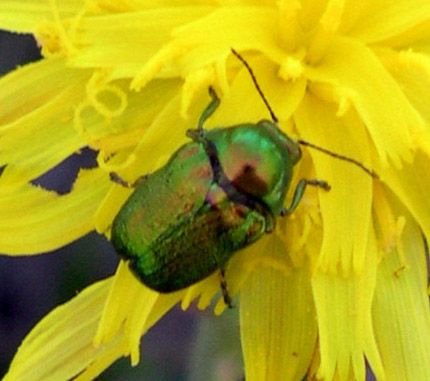
While they share a habitat name with the bark beetle—a separate group of over 2,000 species in the subfamily Scolytinae known for being destructive to living trees—bark-gnawing beetles have distinct habits. For instance, the species Tenebrioides mauritanicus, known as the cadelle in its larval stage, is often found in granaries, where it feeds on both stored grain and other insects. Another species, Tennochilus virescens, is notable for its blue-green coloration and a powerful bite.12
It is important not to confuse these with the more economically damaging bark beetles, which bore into living trees and can transmit plant diseases like Dutch elm disease.2
How do bark-gnawing beetles differ from bark beetles?
Bark-gnawing beetles and bark beetles are distinct groups of insects with different ecological roles and impacts on plant life.
Bark-Gnawing Beetles (Family Trogossitidae)
- Classification: There are approximately 500 species in this family.1
- Habitat: They are primarily found in tropical regions, living under tree bark, in woody fungi, and within dry plant materials.1
- Feeding Habits: These beetles are generally scavengers or predators. For example, the larvae of Tenebrioides mauritanicus (the cadelle) are known to infest granaries, where they feed on stored grain and other insects.1
Bark Beetles (Subfamily Scolytinae)
- Classification: This group includes more than 2,000 species.5
- Habitat: They are found worldwide and are specialized to live beneath the bark of trees.45
- Feeding Habits: Bark beetles are phytophagous (plant feeders) and are considered serious pests. They bore into living trees to form egg chambers and tunnels, which can damage vital areas like the cambium layer.45
- Economic Impact: Because they feed on living trees, they can cause significant damage to forests and timber. Furthermore, they are known to transmit plant diseases, such as Dutch elm disease, by carrying fungal spores.45
What are the stages of a beetle’s life cycle?
Beetles undergo a process known as complete metamorphosis (or holometabolous development), which consists of four distinct developmental stages: egg, larva, pupa, and adult.67
- Egg: Most beetles begin life as fertilized eggs. The eggshell (chorion) protects the developing embryo, and in some species, eggs can enter a state of arrested development, or diapause, to survive unfavorable environmental conditions.68
- Larva: Upon hatching, the larva focuses on feeding and growth. Because the insect’s cuticle cannot grow, the larva must undergo a series of molts—shedding its old skin to form a new, larger one—typically three to five times before reaching maturity.68
- Pupa: During this inactive, nonfeeding stage, the insect undergoes a dramatic transformation. The pupa forms beneath the final larval skin. Internally, larval tissues are broken down, and adult structures, such as wings and reproductive organs, are developed.67
- Adult: The adult emerges from the pupal skin. After its wings stretch to full size and its outer skeleton hardens and gains color, the beetle reaches its final form. No further growth occurs in the adult stage.63
How do insects like the cadelle impact stored grain?
Insects like the cadelle (Tenebroides mauritanicus) pose a significant threat to stored agricultural products. The cadelle is classified as a secondary pest in cereal farming, where its larvae—commonly known as cadelles—infest granaries and storage facilities.110
These beetles impact stored grain through two primary feeding behaviors:
- Direct Consumption: The larvae feed directly on the grain, which can lead to significant losses in weight and overall food value.111
- Predatory Activity: Unlike some other grain pests that focus solely on the endosperm or germ, the cadelle is also predatory; it feeds on other insects present within the grain supply.1
Effective management of these pests requires rigorous “good housekeeping” practices, including the regular cleaning and disinfecting of storage sacks and bags. In cases of heavy infestation, control measures may involve the use of inert insecticidal dusts, contact insecticides, or fumigation to protect the integrity of the cereal stocks.10
Sources
- bark-gnawing beetle — Encyclopædia Britannica
- bark beetle — Encyclopædia Britannica
- Coleoptera - Pupae — Encyclopædia Britannica
- Coleoptera - As plant feeders — Encyclopædia Britannica
- Coleoptera - Feeding habits and habitats — Encyclopædia Britannica
- Coleoptera - General features — Encyclopædia Britannica
- Metamorphosis — Encyclopædia Britannica
- Coleoptera - Larval features — Encyclopædia Britannica
- insect - Egg — Encyclopædia Britannica
- Cereal farming - Storage — Encyclopædia Britannica
- cadelle — Merriam-Webster
Published on · 3 min read