Bark Beetle
Forest managers and scientists monitor bark beetle populations primarily to identify outbreaks early, allowing for timely interventions such as sanitation or…
How do scientists and forest managers monitor bark beetle populations?
Forest managers and scientists monitor bark beetle populations primarily to identify outbreaks early, allowing for timely interventions such as sanitation or salvage harvests. Because direct control measures are expensive and often impractical for large forested landscapes, routine monitoring is essential for managing the spread of these pests.12
Key methods and indicators used for monitoring include:
- Visual Inspection: Managers look for early symptoms of infestation, such as a thinning leaf canopy, splitting bark, or characteristic exit holes (such as the D-shaped holes left by the emerald ash borer).2
- Biological Indicators: Increased woodpecker activity is often a sign that beetles are present within the trees.2
- Pheromone Traps: Scientists utilize traps baited with sex-attractant chemicals, or pheromones, to detect the presence of specific insects and estimate their population density.1
- Regulatory Surveillance: Agencies track the movement of wood products, such as firewood and logs, which are common vectors for the human-facilitated spread of invasive beetle species.2
What are some common species of bark beetles, and how do they differ?
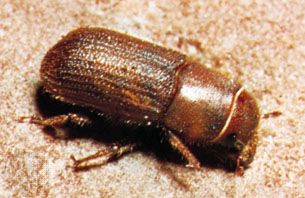
There are more than 2,000 species of bark beetles within the subfamily Scolytinae. While they share a similar cylindrical shape and small size—typically under 6 mm—they differ significantly in their host preferences, behaviors, and the damage they cause.
Key Species and Differences
- Elm Bark Beetles (Scolytus and Hylurgopinus): These species are notable for transmitting the fungal spores responsible for Dutch elm disease. Each species creates a unique, identifiable gallery pattern beneath the bark of infected trees.3
- Pine-Attacking Beetles (Ips and Dendroctonus): These genera primarily target pine trees. Unlike some other species, they are often highly destructive to timber resources.3
- Clover Root Borer (Hylastinus obscurus): Unlike species that target tree bark or wood, this beetle specifically damages the roots of clover plants.3
- Ambrosia Beetles: Often grouped with bark beetles, these insects bore directly into the wood. They are distinct because they cultivate fungi on a bed of excrement and wood chips within their galleries to serve as a food source, leaving behind dark stains on the wood walls.3
It is important to distinguish these from bark-gnawing beetles, which belong to a different family (Trogossitidae) and are generally larger, ranging from 5 to 20 mm.4
How do bark beetles communicate with each other?
Bark beetles primarily communicate using chemical signals known as pheromones. These chemicals are essential for coordinating social behaviors, particularly when the beetles need to locate and colonize host trees.
To attract large numbers of other beetles of the same species to a specific tree, bark beetles utilize aggregation pheromones. These pheromones typically consist of molecules with 8–10 carbon atoms, a size that balances the need for high volatility—allowing the signal to disperse through the air—with the need for chemical specificity to ensure they only attract members of their own species. By releasing these chemical mixtures, the beetles can effectively signal to others that a suitable host has been found, leading to mass colonization.
What is the life cycle of a typical bark beetle?
The life cycle of a typical bark beetle follows a process of development within the host tree, characterized by the following stages:
- Egg Deposition: Adult males and females bore into a tree to construct an egg chamber. The female deposits her eggs in individual niches along the sides of this chamber.3
- Larval Development: Once the eggs hatch, the larvae begin to bore away from the central egg chamber. As they feed, they create a characteristic series of tunnels, often referred to as galleries, beneath the bark.3
- Pupation: When the larva is fully grown, it creates a pupal cell at the end of its tunnel. Within this cell, the larva undergoes pupation, transforming into the adult form.37
- Emergence: After the adult beetle has developed and its body has hardened, it bores a hole through the bark to emerge from the tree, beginning the cycle again.37
Because these beetles spend much of their development inside the tree, their gallery patterns are often visible on the wood surface once the bark is removed.3
Sources
- forestry - Insect and disease control — Encyclopædia Britannica
- emerald ash borer — Encyclopædia Britannica
- bark beetle — Encyclopædia Britannica
- bark-gnawing beetle — Encyclopædia Britannica
- termite - Communication — Encyclopædia Britannica
- Chemoreception - Pheromones — Encyclopædia Britannica
- Coleoptera - Pupae — Encyclopædia Britannica
- Asian longhorned beetle: Top Questions — Encyclopædia Britannica
- Coleoptera - Typical life cycle — Encyclopædia Britannica
Published on · 3 min read