Basilisk
The basilisk lizard (Basiliscus) possesses several distinct physical characteristics that facilitate its unique behaviors and survival in tropical…
What are the unique physical characteristics of the basilisk lizard?
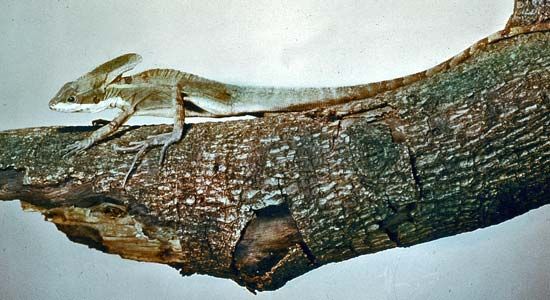
The basilisk lizard (Basiliscus) possesses several distinct physical characteristics that facilitate its unique behaviors and survival in tropical environments:
- Body Shape: These lizards have slender bodies that are compressed from side to side, paired with a long, whiplike tail.1
- Head and Crests: The rear of the head is extended into a flat lobe that resembles a cock’s comb. Additionally, males feature a crest along the back, which extends the full length of the body in two of the four known species.1
- Toe Adaptations: A key feature for their ability to run across water is the presence of broadscale fringes on their toes, which increase surface area and prevent the animal from sinking during a sprint.1
- Locomotion Aids: When running bipedally—a trait for which they are famous—the basilisk uses its long tail as a counterweight, holding it backward and upward to maintain balance.2
Beyond these features, basilisks are adept swimmers, capable of remaining submerged for up to 30 minutes.1
How do basilisk lizards reproduce and care for their young?
Like most lizards, basilisk lizards reproduce through internal fertilization, where the male uses hemipenes to deposit sperm into the female’s reproductive tract. Following successful mating, the female lays leathery-shelled eggs in a nest.345
Regarding parental care, basilisk lizards—like the majority of lizards and snakes—do not provide care for their offspring. Once the eggs are deposited in a suitable site, such as a hollow in the soil or leaf litter, the female typically departs, leaving the eggs and subsequent hatchlings to survive on their own. The hatchlings use a specialized egg tooth to cut through the shell and membranes when they are ready to emerge.5
While some reptiles exhibit more complex behaviors, such as nest guarding or live-bearing, basilisks follow the standard oviparous (egg-laying) pattern where the survival of the young is independent of the parents from the moment of birth.5
In which regions or habitats can basilisk lizards be found?
Basilisk lizards (genus Basiliscus) are native to the tropical regions of North and South America.1
Within these tropical environments, they are specifically found in forest habitats, where they demonstrate a strong preference for living in close proximity to water sources, such as streams. Their ability to thrive in these areas is supported by their skill as swimmers and their unique capacity to run across the surface of the water when threatened.1
How did the basilisk lizard get its name, and what is its mythological connection?
The name “basilisk” is derived from the Greek word basilískos, meaning “minor prince” or “little king,” which itself comes from basileús (“king”). This etymology refers to the creature’s appearance, as the legendary beast was said to possess a crown-like crest on its head.6
In Hellenic and Roman mythology, the basilisk—also known as a cockatrice—was a fearsome, serpent-like monster believed to be capable of killing other creatures with a single deadly stare or fatal breath.76
The modern basilisk lizard (genus Basiliscus) was named for its physical resemblance to this fabled monster. Like the legendary creature, these iguanid lizards feature a prominent, inflatable crest on the back of the head that resembles a cock’s comb. While the mythological beast was a symbol of terror, the real-world lizard is best known for its remarkable ability to run across the surface of water on its hind legs, a trait that has earned it the nickname “Jesus Christ lizard.”17
Sources
- basilisk — Encyclopædia Britannica
- lizard - Locomotion and limb adaptations — Encyclopædia Britannica
- lizard - Life cycle — Encyclopædia Britannica
- reptile - Courtship and fertilization — Encyclopædia Britannica
- reptile - Embryonic development and parental care — Encyclopædia Britannica
- Did you know? — Merriam-Webster
- basilisk — Merriam-Webster
Published on · 3 min read