Black-tailed Rattlesnake
The black-tailed rattlesnake (Crotalus molossus) is a North American pit viper found in rocky habitats ranging from Arizona and southwestern Texas down to…
What is a black-tailed rattlesnake?
The black-tailed rattlesnake (Crotalus molossus) is a North American pit viper found in rocky habitats ranging from Arizona and southwestern Texas down to central Mexico.1
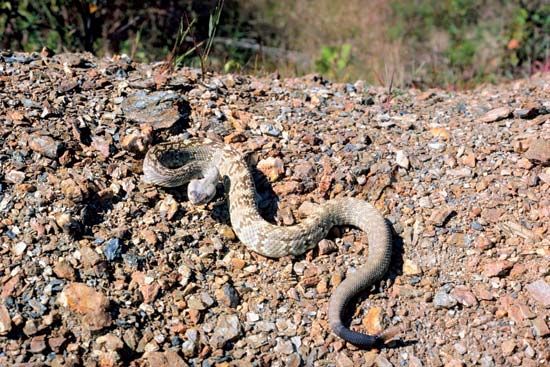
Characterized by a stout body, a triangular head, and a distinctive black tail, this species typically reaches about 0.9 meters (3 feet) in length. It is equipped with heat-sensing pits to locate prey and utilizes hemotoxic venom to hunt small mammals like rabbits and squirrels. While its bite is potentially lethal to humans, the black-tailed rattlesnake is generally noted for having a calm temperament compared to other rattlesnakes.1
These snakes are ovoviviparous, meaning they give birth to live young that develop from eggs retained within the mother. Interestingly, newborns possess venom that is more potent than that of adults, which aids them in securing food early in life.1
Where do black-tailed rattlesnakes live?
The black-tailed rattlesnake (Crotalus molossus) is a North American pit viper primarily found in the following regions:
- United States: Its range includes Arizona and southwestern Texas.21
- Mexico: The species is found southward from the United States into central Mexico.1
Within these geographic areas, the snakes typically inhabit specific environments such as rocky outcrops, canyons, and cliffs in mountain ranges. During the winter months, they hibernate individually within rock crevices, emerging on warmer days to bask.1
What does a black-tailed rattlesnake look like?
The black-tailed rattlesnake (Crotalus molossus) is a pit viper with a distinct appearance characterized by a stout body and a large, triangular head, the latter caused by large venom glands at the base of the jaws.1
Key physical features include:
- Head and Eyes: The snake has a narrow neck and small, silvery eyes with vertical pupils. Overhanging scales above the eyes give the snake a scowling appearance. Between the eyes and nostrils are deep, heat-sensing pits used to locate prey.1
- Body and Coloration: Adults typically average 0.9 meters (3 feet) in length, though some males exceed 1.2 meters (4 feet). Their coloration ranges from greenish gray to gray or yellow. The body is marked with dark, irregular bands that often widen into diamond-shaped blotches with yellow centers. The scales have a bead-like appearance because each scale is a single color.1
- Tail: The snake features a short black tail that ends in a rattle.1
How does a black-tailed rattlesnake defend itself?
The black-tailed rattlesnake (Crotalus molossus) primarily defends itself by using its rattle, a specialized structure at the tip of its tail formed by interlocking, hardened layers of keratinized epidermis. This device serves as a warning signal intended to ward off large mammals.13
While the snake possesses a potentially lethal bite, it is generally known for having a relatively calm temperament and is not considered one of the more dangerous species of rattlesnakes. If threatened, the snake may use its rattle to advertise its presence; however, this behavior is often ineffective against humans, as the sound may inadvertently lead to the snake’s capture or death rather than its escape.13
In addition to this auditory warning, the snake is equipped with venom glands and hollow, retractable fangs that can be deployed for defense if the snake is provoked or feels cornered.1
Sources
- black-tailed rattlesnake — Encyclopædia Britannica
- black-tailed rattlesnake — Merriam-Webster
- snake - Molt — Encyclopædia Britannica
- reptile - Chemoreception — Encyclopædia Britannica
- viper — Encyclopædia Britannica
Published on · 2 min read