Basilosaurid
Basilosaurids are an extinct family of early whales that share a closer evolutionary affinity to living cetaceans than any other extinct group. While they…
How are basilosaurids related to modern whales and dolphins?
Basilosaurids are an extinct family of early whales that share a closer evolutionary affinity to living cetaceans than any other extinct group. While they were once mistakenly classified as lizards, they are now recognized as members of the Pelagiceti, representing the first widespread, fully aquatic group of whales.1
Their relationship to modern whales and dolphins is defined by several key characteristics:
- Evolutionary Link: One specific subfamily of basilosaurids, the Dorudontinae, is believed to have given rise to both modern suborders of cetaceans—baleen whales and toothed whales—during the late Oligocene Epoch.2
- Shared Traits: Like modern whales, basilosaurids possessed flukes for swimming.1
- Distinctions: Unlike their modern descendants, basilosaurids retained small, non-functional hind limbs and possessed triangle-shaped teeth, whereas modern whales have evolved specialized feeding structures and lost these vestigial limbs.1
While some basilosaurids like Basilosaurus were highly specialized and likely did not leave direct descendants, the group as a whole serves as a critical evolutionary bridge between amphibious ancestors and modern marine mammals.12
What is the significance of basilosaurids in understanding whale evolution?
Basilosaurids are significant in the study of whale evolution because they represent the first widespread, fully aquatic group of cetaceans, serving as a critical evolutionary bridge between amphibious ancestors and modern species. While early whales were likely amphibious with functional back legs, basilosaurids evolved to be too large and specialized for land, marking a definitive transition to a permanent marine existence.1
Their importance is highlighted by several key factors:
- Evolutionary Affinity: Basilosaurids share a closer evolutionary relationship to living whales than any other extinct group.1
- Ancestral Links: The subfamily Dorudontinae is believed to have given rise to both modern suborders of cetaceans—baleen whales and toothed whales—during the late Oligocene Epoch.2
- Morphological Transition: They possessed flukes similar to modern whales, yet retained vestigial hind limbs and triangle-shaped teeth, illustrating the gradual loss of terrestrial features and the development of specialized aquatic anatomy.1
What are some of the most well-known basilosaurid species?
The family Basilosauridae includes several notable genera that illustrate the diversity of these early, fully aquatic whales. Some of the most well-known include:
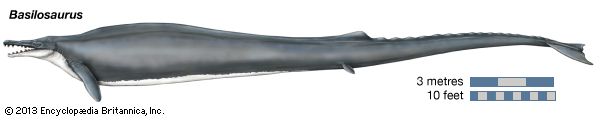
- Basilosaurus: The namesake of the family, this genus is perhaps the most famous. Originally misidentified as a lizard due to its elongated, serpentine body, it reached lengths of up to 21 meters (about 70 feet). It was highly specialized for aquatic life, featuring a long tail that made up three-quarters of its body length, though it retained vestigial hind limbs.12
- Dorudontinae: This subfamily is particularly significant in evolutionary biology. Unlike the elongated basilosaurines, early members of this group possessed shorter bodies and longer skulls. They are widely considered the ancestors of both modern suborders of cetaceans—baleen whales and toothed whales.13
- Kekenodon: Representing the subfamily Kekenodontinae, this genus is notable for being the only basilosaurid known to have survived into the Oligocene Epoch, though it remains poorly understood in the fossil record.1
- Stromerius nidensis: Described in 2007, this species is the sole representative of the subfamily Stromeriinae and dates back to the late Eocene Epoch in Egypt.1
How did basilosaurids move through water, and what evidence supports this?
Basilosaurids moved through the water primarily using their specialized aquatic anatomy, marking them as the first widespread group of fully aquatic whales. Unlike their amphibious ancestors, basilosaurids were too large to haul themselves onto land, and their forelimbs were highly specialized for swimming rather than terrestrial support.1
Evidence for their aquatic locomotion includes:
- Flukes: Basilosaurids possessed flukes similar to those of modern whales, which provided the primary means of propulsion.1
- Elongated Body: The genus Basilosaurus featured an elongated body with an extended tail that accounted for up to three-quarters of its total length, indicating a highly adapted, streamlined form for marine life.13
- Vestigial Hind Limbs: While they retained small hind limbs, these were not connected to the skeleton and were likely too small to assist in swimming. It remains unclear if these limbs were functional or atrophied, though some researchers suggest they may have served as claspers during mating.1
We could dive deeper into how the transition from amphibious to fully aquatic life is reflected in the fossil record of other early cetaceans.
Sources
- basilosaurid — Encyclopædia Britannica
- cetacean - Paleontology — Encyclopædia Britannica
- Basilosaurus — Encyclopædia Britannica
Published on · 3 min read