Bay of Cádiz
The Bay of Cádiz is a significant inlet on the Atlantic coast of southwestern Spain, serving as a hub for commerce and industry. Several notable towns and…
What are some of the notable towns and cities located around the Bay of Cádiz?
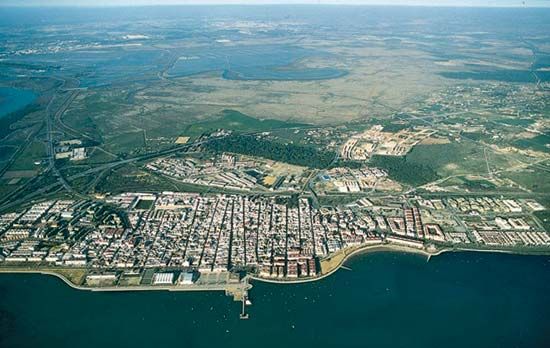
The Bay of Cádiz is a significant inlet on the Atlantic coast of southwestern Spain, serving as a hub for commerce and industry. Several notable towns and cities are situated along its shores, each contributing to the region’s economic and maritime identity:
- Cádiz: The provincial capital and a major port, it is located on a narrow peninsula protected by the Isle of León. It has historically served as a vital center for trade and naval activity.12
- Rota: Situated to the north of the bay, this town is home to a prominent Spanish-U.S. air and naval base.13
- El Puerto de Santa María: Located to the northeast, this city is a key port and part of the bay’s integrated commercial network.1
- Puerto Real: Positioned to the east, this area is known for its industrial contributions, including facilities related to the oil and gas sector.1
- San Fernando: Located to the south, this city is closely linked to the bay’s naval infrastructure, including nearby dockyards.1
These urban centers collectively form a metropolitan area that supports the region’s agricultural hinterland and maritime industries.12
What are the main economic activities associated with the Bay of Cádiz?
The economy of the Bay of Cádiz is diverse, rooted in its maritime history and evolving to meet modern industrial needs. Key economic activities include:
- Commercial Shipping and Trade: The harbours along the bay serve as vital commercial centers for the surrounding agricultural hinterland. The city of Cádiz functions as a principal seaport, handling transoceanic vessels and exporting goods such as wine, salt, olives, figs, cork, and salted fish, while importing coal, iron, machinery, and various foodstuffs.12
- Industrial Manufacturing: While the region was historically a major shipbuilding hub, economic activity shifted in the 1990s toward supporting the oil and gas industry. This includes the manufacturing of parts and providing support services for these sectors, with facilities located at sites like Matagorda in Puerto Real and La Carraca near San Fernando.13
- Salt Production and Fisheries: Salt is obtained through the evaporation of seawater in coastal pans and is traditionally used to prepare fish caught offshore for export.13
- Military and Naval Infrastructure: The bay hosts significant military installations, including the Spanish-U.S. air and naval base at Rota, which supports regional logistics and energy transport.12
How has the Bay of Cádiz played a role in maritime trade and naval history?
The Bay of Cádiz has served as a pivotal maritime and naval hub for millennia, evolving from an ancient trading post into a strategic center for global commerce and military operations.
Maritime Trade
Founded as Gadir by Phoenician merchants around 1100 BCE, the port became a prosperous center under Roman rule as Gades. Its significance surged following the discovery of America in 1492, when it became the headquarters for Spanish treasure fleets. In 1717, the Casa de Contratación—the agency overseeing trade with Spain’s New World empire—was moved to Cádiz, cementing its role as the primary gateway for colonial commerce until the late 18th century.12
Naval History
The bay’s strategic value frequently made it a target for conflict:
- Military Raids: In 1587, an English squadron led by Sir Francis Drake burned the harbour’s shipping.1
- Sieges and Blockades: The city endured British blockades and bombardments in the late 18th and early 19th centuries, and it was besieged by the French from 1810 to 1812.1
- Modern Defense: Today, the bay hosts the Spanish-U.S. air and naval base at Rota, alongside critical dockyards like La Carraca, which support naval logistics and energy transport.4
What are some of the popular recreational activities and tourist attractions in the Bay of Cádiz area?
The Bay of Cádiz area offers a blend of historical exploration and vibrant cultural experiences for visitors.
Cultural and Historical Attractions
- Architectural Landmarks: The city of Cádiz is rich in history, featuring the Baroque cathedral (begun in 1722) and the older cathedral originally built by Alfonso X. Visitors can also explore the San Sebastián and Santa Catalina castles, as well as the Torre de Vigía, a historic signal tower.2
- Ancient History: The region contains significant archaeological sites, including a well-preserved Roman theatre discovered in the Pópulo suburb in 1980.2
- Festivals: The city is famous for its lively annual carnival, held in the week leading up to Shrove Tuesday. This celebration features elaborate processions, costumes, music, and dancing, modeled after the traditions of Venice.2
Recreational Activities
- Coastal Exploration: The bay’s geography, characterized by tidal channels and coastal dunes, provides a unique setting for those interested in the natural landscape of the Gulf of Cádiz.1
- Museums: The city hosts numerous museums that detail the long maritime and colonial history of the region, which served as the headquarters for Spanish treasure fleets following the discovery of America.2
Sources
- Bay of Cádiz — Encyclopædia Britannica
- Cádiz — Encyclopædia Britannica
- Cádiz — Encyclopædia Britannica
- Casa de Contratación — Encyclopædia Britannica
- Gulf of Cádiz — Encyclopædia Britannica
Published on · 4 min read