Bay of Whales
The Bay of Whales was a significant center for Antarctic exploration primarily because it served as the continent’s most southerly open harbor during the…
What were the geographical features that made the Bay of Whales suitable for exploration?
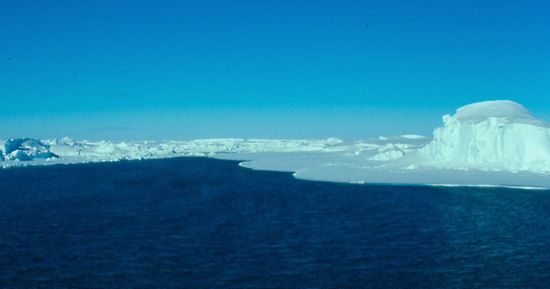
The Bay of Whales was a significant center for Antarctic exploration primarily because it served as the continent’s most southerly open harbor during the summer months. This natural indentation in the Ross Ice Shelf was created by the uneven advancement of the ice shelf, providing explorers with a strategic gateway to the interior of Antarctica.12
Its geographical position offered a distinct logistical advantage for expeditions aiming for the South Pole. For instance, the base established by Roald Amundsen in 1911 was located 60 miles (100 km) closer to the pole than the base used by his rival, Robert Falcon Scott. Beyond its proximity, the Ross Ice Shelf itself provided a vast, gently undulating surface that served as the most effective approach into the continental interior.32
The bay remained a vital site for numerous expeditions, including those led by Richard E. Byrd, until the shifting ice shelf eventually caused the bay to narrow and disappear in 1987.12
How did the Bay of Whales get its name?
The provided search results do not contain information regarding the specific origin or etymology of the name “Bay of Whales.” While the records confirm it was a former indentation in the Ross Ice Shelf and a major site for Antarctic exploration, they do not explain why it was given that name.13
How did the presence of the Bay of Whales impact scientific research in Antarctica?
The Bay of Whales served as a critical hub for Antarctic scientific research by functioning as the continent’s most southerly open harbor during the summer months. This unique geographical feature allowed explorers to establish a series of bases, known as Little America, which provided a stable platform for sustained exploration and data collection.1
The presence of these bases facilitated several key advancements in scientific research:
- Aerial Reconnaissance and Mapping: The bay enabled the use of modern technical resources, such as airplanes and aerial photography, to map vast, previously unknown regions of the Antarctic interior and coastline.8
- Systematic Observation: Expeditions based at the site, particularly those led by Richard E. Byrd, conducted extensive scientific observations and weather monitoring, including the operation of remote stations like the Bolling Advance Base.8
- Foundation for Permanent Research: The logistical success of these early missions, particularly Operation High Jump and Operation Deep Freeze, established the framework for the sustained, permanent scientific research that characterizes modern Antarctic study.8
What role did the Bay of Whales play in the race to reach the South Pole?
The Bay of Whales played a pivotal role in the race to the South Pole by serving as the strategic base of operations for the successful Norwegian expedition led by Roald Amundsen in 1911.14
Its significance in the competition included:
- Geographic Advantage: The bay was located 60 miles (100 km) closer to the South Pole than the base used by the rival British expedition led by Robert Falcon Scott.4
- Logistical Efficiency: Amundsen established his base, known as Framheim, at the bay. From this location, he utilized sled dogs and carefully deposited food supplies along his route, which allowed his team to reach the pole on December 14, 1911, and return safely to the bay by January 25, 1912.46
- Contrast in Outcomes: While Amundsen’s use of the Bay of Whales as a starting point contributed to his expedition’s success, Scott’s party—which relied on a different route via the Beardmore Glacier—faced a much more difficult journey and ultimately perished on the return trip.6
Sources
- Bay of Whales — Encyclopædia Britannica
- Ross Ice Shelf — Encyclopædia Britannica
- Whales, Bay of — Merriam-Webster
- Roald Amundsen — Encyclopædia Britannica
- whaling - Primitive whaling — Encyclopædia Britannica
- Antarctica - Discovery of the Antarctic poles — Encyclopædia Britannica
- whaling - Early commercial whaling — Encyclopædia Britannica
- Amundsen Sea — Encyclopædia Britannica
- Richard E. Byrd — Encyclopædia Britannica
Published on · 3 min read