Bay of Navarino
The provided search results do not contain information regarding specific myths or legends associated with the Bay of Navarino.
Are there any myths or legends associated with the Bay of Navarino?
The provided search results do not contain information regarding specific myths or legends associated with the Bay of Navarino.
The bay is primarily noted for its historical significance, including its identification with Homeric Pylos, the site of a major engagement during the Peloponnesian War, and the decisive 1827 naval battle that helped secure Greece’s independence. While the name “Navarino” is linked to the historical presence of Avars in the region, this is a matter of historical etymology rather than mythology.12
What is the geography and topography of the Bay of Navarino?
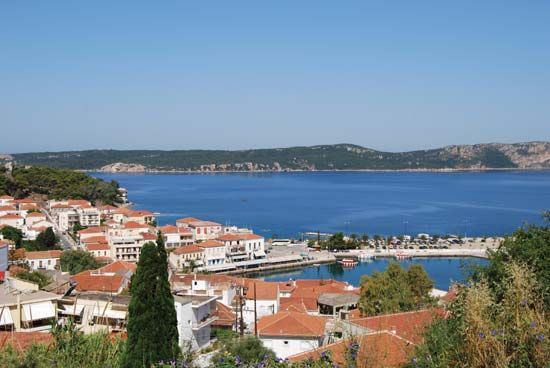
The Bay of Navarino is a small, deep, and almost landlocked bay located in the Messenia department of the southwestern Peloponnese, Greece. It is widely considered one of the safest natural anchorages in the Ionian Sea.1
Topographical Features
- Natural Breakwater: The island of Sfaktiría (Sphacteria) acts as a giant natural breakwater, protecting the bay from the open sea. The island features a summit, Mount Illia, which reaches an elevation of 450 feet (137 meters).12
- Channels: The bay is accessed via two primary passages: a broad channel to the south and the Sikiás Channel to the north.1
- Fortifications: The landscape is defined by historic defensive structures, including the Frankish Palaiókastron (Paleo Kastro) built in 1278, which overlooks the western channel, and the Turkish-built Neo Kastro located at the foot of Mount Áyios Nikólaos.12
- Settlements: The modern town of Pylos is situated on the southern headland of the bay, established by the French in 1829.12
How has the Bay of Navarino been used strategically throughout history?
The Bay of Navarino has served as a vital strategic asset throughout history due to its geography as a deep, sheltered, and nearly landlocked harbor, making it one of the safest natural anchorages in the Ionian Sea.13
Strategic Engagements
- Peloponnesian War (425 BCE): During the conflict between Athens and Sparta, an Athenian force led by Demosthenes established a base at the bay. The subsequent naval victory allowed Athens to trap and force the surrender of elite Spartan troops on the island of Sfaktiría, a major blow to Spartan prestige.32
- Battle of Navarino (1827): This decisive naval engagement during the War of Greek Independence saw the combined fleets of Britain, France, and Russia destroy the Turko-Egyptian fleet. The victory effectively ended the Ottoman naval presence in the region, leading to the creation of the independent Kingdom of Greece.14
Defensive Infrastructure
The bay’s strategic value was reinforced by centuries of fortification:
- Palaiókastron (1278): Built by the Franks, this castle commands the western channel to the harbor.13
- Neo Kastro (1573): Constructed by the Turks at the foot of Mount Áyios Nikólaos, this citadel served to secure the bay during the long periods of Ottoman and Venetian control.3
What is the historical significance of the Bay of Navarino?
The Bay of Navarino, located in the Messenia region of the Peloponnese, is historically significant as one of the safest natural anchorages in the Ionian Sea and a site of pivotal military engagements.13
Key Historical Milestones
- Peloponnesian War: The island of Sfaktiría, which acts as a natural breakwater for the bay, was the site of a major engagement during the Peloponnesian War, where Athenian forces secured a strategic victory.1
- Battle of Navarino (1827): This decisive naval battle during the War of Greek Independence saw the combined fleets of Britain, France, and Russia destroy the Turko-Egyptian fleet. As the last major fleet action of the sailing-ship era, the victory effectively ended Ottoman naval power in the region, leading to the establishment of the independent Kingdom of Greece in 1832.13
The bay also features significant historical architecture, including the 13th-century Frankish castle of Palaiókastron.1
Sources
- Bay of Navarino — Encyclopædia Britannica
- Pylos — Encyclopædia Britannica
- Battle of Navarino — Encyclopædia Britannica
- Battle of Pylos — Encyclopædia Britannica
- ancient Greek civilization - Spartan recovery — Encyclopædia Britannica
Published on · 3 min read