Beach
Coastal landforms like barrier islands and spits are integral components of beach geology, as they are formed by the same processes of sediment transport and…

How do coastal landforms like barrier islands and spits relate to beach geology?
Coastal landforms like barrier islands and spits are integral components of beach geology, as they are formed by the same processes of sediment transport and wave energy that shape beaches themselves.123
Barrier Islands These are elongate, sand-dominated features that parallel the shore. They typically contain a well-developed beach on their seaward side, along with coastal dunes and landward environments like marshes or lagoons. Barrier islands are essentially dynamic systems that maintain an equilibrium profile through the deposition of sediment by waves and longshore currents.24
Spits A spit is a narrow coastal formation tied to the mainland at one end. Like beaches, they are composed of sand or shingle transported by longshore movement. Spits often form where the coast changes direction or across estuary mouths, and they can evolve into bay-mouth barriers that enclose lagoons.14
Both features represent the accumulation of sediment—the same material that constitutes the foreshore and backshore of a beach. Their morphology is dictated by the balance of wave energy, sediment supply, and tidal processes.5263
What are the different types of beach profiles, and how are they formed?
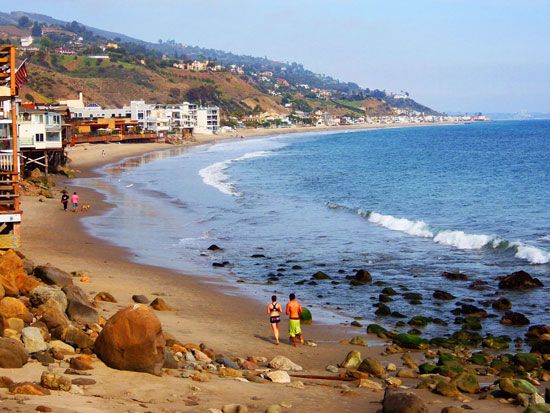
Beach profiles are dynamic, reflecting a balance between wave energy, sediment supply, and tidal processes. A beach profile is generally divided into two main parts: the foreshore (the seaward, relatively steep intertidal zone) and the backshore (the landward, nearly horizontal zone above the high-tide line).2
Profile Variations
Beach profiles change appearance based on prevailing conditions:
- Accretional Profile: During quiescent, low-energy wave conditions, sediment is transported landward, building up both the foreshore and backshore.2
- Erosional Profile: During storm conditions, steep waves remove sediment from the beach and transport it offshore, typically leaving behind only the seaward-sloping foreshore.25
Formation and Contributing Factors
The configuration of these profiles is shaped by several key factors:
- Wave Action: Small waves generally transport sediment toward the coast, promoting beach growth, while large storm waves cause erosion. Waves also sort sediment; coarser grains, such as gravel, typically result in steeper foreshore slopes compared to finer sand.25
- Nearshore Features: The profile often extends into the nearshore zone, which may include submarine longshore bars and troughs. These features help dissipate wave energy and regulate sediment movement.28
- Wind and Tides: Wind action in the backshore can move sand to form dunes, while tidal range influences the width and complexity of the beach slope.28

How do tides influence beach morphology and sediment distribution?
Tides significantly influence beach morphology and sediment distribution by regulating the spatial reach of wave energy and facilitating sediment transport in specific coastal environments.
Influence on Shoreline and Wave Energy
The rise and fall of the tide dictates the position of the shoreline, effectively shifting the zone where waves and longshore currents perform their work. In environments with a large tidal range, this movement can alter the shoreline by as much as one kilometer during a single cycle. By changing the water depth and the location of the active surf zone, tides determine the specific areas of the beach profile that are subjected to erosion or deposition at any given time.9
Sediment Transport
While tidal currents on open beaches are generally too weak to transport sediment, they play a critical role in constricted areas such as inlets and estuary mouths. In these locations, the volume of water moving through the constriction—the tidal prism—can generate currents exceeding two meters per second, which are highly effective at moving large quantities of sand.9
What is a beach in geology?
In geology, a beach is defined as an accumulation of sediment along the shores of a sea or lake. These landforms consist of loose material—most commonly sand, but also gravel, pebbles, or mud—that is shaped by coastal processes, including wave action, tides, and sediment supply.25
Geologically, a beach is not merely the dry sand area but includes the adjacent nearshore environment where waves break and transport sediment. A typical beach profile consists of two primary zones:5
- Foreshore: The seaward, intertidal zone that experiences regular wave activity and slope changes.52
- Backshore: The landward, supra-tidal zone that remains relatively horizontal and is typically only inundated during storms.5
Beaches are dynamic systems that undergo constant change. They may be classified into types based on their setting, such as sediment strips bordering rocky coasts, free beaches along plains, or narrow barriers that separate lagoons from the open sea. Their morphology is highly responsive to energy conditions; for instance, they may shift between an “accretional” state during calm weather and an “erosional” state during storms.25
Sources
- spit — Encyclopædia Britannica
- coastal landforms - Beaches — Encyclopædia Britannica
- coastal landforms - Barrier island/estuarine systems — Encyclopædia Britannica
- lagoon - Waves , tides, and surf — Encyclopædia Britannica
- beach — Encyclopædia Britannica
- coastal landforms - Coastal dunes — Encyclopædia Britannica
- coastal landforms - Landforms of depositional coasts — Encyclopædia Britannica
- coastal landforms - Waves — Encyclopædia Britannica
- coastal landforms - Tides — Encyclopædia Britannica
- coastal landforms - Rip currents — Encyclopædia Britannica
- coastal landforms - Longshore currents — Encyclopædia Britannica
- What causes tides in the ccean? — Encyclopædia Britannica
- beach — Merriam-Webster
- beach — Merriam-Webster
Published on · 4 min read