Coastal Landforms
Coastal landforms are categorized based on the dominant processes shaping them: erosion or deposition.
What is the difference between erosional and depositional coastal landforms?
Coastal landforms are categorized based on the dominant processes shaping them: erosion or deposition.1
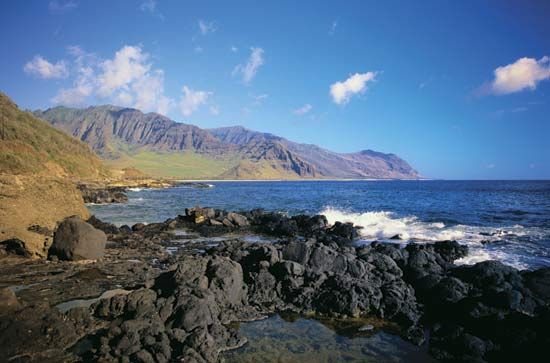
Erosional Coasts These are characterized by little to no sediment and are typically dominated by exposed bedrock with high relief and rugged topography. They often occur on the leading edges of lithospheric plates. Key features include:2
- Sea cliffs: Steep to vertical bedrock faces formed by wave-induced erosion.3
- Sea arches: Structures created by varying rates of bedrock resistance to erosion.4
- Sea stacks: Isolated rock pillars left behind after the collapse of a sea arch.4
Depositional Coasts These are defined by abundant sediment accumulation, resulting in relatively smooth plains and lower relief. Common features include:52
- Beaches: Accumulations of unconsolidated sediment.56
- Coastal dunes: Linear sand accumulations formed by wind transport.7
- Deltas and barrier islands: Large-scale systems built by the deposition of river-borne or marine sediments.86
What are the main types of coastal landforms, and how are they formed?
Coastal landforms are shaped by the interaction of waves, currents, tides, and the underlying geology. They are broadly categorized into two types: erosional and depositional.3
Erosional Landforms
Erosional coasts typically feature rugged topography and exposed bedrock, often found where tectonic plates meet or in glaciated regions. These landforms are created primarily through wave-induced abrasion and impact.96
- Sea cliffs: Steep bedrock faces formed by waves cutting a notch at the base, leading to the collapse of higher rock layers.4
- Sea arches: Formed by differential erosion where weaker rock is worn away faster than surrounding material.10
- Sea stacks: Isolated rock pillars left behind after a sea arch collapses.2
Depositional Landforms
Depositional coasts occur where sediment accumulates faster than it is removed. This process is driven by longshore currents, which transport sediment along the shore.911
- Deltas: Formed at river mouths where sediment discharge exceeds the capacity of coastal processes to carry it away.12
- Beaches and Barrier Systems: These include barrier islands and strand plains, which develop as sediment is deposited by wave action.73
What are some examples of coastal cliffs, and how do they form over time?
Sea cliffs are steep to vertical bedrock formations that can range from a few meters to hundreds of meters in height. They are prominent features of erosional coasts, such as those found along the shores of California and Oregon.14
Formation Process
The development of sea cliffs is primarily driven by the interaction between waves and the coastal bedrock. The process typically follows these stages:615
- Basal Undercutting: Waves strike the base of the cliff, using hydraulic pressure and the abrasive action of sand and pebbles to carve a notch into the bedrock.614
- Gravity and Collapse: As the base is undercut, the rock above loses structural support. Gravity eventually causes the unsupported upper sections to collapse, resulting in the characteristic steep or vertical profile of the cliff.914
- Weathering: Atmospheric agents, including rain and frost, further degrade the cliff face, contributing to the breakdown of rock material.69
Over time, this continuous cycle of erosion and collapse causes the shoreline to retreat. At the base of these cliffs, a flat, bench-like feature known as a wave-cut platform often forms as the cliff recedes.612
What are some unique coastal landforms found in tropical regions, such as coral reefs and mangrove swamps?
Tropical regions host unique coastal landforms shaped by biological activity, known as biogenic landforms. Two of the most prominent examples are coral reefs and mangrove swamps.
Coral Reefs
Coral reefs are complex structures built primarily through the interaction of corals, algae, and bryozoa. They often develop in tropical marine settings, with the Great Barrier Reef serving as the largest example. These reefs can evolve into various forms, such as atolls or barrier reefs, often following the subsidence of volcanic islands or changes in sea level. The reef framework itself creates habitats that trap sediment, which can eventually accumulate to form sandy islets or cays on the reef surface.192021
Mangrove Swamps
Mangrove forests are vital coastal ecosystems found along sheltered tropical estuaries and muddy, saline coasts. These areas are defined by:
- Specialized Root Systems: Mangroves possess prop roots for support and pneumatophores (respiratory roots) that allow them to thrive in oxygen-poor, waterlogged mud.5
- Sediment Trapping: Their dense root networks trap sediments and filter pollutants, which improves water quality and protects nearby coral reefs and seagrass beds.22
- Coastal Protection: By acting as a buffer, mangroves protect shorelines from erosion, storm surges, and flooding.522
Sources
- coast — Encyclopædia Britannica
- coastal landforms — Encyclopædia Britannica
- coastal landforms - Landforms of erosional coasts — Encyclopædia Britannica
- coastal landforms - General coastal morphology — Encyclopædia Britannica
- coastal landforms - Beaches and coastal dunes — Encyclopædia Britannica
- coastal landforms - Sea cliffs — Encyclopædia Britannica
- coastal landforms - Sea arches — Encyclopædia Britannica
- coastal landforms - Coastal dunes — Encyclopædia Britannica
- coastal landforms - Factors and forces in the formation of coastal features — Encyclopædia Britannica
- coastal landforms - Deltas — Encyclopædia Britannica
- coastal landforms - Longshore currents — Encyclopædia Britannica
- coastal landforms - Waves — Encyclopædia Britannica
- coastal landforms - Sea stacks — Encyclopædia Britannica
- erosion — Encyclopædia Britannica
- coastal landforms - Wave-cut platforms — Encyclopædia Britannica
- coastal landforms - Other factors and processes — Encyclopædia Britannica
- cliffs — Merriam-Webster
- coastal landforms - Tides — Encyclopædia Britannica
- coastal landforms - Barrier island/estuarine systems — Encyclopædia Britannica
- mangrove — Encyclopædia Britannica
- mangrove: Top Questions — Encyclopædia Britannica
- Mangroves Matter - Learn more — Encyclopædia Britannica
- biogenic landform — Encyclopædia Britannica
- coral reef - Structure — Encyclopædia Britannica
- coral reef - Origin and development of reefs — Encyclopædia Britannica
- Tropical rainforest - Environment — Encyclopædia Britannica
Published on · 3 min read