Beaked Whale
Beaked whales (family Ziphiidae) are a group of medium-sized toothed whales distinguished by several unique physical characteristics:
What are the unique physical characteristics of beaked whales?
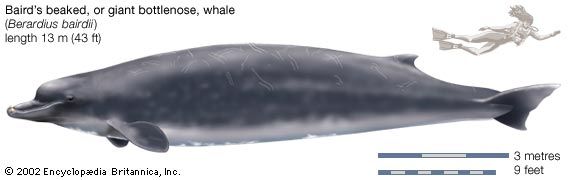
Beaked whales (family Ziphiidae) are a group of medium-sized toothed whales distinguished by several unique physical characteristics:
- Head and Snout: They possess an extended, narrow snout that resembles a beak1. Males often feature a large, bulging forehead, and in some species, the bone within the beak is as dense as rock.12
- Throat and Fins: A defining feature is the presence of two throat grooves that meet under the chin. They have small, rounded flippers and a dorsal fin positioned toward the rear of the body.1
- Flukes: Unlike other whales, beaked whales lack a central notch in their wide flukes.21
- Dentition: They typically lack teeth in the upper jaw. Functional teeth are usually limited to one or two pairs in the lower jaw, which often erupt only in males.21
- Blowhole: Their head structure directs their blow forward rather than upward, making them difficult to spot at the surface.1
What unusual adaptations do beaked whales have for deep-sea diving?
Beaked whales (family Ziphiidae) are among the most accomplished deep-sea divers, with some species, such as Cuvier’s beaked whale, capable of remaining submerged for over three hours. To survive the extreme pressures and oxygen demands of the deep ocean, they utilize several specialized physiological adaptations:7
- Oxygen Storage: Like other diving mammals, beaked whales possess high concentrations of myoglobin in their muscle tissue. This protein acts as an efficient oxygen-storage unit, allowing them to sustain their muscles during long periods without surfacing to breathe.9
- Pressure Tolerance: To avoid the dangers of thoracic squeeze—the compression of the chest cavity and lungs under high pressure—these whales have evolved highly elastic chest cavities. Unlike humans, their lungs are adapted to collapse safely under pressure without separating from the chest wall, preventing tissue damage during deep descents.10
- Efficient Gas Usage: Their bodies are physiologically adapted to utilize gases within the bloodstream more conservatively, which helps them manage oxygen levels effectively while hunting at extreme depths.10
How do beaked whales use echolocation to navigate and find food?
As toothed whales, beaked whales utilize echolocation to navigate their environment, locate food, and avoid obstacles in the deep ocean. This process involves the following mechanisms:1112
- Sound Production: Beaked whales generate high-pitched clicking sounds by passing air through specialized tissues called phonic lips located in their nasal passages beneath the blowhole.11
- Sound Emission: These clicks are directed through the melon, a fatty organ on the whale’s forehead that acts as an acoustic lens to focus the sound waves into the water.11
- Reception: When the sound waves strike an object, they bounce back as echoes. These vibrations are received by the whale through an acoustic window in the lower jaw, which conveys the energy to the inner ear.11
- Frequency: To achieve effective spatial resolution in water, these whales use high-frequency pulses, typically ranging between 5 and 150 kilohertz.1113
This sophisticated system allows them to “see” their surroundings even in the darkness of the deep sea.1312
What is known about the diving behavior and feeding habits of beaked whales?
Beaked whales (family Ziphiidae) are recognized as some of the most accomplished deep-sea divers among cetaceans. They are known for their ability to remain submerged for extended periods, typically holding their breath for nearly an hour. The record for the longest dive belongs to a Cuvier’s beaked whale (Ziphius cavirostris), which was documented remaining underwater for 222 minutes (3 hours and 42 minutes) in 2020.71
Regarding their feeding habits, beaked whales are toothed whales that primarily consume squid, though they also feed on various fish and bottom-dwelling invertebrates. Unlike many other cetaceans, they possess a highly specialized dentition; functional teeth are generally limited to one or two pairs in the lower jaw, which typically only erupt in males. To process their diet, they utilize a complex stomach structure that includes multiple connecting chambers, which are notably more complex than those found in other whale species.13
Sources
- beaked whale — Merriam-Webster
- beaked whale — Encyclopædia Britannica
- cetacean - Feeding adaptations — Encyclopædia Britannica
- toothed whale — Encyclopædia Britannica
- Beak — Encyclopædia Britannica
- Ziphiidae — Merriam-Webster
- How long can whales hold their breath? — Encyclopædia Britannica
- ziphioid — Merriam-Webster
- thoracic squeeze — Encyclopædia Britannica
- Myoglobin — Encyclopædia Britannica
- cetacean - Sound production and communication — Encyclopædia Britannica
- whale vocalization — Encyclopædia Britannica
- sound reception - Echolocation in other mammals — Encyclopædia Britannica
- Echolocation — Encyclopædia Britannica
- sound reception - Marine mammals — Encyclopædia Britannica
- whale — Encyclopædia Britannica
Published on · 3 min read