Blesmol
Blesmols (family Bathyergidae) are rodents highly adapted to a subterranean lifestyle in arid regions of Africa. Their physical characteristics reflect this…
What are the key physical characteristics of blesmols?
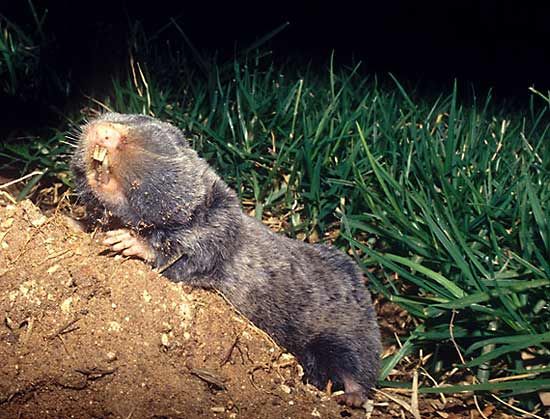
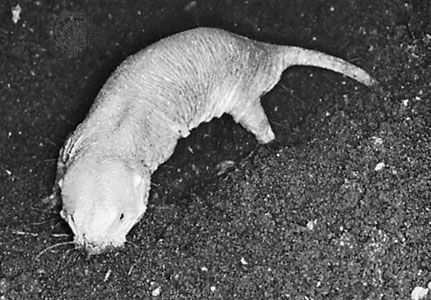
Blesmols (family Bathyergidae) are rodents highly adapted to a subterranean lifestyle in arid regions of Africa. Their physical characteristics reflect this specialized environment:
- Body Shape: They have stocky, cylindrical bodies that appear virtually neckless, allowing them to navigate narrow tunnels efficiently.1
- Head and Teeth: They possess strong, blunt heads with forward-protruding incisor teeth used for digging. A unique feature is that their mouths can close behind these teeth, which prevents them from ingesting soil while excavating.1
- Limbs and Feet: Their limbs are short with large feet. The hind feet are often fringed with stiff hairs to help push soil rearward. While most have small claws on their forefeet, dune blesmols (genus Bathyergus) feature long, strong front claws.1
- Sensory Organs: Blesmols have very small eyes and lack external ears; they possess only openings that are typically hidden by fur or thickened skin. Despite this, they have an acute sense of hearing and are highly sensitive to ground vibrations.1
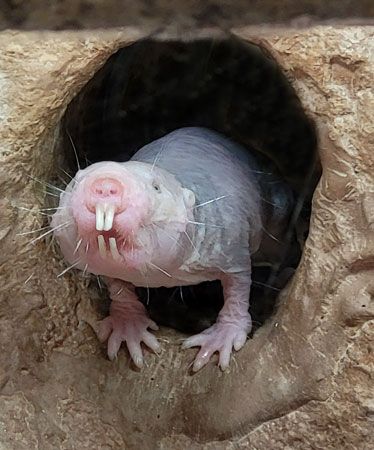
- Coat: With the exception of the naked mole rat, which has wrinkled, pinkish skin, blesmols are covered in dense, velvety fur that varies in color from white and gray to shades of brown, red, and black.1
What are the different species of blesmols?
Blesmols, which belong to the family Bathyergidae, comprise approximately 12 species organized into five genera. These rodents are divided into two subfamilies based on their biological classification:16
Subfamily Bathyerginae
This group includes 11 species across four genera:
- Genus Cryptomys: Known as common blesmols, this genus contains 5 to 10 species.1
- Genus Bathyergus: These are the dune blesmols, consisting of 2 species. They are among the largest blesmols and are distinguished by their long, strong front claws used for digging.1
- Genus Georychus: This genus includes 1 species, the Cape blesmol.1
- Genus Heliophobius: This genus consists of 1 species, the silvery blesmol.1
Subfamily Heterocephalinae
This subfamily contains only one genus and species:
- Genus Heterocephalus: This includes the naked mole rat (Heterocephalus glaber), also known as the naked blesmol. It is the smallest of the blesmols and is unique for its wrinkled, pinkish skin and colonial social structure.1
It is important to note that while other burrowing rodents are sometimes referred to as “mole rats,” such as the blind mole rat (subfamily Spalacinae), they are not members of the blesmol family.14
How do blesmols’ teeth differ from other rodents?
Blesmols possess a specialized dental adaptation that distinguishes them from many other rodents. While most rodents use their teeth primarily for gnawing food, blesmols utilize their forward-protruding incisor teeth as primary tools for excavating their subterranean burrows.1
A key functional difference is the ability of the blesmol to close its mouth behind these front teeth. This anatomical feature allows the animal to dig through soil using its incisors without ingesting the dirt it is displacing. While other rodents may use their teeth to manipulate their environment, this specific “seal” behind the incisors is a critical evolutionary adaptation for a life spent almost entirely underground in arid African environments.1
How have blesmols been studied by scientists, and what have we learned from them?
Scientific research into blesmols, particularly the naked mole rat, has provided significant insights into biology, aging, and disease resistance. Because these rodents live in extreme subterranean environments, they have developed unique physiological adaptations that have become a major focus of study.71
Key findings from scientific research include:
- Exceptional Longevity: Scientists have discovered that naked mole rats defy the Gompertz law, which posits that mortality risk increases exponentially with age. Unlike humans, whose risk of death doubles every eight years after age 30, the mortality risk for a naked mole rat remains constant throughout its life, allowing some to live up to 30 years.7
- Cancer Resistance: Research indicates that these animals have a remarkably low incidence of cancer. This resistance is attributed to the presence of high-molecular-weight hyaluronan, a sugar molecule that prevents cells from clumping together to form tumors.7
- Eusociality: Studies have highlighted their status as one of the few eusocial mammals. Their hierarchical colony structure, led by a single reproductive queen, has provided a model for understanding complex social behaviors and cooperation in the animal kingdom.71
Sources
- blesmol — Encyclopædia Britannica
- Bathyergidae — Merriam-Webster
- blesmol — Merriam-Webster
- blind mole rat — Encyclopædia Britannica
- African pouched rat — Encyclopædia Britannica
- rodent - Evolution and classification — Encyclopædia Britannica
- naked mole rat — Encyclopædia Britannica
Published on · 4 min read