Birch Mouse
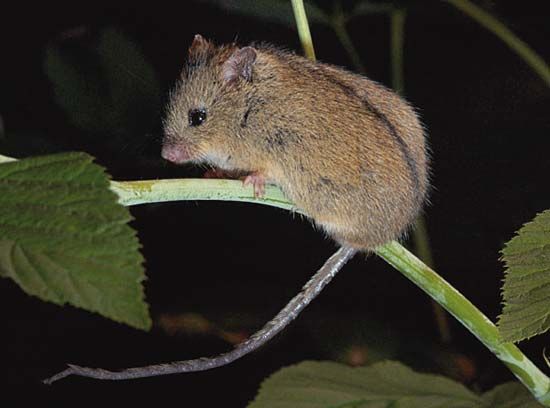
The birch mouse (genus Sicista) refers to any of 13 species of small, long-tailed rodents found in the forests, thickets, and steppes of Europe and Asia.
What is birch mouse?
The birch mouse (genus Sicista) refers to any of 13 species of small, long-tailed rodents found in the forests, thickets, and steppes of Europe and Asia.1
Despite their name, they are not true mice belonging to the family Muridae. Instead, they are members of the family Dipodidae, which also includes jumping mice.1
Key characteristics of the birch mouse include:
- Physicality: They measure 5 to 10 cm in length, excluding a long, semiprehensile tail used for support while climbing. They typically have brown or yellowish-brown fur, sometimes featuring a dark stripe along the back.1
- Behavior: They are adept climbers and ground-leapers that consume both insects and plant material. They reside in burrows and undergo hibernation from fall through spring.1
- Evolutionary History: Their lineage dates back to the Oligocene Epoch, with fossil evidence suggesting they originated in Eurasia.1
What are the differences between birch mice and true mice?
While both birch mice and “true mice” are rodents, they are distinct animals belonging to different biological families. The term “true mice” refers specifically to members of the family Muridae, whereas birch mice belong to the family Dipodidae.12
The primary differences between them include:
- Taxonomy: True mice belong to the genus Mus within the subfamily Murinae. Birch mice belong to the genus Sicista within the family Dipodidae, a group that also includes jumping mice and jerboas.321
- Physical Traits: Birch mice possess a long, semiprehensile tail that they use for support while climbing. In contrast, true mice generally have tails that are either shorter or roughly equal to the length of their head and body, and they lack the specialized climbing adaptations of the birch mouse.13
- Behavior: Birch mice are known for hibernating underground from fall through spring. While some true mice are adaptable, they do not share this specific hibernation cycle; many species of Mus remain active throughout the year, depending on their environment.13
- Locomotion: Birch mice are specialized to travel by leaping and are also adept climbers. While some true mice are agile climbers or leapers, they are primarily ground-dwelling rodents.13
How do birch mice use their tails for climbing?
Birch mice are highly skilled climbers that utilize their tails as a form of additional support while navigating through forests and thickets. Their tails are described as semiprehensile, meaning they possess the ability to grasp or wrap around objects to provide stability.1
Because the tail is longer than the combined length of the animal’s head and body, it acts as a vital balancing tool. By using the tail for support, these rodents can maintain their grip and posture while moving across branches or uneven terrain in their natural habitats.1
What is the purpose of hibernation for small rodents?
The primary purpose of hibernation for small rodents is to survive periods when food supplies are scarce and environmental conditions are harsh, such as during the winter months. By entering a state of deep dormancy, these animals bypass the need for constant food intake, which would otherwise be difficult to sustain.4
Key aspects of this survival strategy include:
- Energy Conservation: Hibernation allows rodents to reduce their metabolic rate, heart rate, and respiration dramatically, conserving energy when resources are unavailable.45
- Metabolic Adaptation: Rodents prepare for this period by accumulating significant stores of white and brown body fat in the fall. Brown fat is particularly important as it provides both energy and heat when the animal eventually wakes up.4
- Environmental Protection: By retreating into protected niches like underground burrows, rodents can escape predators and extreme weather.65
- Physiological Resilience: Hibernation may offer secondary benefits, such as increased resistance to radiation and certain infectious diseases, as the lowered body temperature and metabolic state facilitate cellular repair and inhibit parasite development.7
While hibernation is an effective species-survival mechanism, it is a precarious process for the individual, requiring a delicate balance between maintaining life and minimizing energy expenditure.5
Sources
- birch mouse — Encyclopædia Britannica
- mouse — Encyclopædia Britannica
- rodent - Evolution and classification — Encyclopædia Britannica
- Why Do Some Animals Hibernate? — Encyclopædia Britannica
- Dormancy - Protection from disease and radiation — Encyclopædia Britannica
- Dormancy - Neural changes — Encyclopædia Britannica
- Dormancy - Endocrine activity — Encyclopædia Britannica
- Dormancy - Entrance into hibernation — Encyclopædia Britannica
- Dormancy - Types of hibernation in mammals — Encyclopædia Britannica
- Dormancy - True mammalian hibernation — Encyclopædia Britannica
Published on · 3 min read