Arctic Archipelago
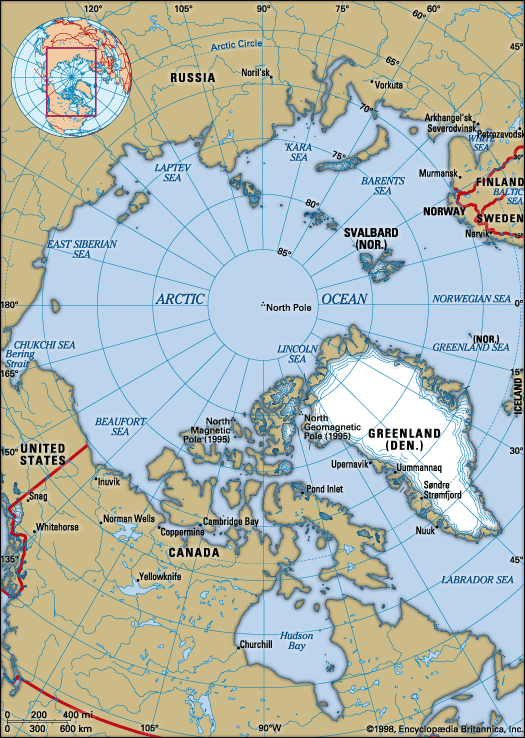
The Arctic Archipelago is a vast group of Canadian islands located in the Arctic Ocean, situated north of the Canadian mainland. Covering an area of…
What is Arctic Archipelago?
The Arctic Archipelago is a vast group of Canadian islands located in the Arctic Ocean, situated north of the Canadian mainland. Covering an area of approximately 550,000 square miles (1,424,500 square km), the region features diverse geological characteristics: the southeastern islands are an extension of the Canadian Shield, while the remaining areas consist of the Arctic lowlands to the south and the Innuitian Mountains to the north.1
The archipelago comprises numerous islands, including several of the world’s largest, such as Baffin, Ellesmere, Victoria, Banks, and Prince of Wales.1
What is the Northwest Passage and why is it historically significant?
The Northwest Passage is a historical sea route that winds through the Arctic Archipelago of Canada, connecting the Atlantic Ocean to the Pacific Ocean via the Arctic Beaufort Sea.4
Historical Significance
For centuries, the passage represented one of the world’s most challenging maritime objectives. Following the disruption of overland trade routes to the East in the 15th century, Western explorers sought a northern maritime shortcut to East Asia to bypass the long voyages around Africa or South America.4
The quest for the passage claimed many lives and ships, including the ill-fated 1845 expedition of Sir John Franklin. It was not successfully navigated by sea until 1903–1906, when Roald Amundsen completed the first full transit.45
Modern Context
Today, the passage holds significant economic potential for global trade, as it could drastically reduce shipping distances between major ports like London and Tokyo. Due to global warming and the resulting decline in summer sea ice, the route has become increasingly accessible to commercial vessels and cruise ships, sparking ongoing discussions regarding sovereignty and environmental regulation.4
How does permafrost affect the landscape and wildlife of the Arctic?
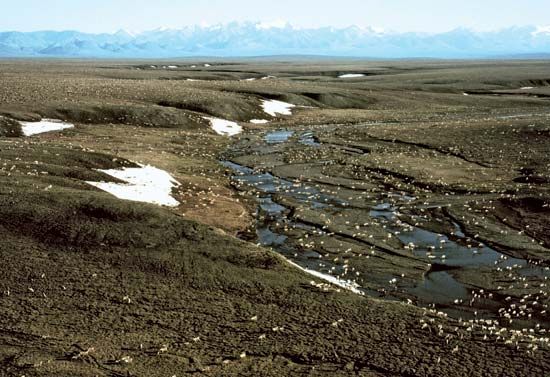
Permafrost is ground that remains at or below 0 °C (32 °F) for at least two consecutive years, acting as a fundamental shaper of the Arctic landscape and its ecosystems.6
Landscape Effects
Because permafrost is impermeable to water, it prevents downward drainage, causing the surface to become saturated and boggy during the summer thaw. This process leads to several distinct geological features:78
- Patterned Ground: The freeze-thaw cycle causes soil and rock to shift, creating stone circles, polygons, and stripes.78
- Thermokarst: When ground ice melts, the surface settles unevenly, forming pits, sinkholes, and hummocks.9
- Pingos: These are large, ice-cored mounds that can reach up to 200 feet in height.78
- Solifluction: Waterlogged soil near the surface slides downhill over the frozen layer, grading slopes into smooth profiles.78
Wildlife and Environmental Impact
Most biological activity, including root growth and animal burrowing, is restricted to the “active layer” above the permafrost. However, thawing permafrost poses significant risks:7
- Pollution: Thawing releases trapped heavy metals and minerals into waterways, which can be toxic to fish and insects.10
- Habitat Loss: Changes in vegetation and the potential for increased tundra fires threaten species like caribou by reducing their habitats.11
- Climate Feedback: Thawing releases stored carbon and methane, which accelerates global warming and further degrades the ecosystem.1110
What are some unique animals that live in the Canadian Arctic Archipelago?
The Canadian Arctic Archipelago is home to a variety of unique animals adapted to the extreme conditions of the High Arctic. Because of the harsh environment, many of these species are circumpolar in distribution and have evolved specialized traits to survive the cold and limited food supply.1213
Notable Mammals
- Musk Ox: These large herbivores are well-equipped for the cold with exceptionally thick coats. They are found on several Canadian Arctic islands and are considered a “refugee” species that has persisted in the far north.1413
- Peary Caribou: The smallest subspecies of caribou, they are native to the High Arctic of Canada and Greenland. Uniquely, they exchange their silvery summer coats for white ones during the winter.1512
- Polar Bear: While they are marine animals that spend much of their time on sea ice hunting seals, they are frequently found on land in the archipelago, where females den to bear young.161217
- Collared Lemmings: Unlike other lemmings, these turn white in the winter and grow specialized “claws”—extensions of their toe pads—to dig through snow drifts to reach food.1512
- Arctic Fox: These predators are highly adapted to the tundra, typically sporting a white coat in winter for camouflage against the snow.1412
Birds and Marine Life
- Ptarmigans: These birds are among the few permanent residents of the Arctic. They trade their brown summer plumage for white feathers in winter and even develop downy “boots” to help them walk on snow.1512
- Marine Mammals: The waters surrounding the archipelago support species such as the beluga whale, narwhal, and various seals, including the ringed seal and bearded seal.17
Sources
- Arctic Archipelago — Encyclopædia Britannica
- Arctic - Study and exploration — Encyclopædia Britannica
- Alaska - Climate of Alaska — Encyclopædia Britannica
- Northwest Passage — Encyclopædia Britannica
- European exploration - The northern passages — Encyclopædia Britannica
- Tundra - Soils — Encyclopædia Britannica
- thermokarst — Encyclopædia Britannica
- permafrost — Encyclopædia Britannica
- Tundra - Effects of human activities and climate change — Encyclopædia Britannica
- Arctic - Drainage and soils — Encyclopædia Britannica
- permafrost - Climatic change — Encyclopædia Britannica
- Tundra - Arctic mammals — Encyclopædia Britannica
- 7 Animals That Turn White in Winter — Encyclopædia Britannica
- polar bear — Encyclopædia Britannica
- Arctic National Wildlife Refuge — Encyclopædia Britannica
- Arctic - Climate of the Arctic — Encyclopædia Britannica
- Polar ecosystem - Biota of the Arctic — Encyclopædia Britannica
- Arctic - Animals of the land and fresh water — Encyclopædia Britannica
- polar bear: Top Questions — Encyclopædia Britannica
- Arctic - Marine fauna — Encyclopædia Britannica
Published on · 4 min read