Barrow Canyon
Barrow Canyon is a submarine canyon carved into the Arctic continental shelf off the coast of Alaska.
What is Barrow Canyon?
Barrow Canyon is a submarine canyon carved into the Arctic continental shelf off the coast of Alaska.1
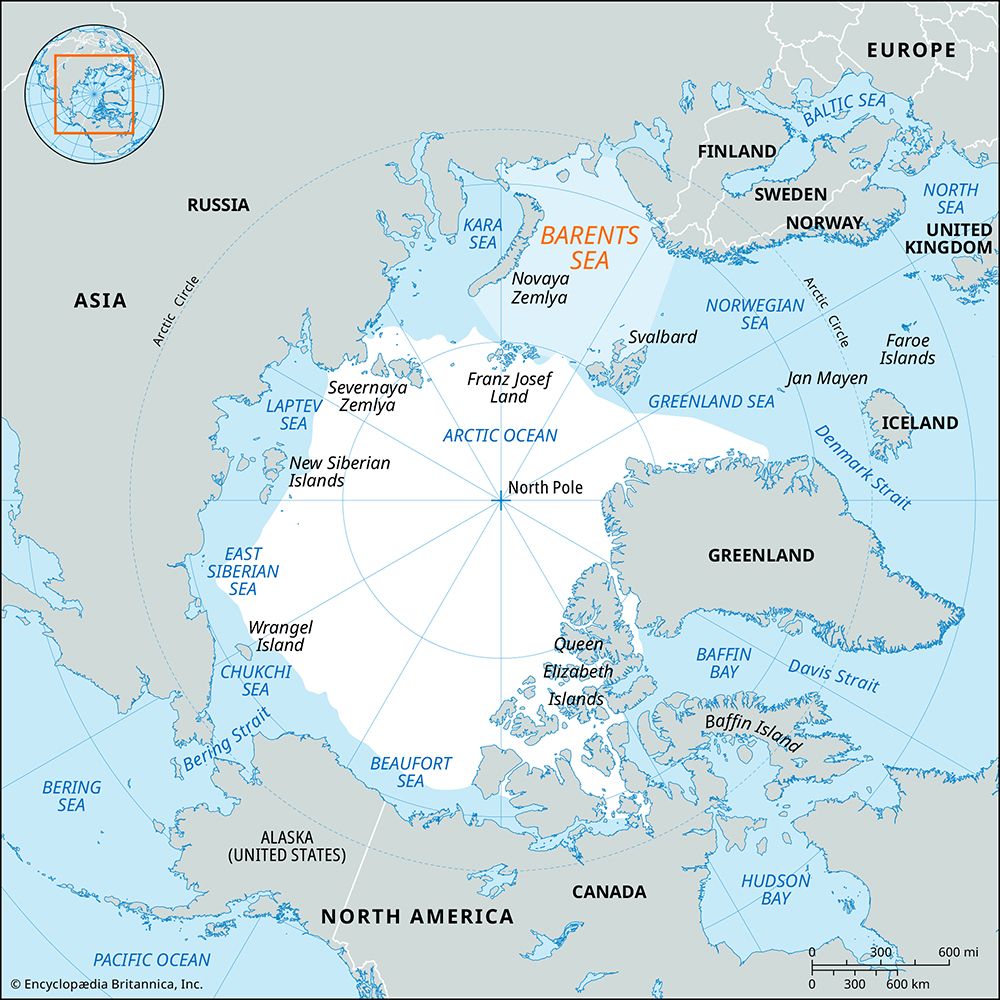
The canyon begins in the Chukchi Sea, approximately 95 miles west of Point Barrow, at a depth of about 150 feet. It follows a northeast trajectory along the coast before crossing into the Beaufort Sea. Characterized by a U-shaped cross-section, the canyon ranges from 3.5 to 6 miles in width and reaches depths of 165 to 330 feet while on the Chukchi Shelf.1
While the canyon is less extensively mapped within the Beaufort Shelf, it is known to extend to the shelf edge. Historically, the canyon served as a submarine passage into the Arctic Basin during the 1958 trans-polar crossing by the U.S. Navy submarine USS Nautilus.1
What is a submarine canyon?
A submarine canyon is a narrow, steep-sided valley that cuts into the continental slopes and continental rises of the oceans. These features, which resemble terrestrial canyons, typically originate on the continental shelf or within the slopes themselves.23
Most submarine canyons are V-shaped with steep, rocky walls that can reach heights of several kilometers. While many are less than 48 km (30 miles) long, some extend over 320 km (200 miles). They serve as vital conduits, transporting sediment from continental margins to the deep-sea abyssal plains2.2
The formation of these canyons is attributed to a combination of processes. Prevailing theories suggest they may have begun with subaerial erosion during the Pleistocene Epoch when lower sea levels exposed the continental shelves. However, marine processes—specifically the movement of turbidity currents and underwater avalanches of sediment—are considered the primary agents responsible for their deep excavation and ongoing maintenance.23
How does the Arctic continental shelf differ from others?
The Arctic continental shelf is distinct from others primarily due to its immense size and asymmetrical distribution. While the global average width of a continental shelf is approximately 40 miles (65 km), the Arctic shelf is exceptionally broad in the Eurasian sector, extending between 300 and 1,100 miles (480 to 1,770 km) from the coast of Siberia. In contrast, the shelf north of Alaska and Greenland maintains a more typical width of 60 to 120 miles.56
Key characteristics that differentiate the Arctic shelf include:
- Scale: It is the world’s largest continental shelf, with nearly one-third of the total area of the Arctic Ocean underlain by shelf deposits.56
- Marginal Seas: The Eurasian sector is divided by islands and peninsulas into five main marginal seas—the Chukchi, East Siberian, Laptev, Kara, and Barents seas—which occupy 36 percent of the ocean’s area despite containing only 2 percent of its water volume.7
- Sedimentation: These shallow marginal seas receive the discharge of major rivers, which significantly influences surface-water conditions and contributes to the distribution of sand, gravel, and mud across the shelf.87
What kind of marine life lives in the Chukchi Sea?
The Chukchi Sea supports a diverse range of marine life, characterized by species adapted to the Arctic environment. Indigenous marine mammals include several species of seals and walrus, while various whales are common summer visitors to the region.12
The broader Arctic marine ecosystem, which includes the Chukchi Sea, features several key groups:
- Marine Mammals: Beyond seals and walruses, Arctic-specific whale species include the beluga and narwhal. The polar bear also occupies a unique ecological niche, functioning as an aquatic animal that relies on sea ice.13
- Fish: While fish are less abundant in the Arctic zone compared to other regions, the arctic char and small gadids, such as the polar cod and arctic cod, are notably present.13
- Seabirds: Many seabirds migrate to the area during the summer, including members of the auk family, various sea ducks, gulls, terns, and jaegers.13
- Ice-Associated Ecosystems: A critical food web exists within the sea ice itself, supported by algae that provide energy for organisms ranging from copepods and crustaceans to fish and seals.13
Sources
- Barrow Canyon — Encyclopædia Britannica
- submarine canyon — Encyclopædia Britannica
- submarine canyon — Merriam-Webster
- canyon — Encyclopædia Britannica
- Arctic Ocean - Topography of the ocean floor — Encyclopædia Britannica
- Beaufort Sea — Encyclopædia Britannica
- continental shelf - Structure — Encyclopædia Britannica
- ice shelf — Encyclopædia Britannica
- Arctic Ocean - Sea ice — Encyclopædia Britannica
- Arctic Ocean - Oceanography — Encyclopædia Britannica
- Arctic Ocean - Origin — Encyclopædia Britannica
- Chukchi Sea — Encyclopædia Britannica
- Chukchi — Encyclopædia Britannica
- sea ice - The emerging impacts of recent changes to sea ice — Encyclopædia Britannica
- Arctic - Marine fauna — Encyclopædia Britannica
Published on · 3 min read