Bee Fly
Bee flies (family Bombyliidae) mimic bees through their physical appearance, specifically by possessing a covering of dense hair that gives them metallic…
How do bee flies mimic bees, and what are the advantages of this mimicry?
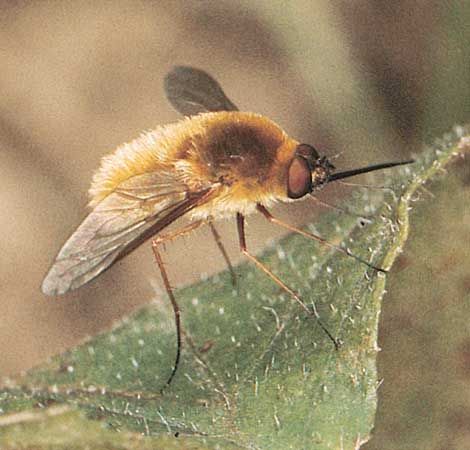
Bee flies (family Bombyliidae) mimic bees through their physical appearance, specifically by possessing a covering of dense hair that gives them metallic brown, black, or yellow colorations similar to those of bees. Some species also feature patches of delicate scales on their bodies or wings to enhance this resemblance.1
This mimicry serves as a form of Batesian mimicry, a biological strategy where a harmless organism gains protection by resembling a dangerous or noxious model—in this case, a stinging bee. Because predators often associate the appearance of bees with the risk of being stung, they tend to avoid the harmless bee flies, mistaking them for their dangerous counterparts. By effectively deceiving potential predators, the bee fly increases its chances of survival.2
How do bee flies defend themselves against predators?
Bee flies (family Bombyliidae) primarily defend themselves against predators through a strategy known as Batesian mimicry.26
By evolving a physical appearance that closely resembles bees—including dense, hair-covered bodies and specific color patterns—these harmless flies deceive potential predators. Because many predators associate the appearance of bees with the risk of being stung, they avoid the bee flies, mistaking them for their dangerous, stinging models. This deceptive resemblance provides the bee fly with a significant survival advantage, as it allows them to deter predators without needing to possess any actual defensive weaponry of their own.216
What types of flowers do bee flies typically visit, and why?
Bee flies (family Bombyliidae) are recognized as important long-tongued pollinators that visit a variety of flowers to feed on nectar and pollen.910
As adults, bee flies rely on these floral resources to meet their nutritional needs, which often compensate for the limitations of their larval diet. Their specialized, elongated mouthparts allow them to access nectar from flowers that might be inaccessible to other insects, making them efficient pollinators for specific plant species. While many adult flies are generalists that visit various flowers for water, nectar, and protein-rich pollen, bee flies are particularly noted for their role as specialized nectar drinkers.11910
The relationship is mutually beneficial: the flowers provide the essential carbohydrates and proteins required for the fly’s survival, while the bee fly facilitates the transfer of pollen, aiding in the plant’s reproduction.1011
What are the main differences between male and female bee flies?
The provided search results do not contain information regarding the specific physical or behavioral differences between male and female bee flies (family Bombyliidae). While the documents describe the general characteristics of bee flies—such as their dense hair, metallic coloration, and long proboscises—they do not detail sexual dimorphism within this family.
The information provided about honeybees and other insects in the search results cannot be applied to bee flies, as these are distinct groups with different biological structures and reproductive strategies.
Sources
- Batesian mimicry — Encyclopædia Britannica
- bee fly — Encyclopædia Britannica
- mimicry - Automimicry — Encyclopædia Britannica
- mimicry - The importance of the signal receiver — Encyclopædia Britannica
- Hymenoptera - General features — Encyclopædia Britannica
- mimicry - Batesian mimicry — Encyclopædia Britannica
- pollination - Beetles and flies — Encyclopædia Britannica
- robber fly — Encyclopædia Britannica
- major types of pollinators - Beetles and flies — Encyclopædia Britannica
- Asparagales - Pollination — Encyclopædia Britannica
- orchid - Sexual deception — Encyclopædia Britannica
- pollination - Bees — Encyclopædia Britannica
- Diptera - Adults — Encyclopædia Britannica
- western honeybee - Physical description — Encyclopædia Britannica
- Reproductive behaviour - Insects — Encyclopædia Britannica
- Hymenoptera - Size range and diversity of structure — Encyclopædia Britannica
Published on · 2 min read