Bell-magpie
The bell-magpie is an Australasian songbird belonging to the family Cracticidae. It is named for its loud, metallic call and its black-and-white plumage…
What is Bell-magpie?
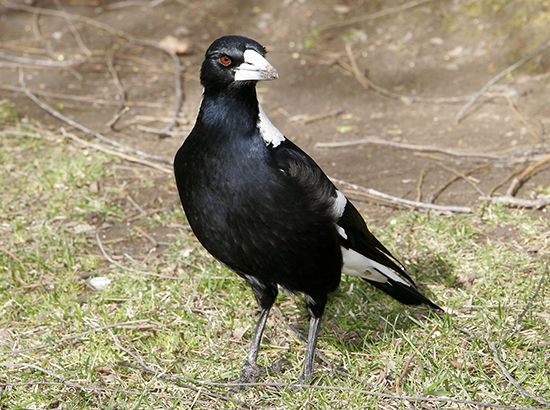
The bell-magpie is an Australasian songbird belonging to the family Cracticidae. It is named for its loud, metallic call and its black-and-white plumage, which resembles that of a true magpie.1
While some authorities classify bell-magpies into three distinct species—the white-backed, western, and black-backed—most consider them a single widespread species, Gymnorhina tibicen. These birds typically measure 35–50 cm (14–20 inches) in length and are characterized by their relatively short tails compared to true magpies.1
Bell-magpies are known for being aggressive, particularly during the breeding season, when they may attack larger birds and even humans. They inhabit open country, where they feed on large insects, lizards, and snakes. Their nests are often constructed from grass and sticks, and in rural areas, they may incorporate wire into the structure.1
What are the main differences between Australasian bell-magpies and Eurasian magpies?
While both birds share black-and-white plumage, they belong to different biological families and exhibit distinct physical and behavioral traits.
Taxonomic and Physical Differences
- Family Classification: Australasian bell-magpies belong to the family Cracticidae, whereas true magpies, including the Eurasian magpie, are members of the family Corvidae.11
- Tail Length: A primary physical distinction is tail length; bell-magpies are characterized by relatively short tails, while true magpies are known for being long-tailed birds.31
- Size: Bell-magpies range from 35–50 cm in length. The Eurasian magpie is generally similar in coloration but is noted for being slightly larger than some other magpie species.31
Behavioral and Nesting Differences
- Diet: Bell-magpies primarily hunt lizards, snakes, and large insects in open country. In contrast, the Eurasian magpie has a more varied diet that includes insects, seeds, small vertebrates, eggs, young birds, and carrion.31
- Nesting: The nesting habits differ significantly. Bell-magpies build open nests often constructed from grass, sticks, and sometimes wire. Eurasian magpies construct large, round nests made of twigs cemented with mud.31
Why are bell-magpies known for being aggressive toward humans?
Bell-magpies are known for their aggressive behavior primarily during the breeding season. During this time, they become highly territorial and protective of their nests, leading them to launch defensive attacks against larger birds and humans who venture too close to their nesting sites.1
This behavior is a natural instinctual response to perceived threats to their offspring and territory. While they are generally known for their loud, metallic calls and distinctive black-and-white plumage, this seasonal aggression is a defining characteristic of the species Gymnorhina tibicen within the family Cracticidae.1
What other birds belong to the Cracticidae family?
The Cracticidae family, a group of Australasian songbirds belonging to the order Passeriformes, consists of three primary groups:5
- Bell-magpies: These birds are well-known for their territorial behavior and vocal abilities.5
- Butcherbirds: Members of the genus Cracticus, these stocky birds are characterized by their heavy, hook-tipped bills and their habit of impaling prey on thorns or in tree crevices. A familiar example is the gray butcherbird (C. torquatus).6
- Currawongs: These are large songbirds, reaching up to 50 centimeters in length, with distinctive yellow eyes and resounding, metallic voices. Notable species include the pied currawong (Strepera graculina) and the gray currawong (S. versicolor), which is also known as the squeaker or rainbird.7
Collectively, these birds are sometimes referred to as songshrikes due to their vocal power and behaviors that resemble those of the shrike family.5
Sources
- Bell-magpie — Encyclopædia Britannica
- Magpie goose — Encyclopædia Britannica
- Magpie — Encyclopædia Britannica
- Eurasian Magpie: A True Bird Brain — Encyclopædia Britannica
- Butcherbird — Encyclopædia Britannica
- Currawong — Encyclopædia Britannica
- Cracticidae — Encyclopædia Britannica
- Cracticidae — Merriam-Webster
Published on · 3 min read