Bergschrund
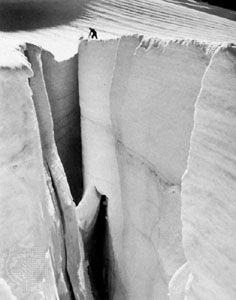
A bergschrund (from the German for "mountain crevice") is a large crevasse or series of crevasses that forms near the head of a mountain glacier. It…
What is bergschrund?
A bergschrund (from the German for “mountain crevice”) is a large crevasse or series of crevasses that forms near the head of a mountain glacier1. It typically develops between the stationary ice attached to the mountain and the moving ice of the glacier.123
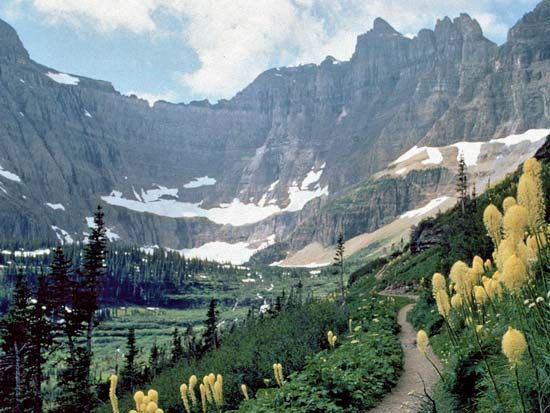
During early summer, the bergschrund opens, exposing the rock at its base to daily temperature fluctuations. This process facilitates frost action, which causes the rock to disintegrate and creates the steep head walls characteristic of a cirque—an amphitheatre-shaped basin. The eroded rock material is then incorporated into the glacier, which scours the basin floor as it moves.42
How do glaciers create cirques?
Cirques are amphitheatre-shaped basins formed at the head of a glacial valley through a combination of weathering and glacial erosion. The process generally involves the following stages:25
- Frost Shattering: Near the head of a glacier, a large crevasse known as a bergschrund separates the moving ice from the stationary ice attached to the mountain. In early summer, this crevasse opens, exposing the rock at its base to daily temperature fluctuations. This triggers frost action, causing the rock to disintegrate and the upper headwall to collapse, creating a steep, often vertical cliff.25
- Glacial Abrasion and Plucking: The rock debris produced by this weathering falls into the glacier and is incorporated into the ice. Acting like a powerful abrasive tool, this debris—along with rocks removed from the bed through glacial plucking—scours and polishes the floor of the basin.256
- Basin Formation: As the glacier moves, it deepens the basin, often creating a hollow that may later contain a lake known as a tarn if the ice retreats.25
What are seracs and how do they form?
Seracs are jagged pinnacles, sharp ridges, or blocks of ice found on the surface of a glacier.89
They form primarily due to the intersection of different types of crevasses. As a glacier moves, it experiences various stresses that cause the ice to crack:
- Transverse crevasses develop in areas of tensile stress, often curving downstream.39
- Splaying crevasses form due to the transverse expansion of the glacier’s flow.3
- Marginal crevasses are created by the drag of valley walls, typically intersecting the glacier margin at a 45-degree angle.39
When these different sets of crevasses intersect—particularly in areas such as the terminus of a glacier or steep icefalls—they chop the surface of the ice into the discrete, tower-like structures known as seracs.39
How do mountaineers safely cross crevasses?
Safely crossing crevasses is a critical skill in mountaineering, requiring both technical expertise and careful judgment. Because crevasses can be concealed by snow bridges—accumulations of windblown snow that hide the fissure—mountaineers must be highly vigilant in detecting them.123
To manage the risks associated with glaciers, climbers rely on several essential practices:
- Rope Management: The rope serves as a vital lifeline. Climbers are typically roped together so that if one person falls into a crevasse, the others can arrest the fall and assist in a rescue.12
- Use of Specialized Gear: An ice ax is indispensable for probing the snow to identify hidden cracks, achieving balance, and securing the rope through belaying. Crampons are used to provide traction on steep or icy surfaces, preventing slips that could lead to dangerous falls.12
- Environmental Awareness: Experienced mountaineers carefully consider the time of day, as snow conditions change with the sun’s heat. Starting early when the snow is hard is often preferred to minimize the risk of breaking through weak snow bridges.12
- Technical Proficiency: Mastery of rope handling and the ability to place anchors in ice are fundamental to safety. These skills are developed through extensive experience and training.12
Sources
- bergschrund — Encyclopædia Britannica
- cirque — Encyclopædia Britannica
- crevasse — Encyclopædia Britannica
- bergschrund — Merriam-Webster
- glacial landform - Cirques , tarns, U-shaped valleys, arêtes, and horns — Encyclopædia Britannica
- glacial landform - Glacial erosion — Encyclopædia Britannica
- glacial landform - Periglacial landforms — Encyclopædia Britannica
- serac — Merriam-Webster
- glacier - Surface features — Encyclopædia Britannica
- glacier - Transformation of snow to ice — Encyclopædia Britannica
- permafrost - Origins — Encyclopædia Britannica
- mountaineering - Techniques — Encyclopædia Britannica
- ski mountaineering: Top Questions — Encyclopædia Britannica
Published on · 3 min read