Mount Ossa
There are two distinct locations known as Mount Ossa.
What is Mount Ossa?
There are two distinct locations known as Mount Ossa.
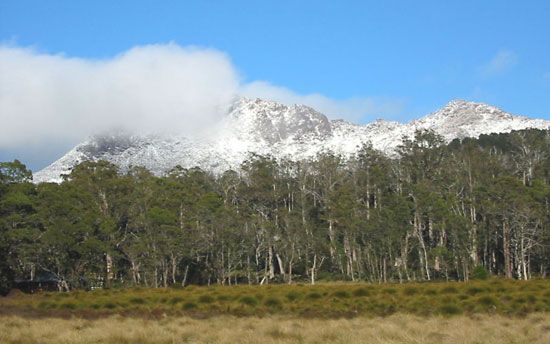
The first is the highest peak in Tasmania, Australia, which rises to 5,305 feet (1,617 m) within the Cradle Mountain–Lake St. Clair National Park. Its landscape is characterized by glacial corries and rugged terrain in the central highlands.12
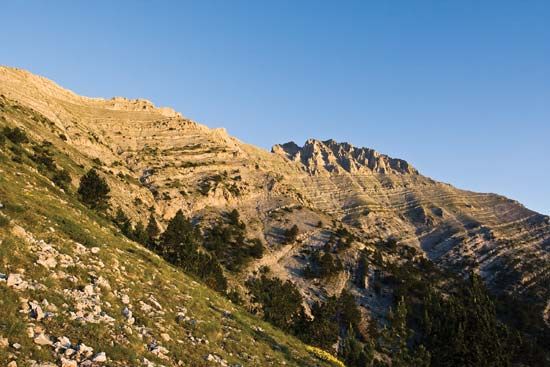
The second is a mountain massif located in the Thessaly region of Greece. This peak reaches 6,489 feet (1,978 m) and is situated near the Vale of Tempe, which separates it from the Olympus massif. This mountain is famously featured in Greek mythology regarding the Aloads’ attempt to reach heaven by stacking mountains.341
What is the significance of the Vale of Tempe in Greek geography?
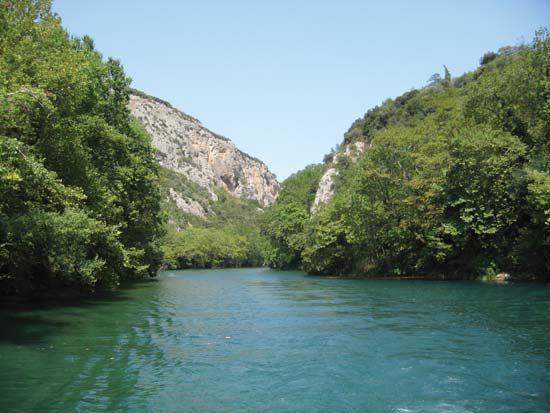
The Vale of Tempe is a narrow, 6-mile-long gorge in northeastern Thessaly, Greece, situated between the Olympus and Ossa massifs. Its geographical and historical significance is defined by three primary factors:
- Hydrological Role: The valley serves as the outlet for the Pineiós River. Geologically, it formed during the Quaternary Period when stream erosion drained the ancient Larissian Lake, establishing the river’s lower course.5
- Strategic Importance: As a natural passage between the coast of Macedonian Greece and the Thessalian plain, the vale has served as a traditional invasion route for centuries. It is marked by historical fortifications dating from the Roman period through the Middle Ages, and it was a site of defense during the 1941 German invasion.5
- Cultural and Religious Heritage: Ancient Greeks dedicated the lush valley to the god Apollo. It was believed to be the site where Apollo purified himself after slaying the serpent Python, and it served as a source for sacred laurels used to crown victors at Delphi.5
How do glacial corries shape mountain landscapes?
Glacial corries, also known as cirques, are amphitheatre-shaped basins that play a fundamental role in sculpting rugged mountain landscapes through intense erosion.
These features typically form at the head of a glacial valley through a combination of frost shattering and glacial activity:
- Formation: As ice accumulates, a large crevasse called a bergschrund separates moving ice from the stationary rock wall. Temperature fluctuations cause frost to disintegrate the rock, which then falls into the glacier to act as abrasive “tools” that scour the basin floor and deepen the headwall.78
- Landscape Transformation: The expansion of neighboring corries creates sharp, jagged features. When two corries erode toward each other, they form a knife-edge ridge known as an arête. If three or more corries develop radially around a mountain, they leave behind a steep, pyramid-shaped peak called a horn.78
- Residual Features: Once a glacier retreats, the over-deepened basin often remains as a tarn, a small mountain lake.78
What are some other famous mountains in Greek mythology?
Beyond Mount Olympus, which served as the primary abode of the gods, several other mountains hold significant places in Greek mythology:
- Mount Parnassus: Located in central Greece, this mountain was sacred to Apollo and the Corycian nymphs. It was also home to the Corycian cave, which was sacred to the god Pan.
- Mount Helicon: Celebrated as the favorite haunt of the Muses, this mountain featured the fountains Aganippe and Hippocrene. According to legend, the latter was created by the hoofprint of the winged horse Pegasus.
- Mount Ida: This name refers to two distinct locations. One range in Asia Minor was the site where Paris judged the rival goddesses and where the gods watched the Trojan War. Another Mount Ida, located on the island of Crete, was considered the sacred site where Zeus was reared in a cave.10
Sources
- Mount Ossa — Encyclopædia Britannica
- Ossa — Encyclopædia Britannica
- Ossa, Mount — Merriam-Webster
- Tasmania - Relief — Encyclopædia Britannica
- Vale of Tempe — Encyclopædia Britannica
- Tempe, Vale of — Merriam-Webster
- cirque — Encyclopædia Britannica
- glacial landform - Cirques , tarns, U-shaped valleys, arêtes, and horns — Encyclopædia Britannica
- glacial landform - Felsenmeers, talus, and rock glaciers — Encyclopædia Britannica
- Mount Olympus: Top Questions — Encyclopædia Britannica
- Mount Parnassus — Encyclopædia Britannica
- Mount Olympus — Encyclopædia Britannica
- Mount Helicon — Encyclopædia Britannica
- Ida — Encyclopædia Britannica
- Greek mythology: Top Questions — Encyclopædia Britannica
- Heliconian — Merriam-Webster
Published on · 3 min read