Bermejo River
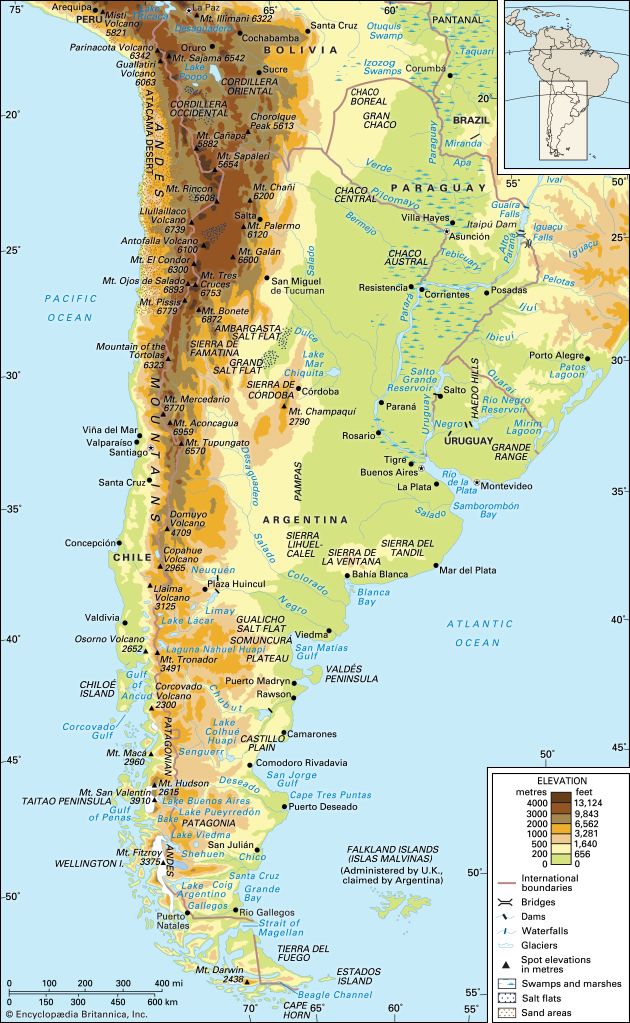
The Bermejo River is a western tributary of the Paraguay River located in south-central South America.
What is Bermejo River?
The Bermejo River is a western tributary of the Paraguay River located in south-central South America.1
Rising near Tarija, Bolivia, the river descends into the Chaco lowlands at the Argentina border. It flows approximately 650 miles (1,046 km) southeastward, receiving major tributaries such as the Grande de Tarija and San Francisco before joining the Paraguay River near Pilar, Paraguay.1
The river is named for its reddish color, which is caused by the significant amount of silt it carries in suspension. Along its course, it forms the boundary between the Argentine provinces of Formosa and Chaco. While it is navigable for small craft in its central section—often called the Teuco River—its channels are known to shift.1
What is the significance of the Gran Chaco region?
The Gran Chaco is a vast, subtropical alluvial plain in south-central South America covering approximately 280,000 square miles across Argentina, Paraguay, and Bolivia. Its significance is defined by its unique geography, economic history, and role as a challenging frontier.2
Economic and Historical Significance
Historically, the region was a formidable frontier that defied effective European settlement until the 19th century due to its harsh environment and the resistance of native peoples. Its economic development has been primarily driven by:34
- Cattle Ranching: The region has long supported the grazing of criollo cattle, which are valued for their hardiness.34
- Forestry: The exploitation of quebracho trees for tannin and lumber became a major industrial activity, leading to the development of railroads and settlements like Resistencia and Formosa.34
- Agriculture: In the 20th century, the eastern Chaco became a significant area for cotton cultivation.4
Physical and Ecological Importance
The Gran Chaco acts as a massive geosynclinal basin filled with deep alluvial sediments. It is characterized by:5
- Hydrology: The Pilcomayo and Bermejo rivers are the only permanent water sources, creating complex, flood-prone landscapes that support diverse savanna and dry forest ecosystems.267
- Biodiversity: The region features complex vegetation, including the quebrachales (hardwood forests), which are vital for both the local ecology and the regional timber industry.7
How do rivers contribute to the formation of borders between countries?
Sorry, the Britannica knowledge base does not contain information regarding how rivers specifically contribute to the formation of borders between countries.
What are the major river systems in South America?
South America’s drainage is defined by the continent’s physical structure, with the majority of major basins located east of the Andes Mountains and flowing toward the Atlantic Ocean. Four primary systems account for approximately two-thirds of the continent’s drainage.10
Major River Systems
- Amazon River: The largest drainage system in the world by volume, it carries one-fifth of the Earth’s flowing fresh water. Stretching at least 4,000 miles, it drains about two-fifths of South America and features over 1,000 tributaries.1011
- Río de la Plata System: This system, which includes the Paraguay, Paraná, and Uruguay rivers, is the second most important in South America. These rivers discharge into a massive estuary that separates Argentina and Uruguay.1012
- Orinoco River: The third largest system, it flows through Venezuela and Colombia. A unique feature is the Casiquiare, a natural waterway that links the Orinoco and Amazon systems.1013
- São Francisco River: The fourth largest system, it flows entirely within Brazil and has served as a vital artery for communication and hydroelectric power since colonial times.10
Drainage to the Pacific Ocean is limited due to the proximity of the Andes to the coast, resulting in shorter rivers with lower water volumes.10
Sources
- Bermejo River — Encyclopædia Britannica
- Gran Chaco — Encyclopædia Britannica
- Gran Chaco - European colonization and economic activity — Encyclopædia Britannica
- Gran Chaco - Physiography — Encyclopædia Britannica
- Argentina - The Gran Chaco — Encyclopædia Britannica
- Gran Chaco - Drainage — Encyclopædia Britannica
- Gran Chaco - Plant life — Encyclopædia Britannica
- river - Braided channels — Encyclopædia Britannica
- river - Significance in early human settlements — Encyclopædia Britannica
- South America - Rivers of South America — Encyclopædia Britannica
- Orinoco River - Physiography of the Orinoco — Encyclopædia Britannica
- Río de la Plata — Encyclopædia Britannica
- Amazon River — Encyclopædia Britannica
Published on · 3 min read