Savanna
Wildfire is a fundamental component of savanna ecosystems, serving as a primary mechanism for maintaining the balance between grasses and woody plants. By…
What role do wildfires play in maintaining savanna ecosystems?
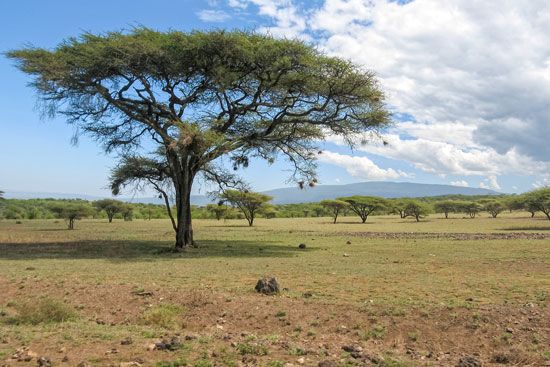
Wildfire is a fundamental component of savanna ecosystems, serving as a primary mechanism for maintaining the balance between grasses and woody plants. By consuming dead plant material and grasses, fire prevents the encroachment of trees and shrubs; without this regular disturbance, many savanna regions would naturally revert to deciduous forest.12
Vegetation in these areas has evolved specific adaptations to survive and thrive in fire-prone environments. Many savanna trees possess thick, corky bark that protects their trunks from heat once they reach maturity. Other plants utilize underground buds or seeds that germinate rapidly in the nutrient-rich, scorched soil following a burn.12
While fire promotes biodiversity by reducing plant competition and encouraging the growth of fire-adapted species, it also plays a complex role in land management. Indigenous practices, such as those of Australian Aboriginal peoples, have long utilized controlled burning to clear land, manage game, and protect fire-sensitive habitats.123
What are the major types of savannas found around the world?
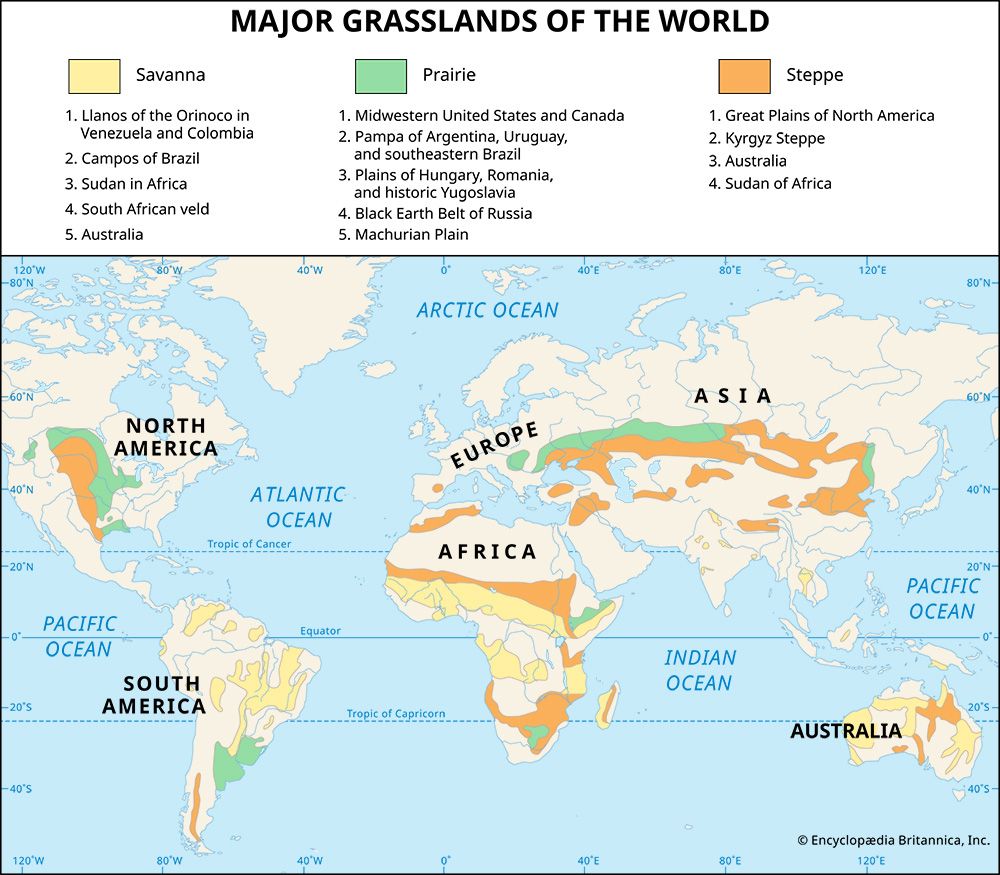
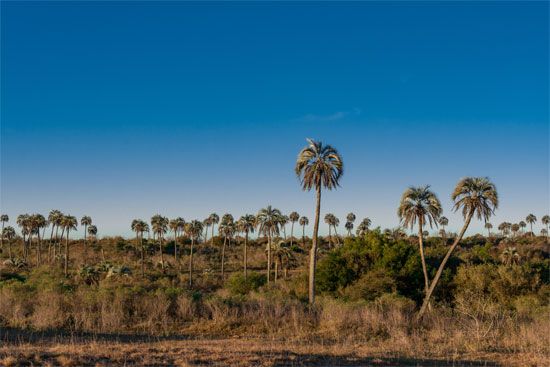
Savannas are tropical or subtropical vegetation types characterized by a continuous grass cover interrupted by varying densities of trees and shrubs. They are generally classified based on the length of their dry season or the density of their woody vegetation.4
Classification by Dry Season
Savannas are often categorized into three types based on the duration of the dry season:4
- Wet savannas: The dry season typically lasts 3 to 5 months.4
- Dry savannas: The dry season lasts 5 to 7 months.4
- Thornbush savannas: The dry season is longer than 7 months.4
Classification by Vegetation Structure
An alternative classification focuses on the presence and density of trees and shrubs:4
- Savanna woodland: Features a light canopy formed by trees and shrubs.4
- Tree savanna: Characterized by scattered trees and shrubs.4
- Shrub savanna: Contains scattered shrubs with few or no trees.4
- Grass savanna: Primarily composed of grasses, with trees and shrubs generally absent.4
These categories exist along a dynamic continuum influenced by factors such as soil quality, grazing intensity, and the frequency of wildfires.4
How do the flora and fauna of savannas adapt to the unique climate conditions?
Savanna flora and fauna have evolved diverse strategies to survive the region’s distinct climate, characterized by alternating wet and dry seasons and frequent wildfires.
Flora Adaptations
Plants in the savanna must manage water scarcity and fire exposure:
- Water Conservation: Many trees, such as the baobab, are adapted to survive long dry periods. Some species shed their leaves to reduce transpirational loss, while others, like Australian eucalyptus, are sclerophyllous, possessing tough leaves that minimize water loss.72
- Deep Root Systems: While grasses rely on shallow roots to capitalize on brief rains, trees often feature deep root systems that tap into moisture stored far beneath the soil surface.2
- Fire Resistance: To survive annual burns, many savanna trees develop thick, corky bark that protects their trunks. Others utilize underground buds or seeds that germinate rapidly in the nutrient-rich, scorched soil following a fire.81
Fauna Adaptations
Animals adapt to the seasonal fluctuations in food and water availability:
- Migration: Many large mammals, such as wildebeests and zebras, are seasonal migrants. They occupy the savanna during the lush wet season and move to areas with better water and food supplies as the dry season progresses.29
- Subterranean Living: A significant portion of savanna biomass exists belowground. Many invertebrates, particularly termites, spend most of their lives underground to escape the harsh surface climate.2
- Physiological Mechanisms: Animals like gazelles have evolved specialized nasal passages that cool exhaled air, allowing them to condense and reabsorb water vapor that would otherwise be lost during respiration.4
What are some of the most threatened plant and animal species in savanna regions?
Savanna ecosystems worldwide face significant threats from land-use changes, such as conversion to agriculture, human development, and overgrazing by livestock, which lead to habitat loss and soil erosion. These pressures, combined with the impacts of anthropogenic climate change, have placed numerous species at risk of extinction.1213
Threatened Animal Species
Large mammals are particularly vulnerable to habitat fragmentation and poaching.
- Elephants: All three species are considered endangered by the IUCN, with the African forest elephant listed as critically endangered.8
- Predators: Species such as the cheetah, leopard, and jaguar have faced significant population declines due to hunting and human encroachment.1415
- Marsupials: In Australia, more than one-fourth of native marsupial species have gone extinct since European settlement, and many others have seen drastic population declines due to introduced predators like foxes and feral cats.1617
Threatened Plant Species
Plant biodiversity is heavily impacted by the conversion of natural landscapes and the spread of invasive species.13
- Fynbos Flora: In South Africa, approximately 1,700 plant species are currently threatened, largely due to the introduction of invasive acacia species and agricultural expansion.13
- Regional Endemics: Across regions like Western Australia, hundreds of plant species are classified as rare or threatened due to land clearing and habitat degradation.17
Sources
- Savanna: Top Questions — Encyclopædia Britannica
- Savanna - Role of wildfire — Encyclopædia Britannica
- Wildfire: Top Questions — Encyclopædia Britannica
- Savanna - Environment — Encyclopædia Britannica
- Savanna — Encyclopædia Britannica
- Savanna - Biological productivity — Encyclopædia Britannica
- Savanna - Flora — Encyclopædia Britannica
- Savanna - Population and community development and structure — Encyclopædia Britannica
- Migration - Terrestrial mammals — Encyclopædia Britannica
- Biosphere - Humidity — Encyclopædia Britannica
- bat - Activity patterns — Encyclopædia Britannica
- Savanna - Threats — Encyclopædia Britannica
- Africa - Conservation of Africa — Encyclopædia Britannica
- South Australia - Plant and animal life — Encyclopædia Britannica
- Savanna - Fauna — Encyclopædia Britannica
- elephant - Conservation — Encyclopædia Britannica
- Brazil - Highlands, coastal regions, and the Pantanal — Encyclopædia Britannica
- conservation - Flowering plants — Encyclopædia Britannica
- Western Australia - Plant and animal life — Encyclopædia Britannica
Published on · 5 min read